Incident KPI Best Practices: Metrics Engineers Should Actually Measure

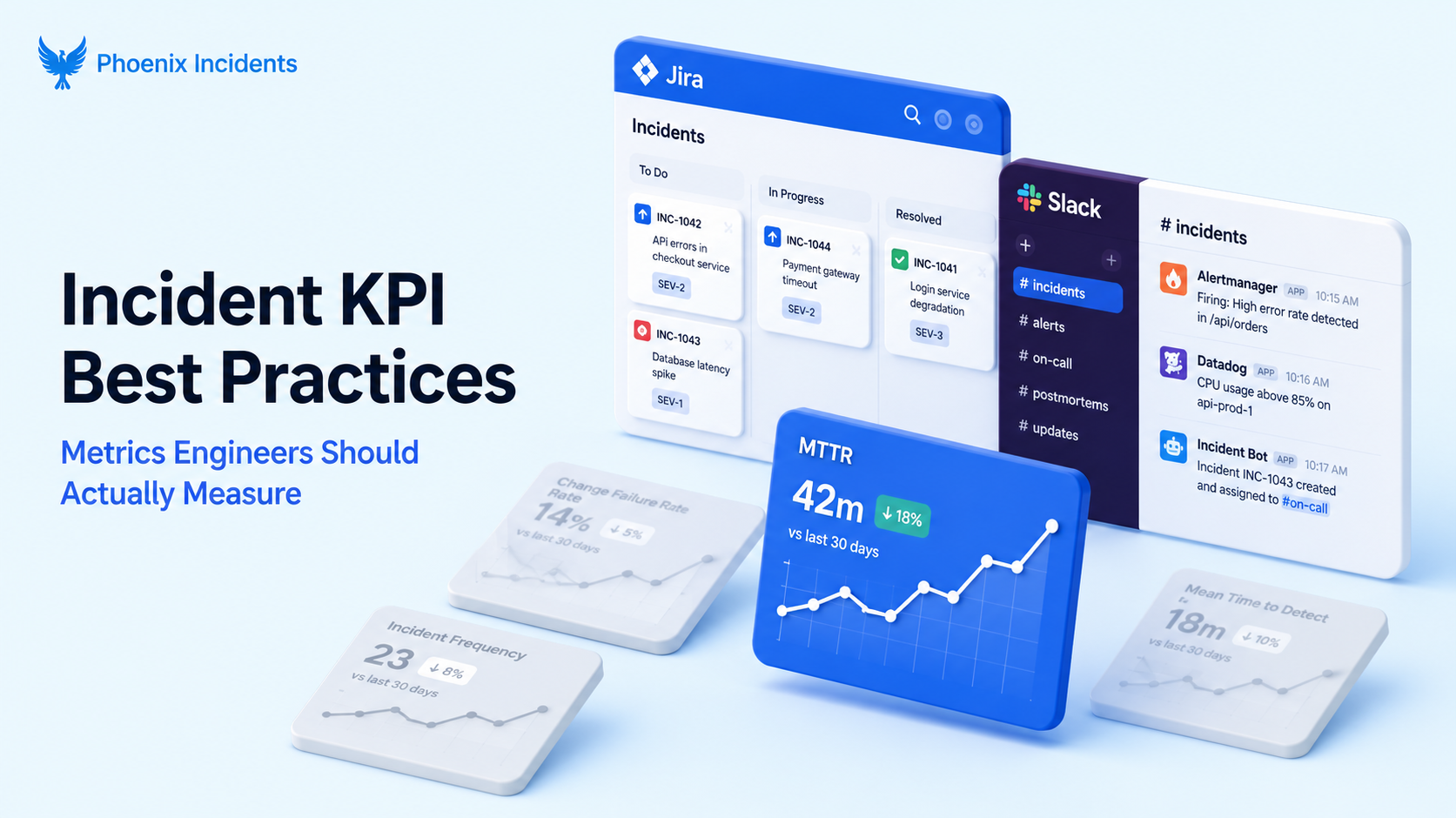
When an incident is finally resolved and everything returns to normal, a few questions show up:
- Are we actually getting better at this?
- Or did we just survive another incident?
The answer lives in the incident KPIs you choose to track, and more importantly, in what those KPIs tell your engineers to do.
When you search for incident KPI best practices, you'll get a catalog of thirteen metrics, a definition of KPI versus metric, and a detour into data normalization formulas. Useful if you're building a dashboard, but less useful if you're trying to run calmer incidents.
Every incident KPI sends a message about what behavior gets rewarded, tolerated, or ignored, and the few right metrics tracked where incidents already happen in Jira and Slack, do far more for your team than thirty wrong metrics ever will.
What this guide covers: why detection isn't really incident management, the handful of incident management KPIs that actually matter, what each one signals about your culture, and how to choose metrics that make it easier for engineers to do the right thing under pressure.
What Is an Incident KPI, Really?
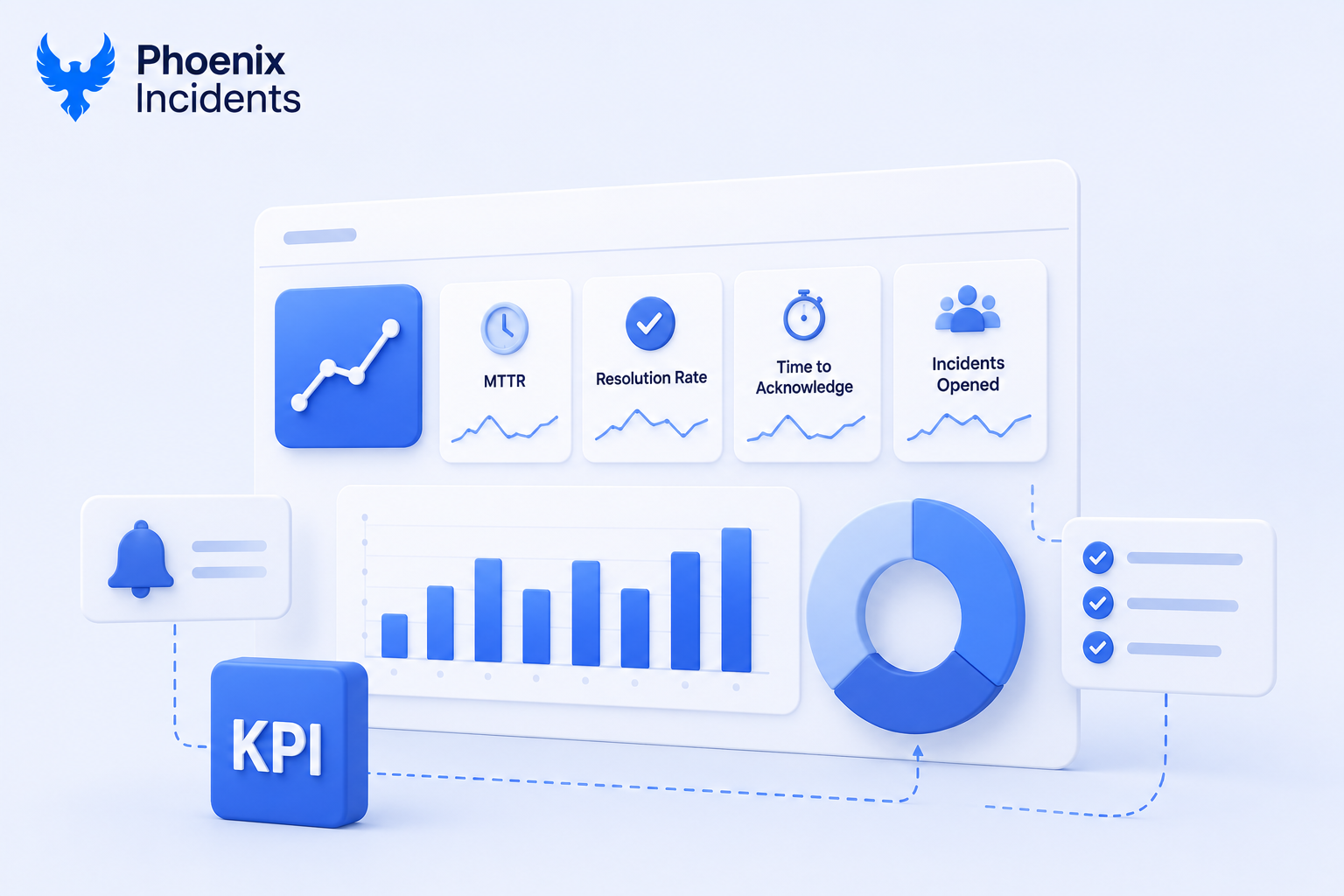
An incident KPI is a signal about how effectively your organization handles production incidents. Not how fast someone typed "resolved," but how well your team detected the issue, coordinated the response, communicated impact, and learned afterward.
A strong incident management KPI reinforces good operational behavior, but a weak one, rewards silence or delay. Basically, if a KPI makes post-incident learning feel optional or performative, it isn't pulling its weight.
It's worth separating two words that get used interchangeably.
A metric is any data point you can measure, while a KPI is the metric you've decided is tied to a behavior or outcome you actually care about. All KPIs are metrics, but most metrics never need to be KPIs.
The goal of incident metrics is to help you spot problems so you can fix them in a clear, organized way.
Detection Is Not Incident Management
Before getting into the metrics, there's a distinction that most incident KPI lists get wrong. Mean Time to Detect (MTTD) almost always shows up as a core incident management KPI. It shouldn't.
Detection is driven by observability tooling like Datadog, New Relic, and Sentry, not by your incident response process. When MTTD is weak, it points to gaps in monitoring coverage or alert quality, not to how your humans respond once they know something is wrong.
Treating detection as an incident management KPI sends engineers chasing the wrong fix: tuning a process when the real problem is instrumentation.
That's why every metric in this guide starts after an alert exists and a human needs to act.
| Phase | What it measures | Owned by | Tooling |
|---|---|---|---|
| Detection (MTTD) | Time until the system notices the issue | Observability | Datadog, New Relic, Sentry |
| Response (MTTA to MTTR) | How the team coordinates and resolves | Incident management | Jira and Slack workflow |
Incident Management KPI Examples
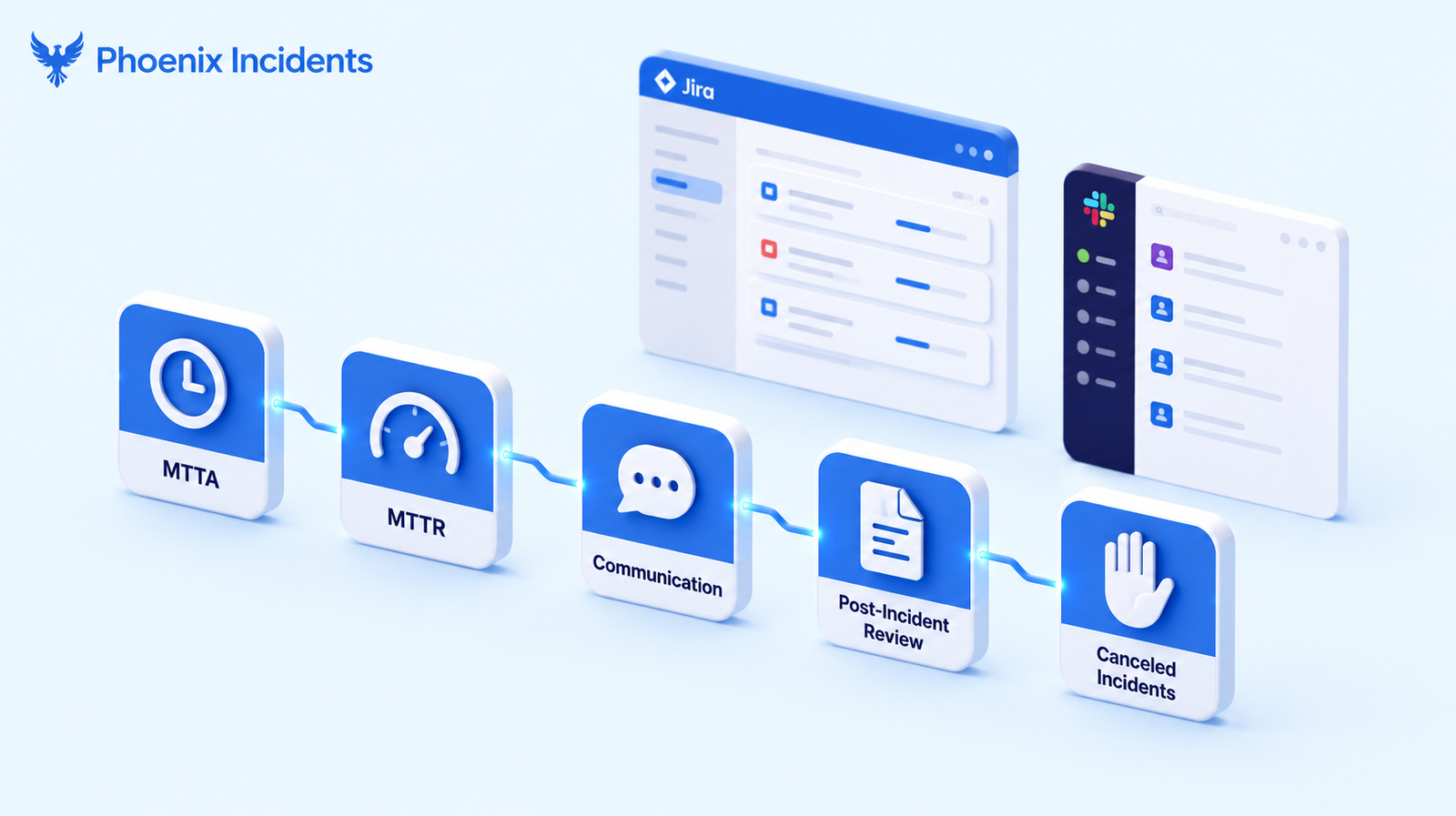
What follows is a deliberately short list. Not because there's nothing else to measure, but because a focused set of opinionated metrics beats a sprawling dashboard that nobody reads.
Each of these maps to a real point in the response lifecycle, from the moment a human acknowledges the alert to the moment the team decides whether the escalation was even warranted.
1. MTTA (Mean Time to Acknowledge)
Mean Time to Acknowledge measures how long it takes a human to acknowledge an alert after it fires. Technically MTTA is a component of MTTR, but its real value is diagnostic rather than outcome-driven.
When MTTA is high or inconsistent, it rarely means engineers are slow. It usually means something cultural. Teams hesitate because they aren't sure they're allowed to declare an incident, or because alerts have become noise, or because ownership is unclear.
MTTA gets more revealing when you read it against MTTR. High MTTA paired with high MTTR often points to on-call or alerting problems, while low MTTA with high MTTR points to resolution problems instead.
- What high MTTA usually means: Alert fatigue, unclear ownership, or hesitation to escalate
- What it doesn't mean: Shaving seconds off acknowledgment will not, on its own, fix your resolution time
Reducing MTTA slightly won't magically shorten an incident. But persistently poor MTTA is an early warning that response will struggle once real pressure arrives.
2. MTTR (and Why It's the Most Abused Major Incident KPI)
For this guide, MTTR means Mean Time to Recovery: the time it takes to restore normal service. The "R" gets used for Repair, Resolve, and Respond elsewhere, so it's worth stating which one you mean once and sticking to it, because engineers will notice if you don't.
MTTR is the most widely tracked major incident KPI and the most abused. Leadership loves it because it's a single, clean number. Engineers tend to distrust it for exactly the same reason: it flattens a messy, multi-team scramble into one figure that hides everything that actually happened.
Used responsibly, MTTR is genuinely useful. It tells you whether your response to a given system is improving over time, which is genuinely worth knowing. The trouble starts when it becomes a performance score, especially across teams running very different systems.
A team maintaining a tangle of legacy services and a team running a clean greenfield stack will never post comparable numbers, and holding them to the same bar isn't a fair read of either one. MTTR works best as a way to understand your own response, not to rank people.
Looked at within the same service over time, it tells you something true. Turned into a Team A versus Team B comparison, it tends to breed resentment and quiet ticket-closing workarounds, which is the opposite of what anyone wanted from it.
Severity-based targets give a useful starting frame:
| Severity | Typical recovery target |
|---|---|
| SEV-1 | Under 1 hour |
| SEV-2 | Under 4 hours |
| SEV-3 | Under 24 hours |
Treat these as a reference point, not a verdict. A 20% improvement against your own baseline says more about your team than hitting a number someone else published.
3. Communication KPIs
Some of the calmest incidents are the ones where nobody had to ask "what's going on?" Teams that track whether updates went out on time, whether stakeholders were informed, and whether a clear incident lead was established, tend to run noticeably steadier responses. These KPIs don't measure speed. They measure coordination.
The honest problem with communication metrics is that they fall apart the moment updates have to be synced by hand across Microsoft Teams, Slack, Jira, and a paging tool. During a high-severity incident, engineers will always prioritize fixing the issue over updating four systems, and they should.
Any communication KPI that depends on someone remembering to post the same update in multiple places will degrade over time. The metric isn't wrong; the manual workflow underneath it is.
4. Post-Incident Review Completion and Overdue Action Items
Plenty of organizations say they value learning from incidents, but their metrics usually tell a different story. A simple but powerful incident management KPI is the Post-Incident Review (PIR) completion rate. When PIRs routinely don't happen, or happen three weeks later when nobody remembers the details, it's almost always because the process is too heavy or disconnected from daily work.
What matters more than the document is whether the review produces concrete action items with owners and timelines. That's also where the most useful signal hides:
- PIR completion rate is a lagging indicator. It tells you whether reviews happened.
- Overdue action items is a leading indicator. It's one of the few measures that tells you whether you're actually reducing future risk.
Language matters here too. Treating review outcomes as "tasks" turns learning into chores that slide down the backlog. But treating them as action items, owned and dated, reinforces accountability without blame.
5. Canceled Incidents
This is the KPI almost nobody tracks, and it might be the clearest signal of a healthy incident culture. A canceled incident is a healthy escalation that turned out not to need a full response. Someone saw something concerning, raised it, and it resolved before the full machinery spun up.
High-performing teams encourage these. They don't punish them, and they don't ignore them either. The practice is straightforward: track canceled incidents, require a cancellation reason, and review the patterns periodically. What you're really measuring is whether engineers feel safe escalating early, which is exactly the behavior you want when something genuinely is on fire. Many teams say they value early escalation. Very few build a metric that proves they mean it.
Pulling the set together, the point isn't what each KPI measures. It's the message each one sends to the engineers watching, and which numbers leadership actually cares about.
| KPI | What it measures | The message it sends |
|---|---|---|
| MTTA | Time to human acknowledgment | Is it safe and clear to respond? |
| MTTR | Time to recovery within a system | Are we getting better at this system over time? |
| Communication consistency | Updates sent and incident lead established | Do we coordinate, or scramble? |
| PIR completion | Reviews actually done | Is learning real or performative? |
| Overdue action items | Follow-through on fixes | Are we reducing future risk? |
| Canceled incidents | Healthy early escalations | Is raising a hand rewarded or punished? |
How to Choose Incident KPIs That Improve Reliability
Before adding any new incident KPI, engineering leaders should ask one question: will this metric make it easier for the team to do the right thing during an incident? If the answer is no, it probably isn't worth tracking, no matter how good it looks on a dashboard.
The best incident management KPIs share a few traits:
- They encourage early escalation rather than punishing it
- They reinforce clear communication during the response
- They make post-incident learning unavoidable but not painful
- They stay few and opinionated instead of sprawling across thirty metrics
- They measure improvement against your own baseline, not a benchmark from a different company with a different stack
When those conditions are met, the metrics stop being controversial and start being useful.
How Phoenix Incidents Supports Incident KPIs
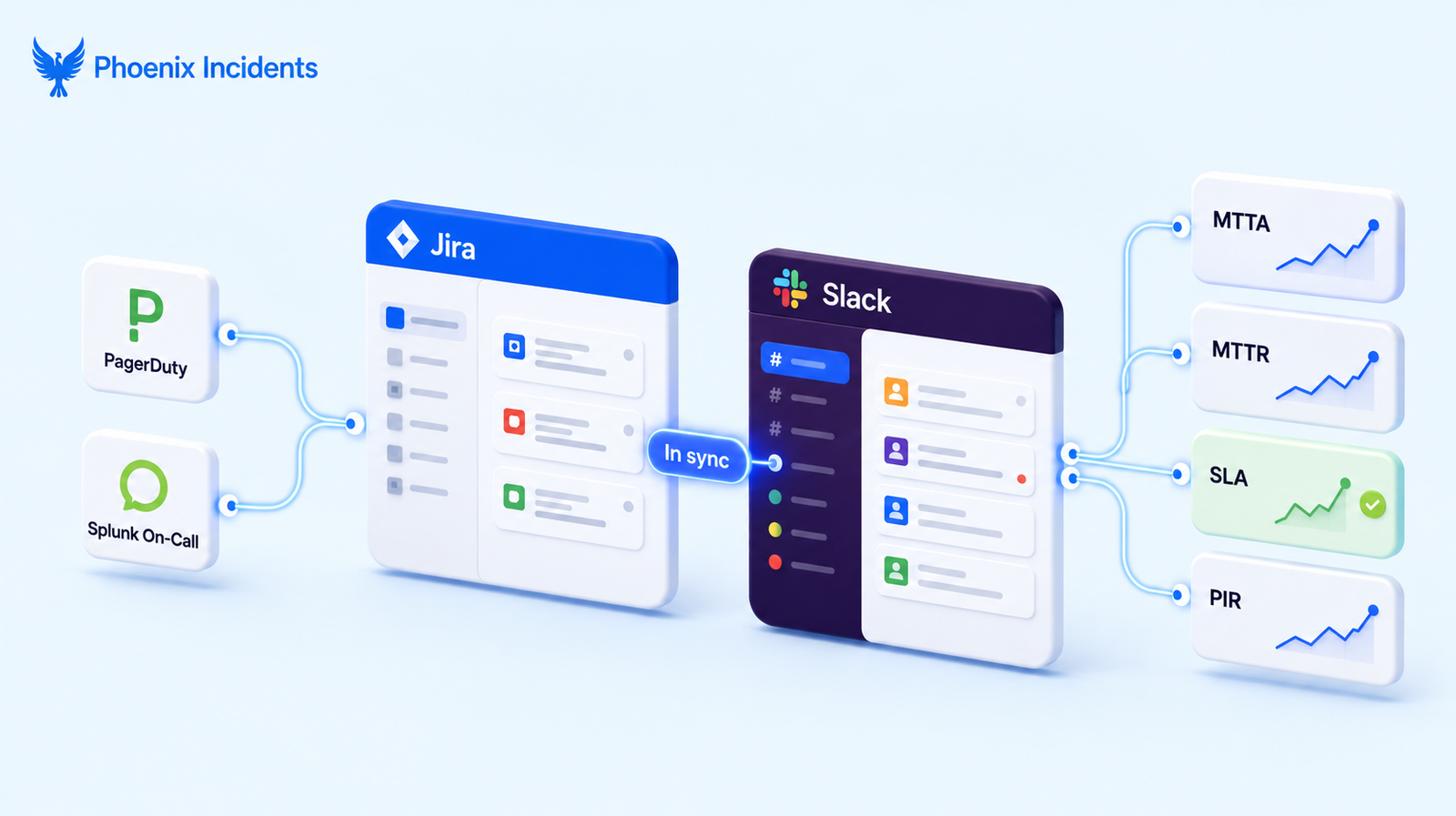
Phoenix Incidents is built around a simple reality: incidents already live in Jira and Slack. Rather than introducing a separate platform for engineers to learn and maintain, it enforces a clear incident workflow directly inside the tools they already use.
Because the workflow runs where the work happens, the KPIs emerge from the process instead of being assembled by hand afterward:
- MTTA, MTTR, SLA compliance, PIR completion, and overdue action items come out of the normal flow of an incident, not a separate reporting exercise.
- Slack channels stay in sync with Jira automatically, so communication metrics don't depend on anyone remembering to cross-post.
- Paging tools like PagerDuty, Splunk On-Call, and Opsgenie integrate cleanly, so engineers don't have to context-switch, and Phoenix Incidents doesn't replace or modify your alerting.
Cancelled incidents are a first-class concept rather than an afterthought. Phoenix requires teams to record why an incident was cancelled and makes those patterns reviewable over time, which supports early escalation without punishment, something many teams want culturally but struggle to operationalize. The goal isn't faster heroics. It's fewer repeat incidents, calmer responses, and learning that actually sticks.
Measure Fewer Incident KPIs, Run Calmer Incidents
Every incident KPI sends a message. It tells engineers what behavior is rewarded, tolerated, or ignored, long before anyone says it out loud. Chosen carelessly, KPIs become a source of stress and quiet workarounds. Chosen well and supported by the right workflow, they become a stabilizing force that helps leaders see what's breaking, why it's breaking, and whether the organization is actually fixing the underlying problems.
That's the difference between measuring incidents and managing them.
If you want incident KPIs that reflect how incidents actually happen, without bolting on another tool or another layer of process, book a demo and see how teams manage incidents, reviews, and metrics directly inside Jira and Slack.
Frequently Asked Questions
1. What is an incident KPI?
An incident KPI is a measurable signal of how effectively your team handles production incidents, covering detection, coordination, resolution, and learning. The useful ones reinforce good operational behavior rather than rewarding speed or silence.
2. What's the difference between a metric and a KPI?
A metric is any data point you can measure. A KPI is the metric you've tied to a behavior or outcome you care about. All KPIs are metrics, but most metrics don't need to be KPIs.
3. Is MTTD an incident management KPI?
Not really. Mean Time to Detect is driven by observability tooling like Datadog, New Relic, and Sentry, so weak detection points to monitoring gaps rather than to your incident response process. Most incident management KPIs are better measured after an alert exists and a human needs to respond.
4. What is a good MTTR?
Common severity-based targets are under one hour for SEV-1, under four hours for SEV-2, and under twenty-four hours for SEV-3. Treat these as a starting reference. Improving against your own baseline matters more than matching a generic benchmark.
5. How many incident KPIs should a team track?
Fewer than most dashboards suggest. A focused, opinionated set covering acknowledgment, recovery, communication, learning, and escalation culture beats tracking thirty metrics nobody reviews.
6. Why track cancelled incidents?
A cancelled incident is a healthy escalation that turned out not to need a full response. Tracking them, with a required reason, shows whether engineers feel safe escalating early, which is exactly the behaviour you want when something genuinely is wrong.