What is DevOps? A Guide for Better Incident Management

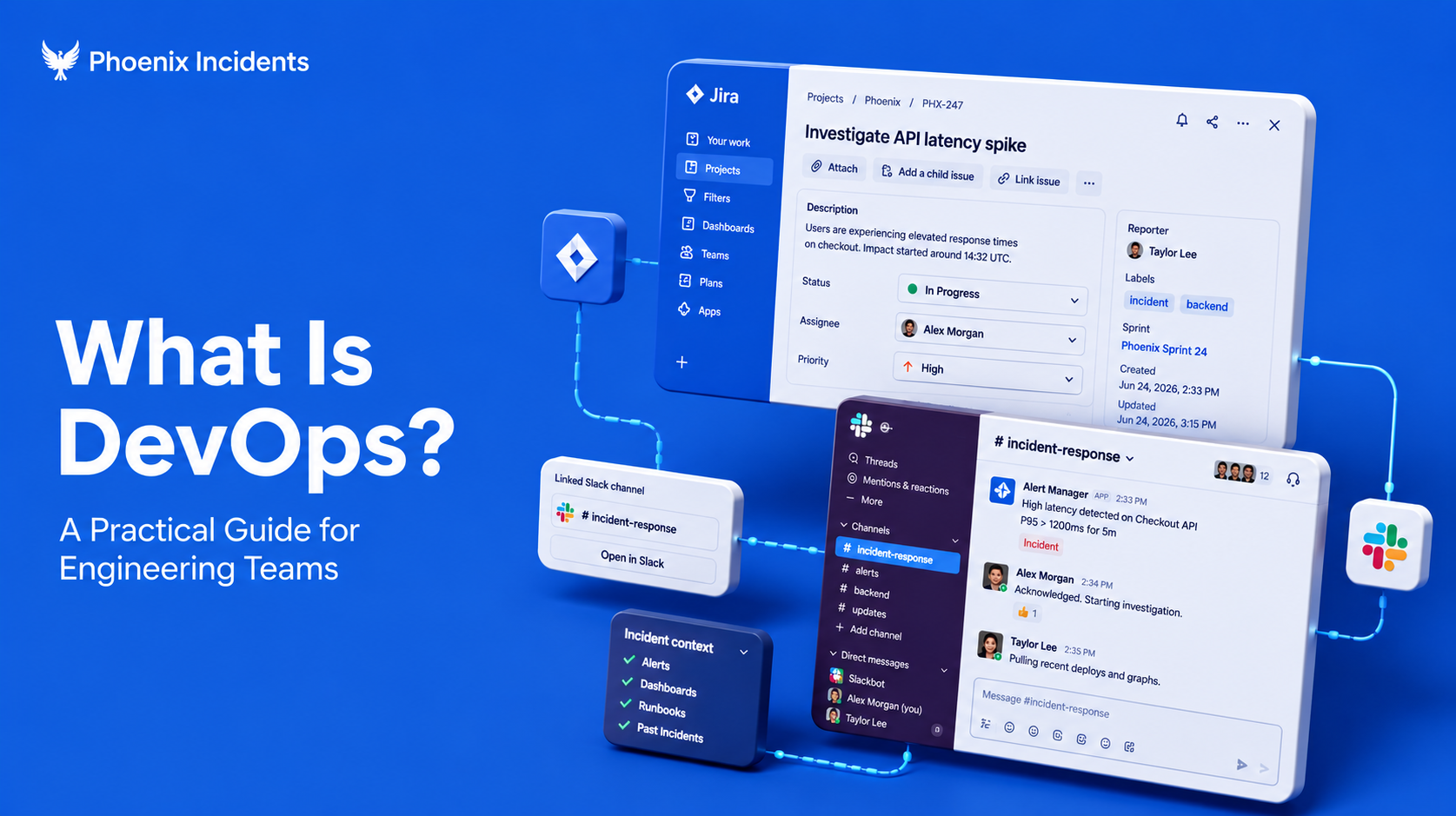
Most engineering teams get handed two goals that quietly work against each other: ship features quickly, and keep production stable. Developers are measured on how much they release, and Operators are measured on how little the system breaks. When those incentives sit in separate teams, every release becomes a small standoff, and the people writing the code stop feeling responsible for what happens after it deploys.
DevOps exists to close that gap. It’s a set of cultural and technical practices that make development and operations share ownership of the same outcome, from the first commit to whatever happens when a service starts throwing errors.
The philosophy is easy to state and harder to live, and the place it gets tested most is during an incident.
That is where this guide spends most of its time, because how a team responds to an incident says more about its DevOps maturity than any pipeline diagram.
What Is DevOps?
DevOps combines development (Dev) and operations (Ops) into a single, shared responsibility model. Instead of developers writing code and tossing it over a wall to an operations team that runs it in production, both sides own the full lifecycle together. The goal is to shorten the time between an idea and working software, without trading away reliability to get there.
The model took hold in the late 2000s as a reaction to the traditional split between the people who wrote software and the people who kept it running.
That split however, produced a predictable set of problems:
- Slow release cycles: When work passes from one team to the next by hand, finished code just sits and waits, idle while it waits for another group to review it, approve it, or slot it into a release schedule.
- Fragile deployments: Without shared context, code that ran fine on a developer's machine behaves differently in production, and nobody owns the gap.
- The alert-versus-incident gap: When teams work in isolation, each one tunes its own monitoring, and over time the alerts pile up into background noise. The real problems then end up getting lost in the volume of notifications.
That last point matters more than it usually gets credit for. An alert is just a signal that some threshold was crossed; an incident is a human decision that something matters enough to mobilize a response. Treat every alert as an incident and you burn out your on-call engineers. Wait for customers to complain and you’re late.
A healthy DevOps culture is one that protects the engineer who decides to escalate instead of punishing them for it.
Why DevOps Matters
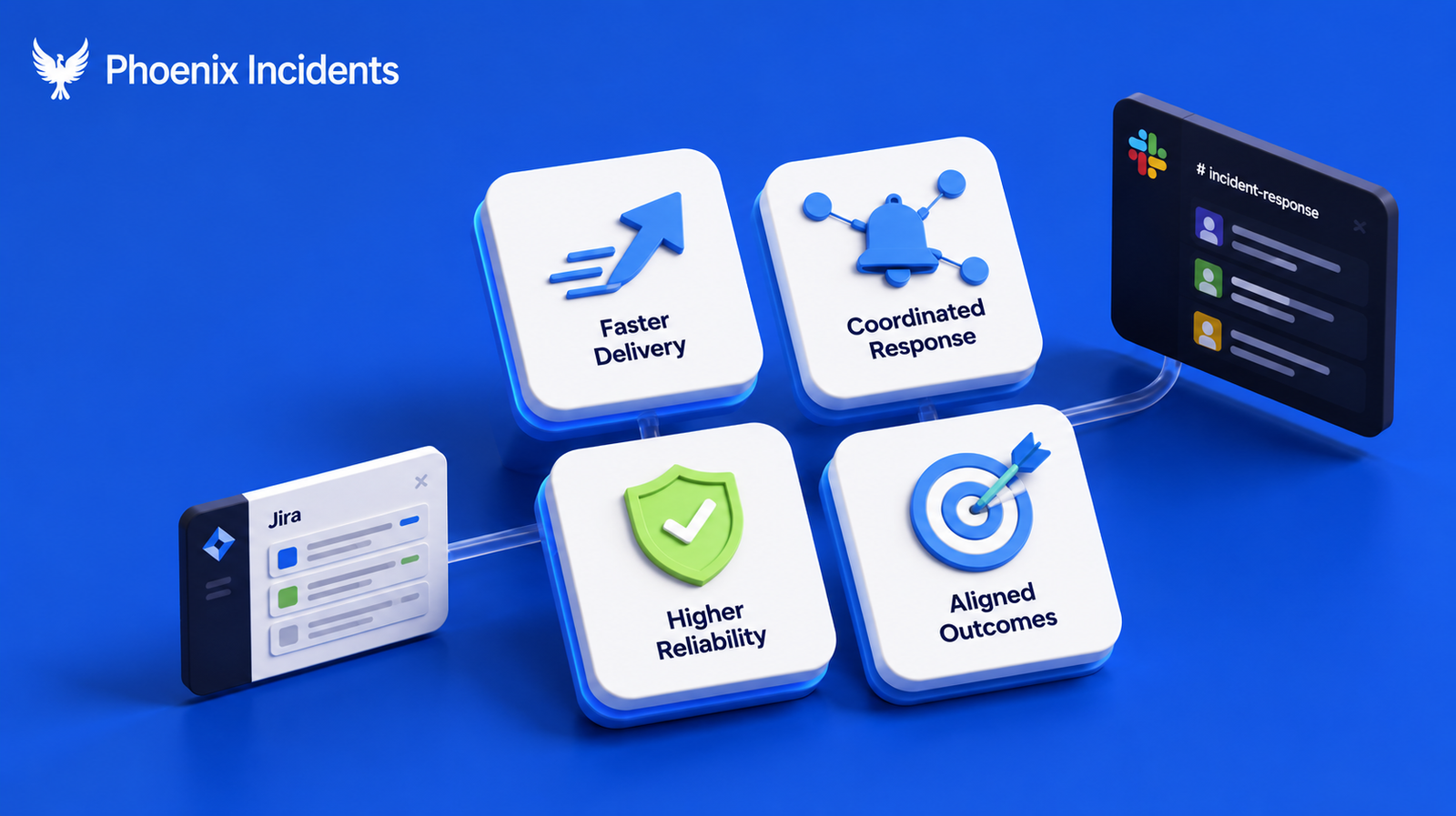
As software gets spread across more services and teams ship updates several times a day, the old operating model stops keeping up. Manual steps, separated teams, and constant last-minute firefighting can't match that pace either. DevOps gives teams a way to move fast and stay reliable at once, and research shows those two goals don't actually pull against each other.
And the best teams deploy more often and recover from failures faster, beating slower teams on speed and stability at the same time rather than trading one for the other.
In practice, that translates to a few concrete gains:
- Faster delivery without giving up stability
- Quicker and better-coordinated incident response
- Higher reliability through automation and measurement
- Engineering work that lines up with business outcomes
The shift turns software delivery from a series of disconnected handoffs into one continuous, repeatable process that a team actually owns end to end.
The DevOps Lifecycle Explained
| Phase | What happens | Common tools |
|---|---|---|
| Plan | Define requirements, prioritize work, align on outcomes | Jira, Confluence |
| Build | Write, review, and version code in shared repositories | Git, GitHub, GitLab |
| Test | Validate changes automatically, early and often | CI test suites |
| Deploy | Ship changes through automated pipelines | CI/CD pipelines |
| Operate | Run in production, watch availability and performance | Monitoring and observability stacks |
| Observe & Learn | Feed telemetry and user feedback back into planning | Logs, metrics, alerts, dashboards |
DevOps is best understood as a continuous loop rather than a single activity. The exact phases vary between organizations, but most workflows move through the same stages, each with its own tooling.
The first half of that loop, from planning through deployment, gets most of the attention in tools and tutorials. But DevOps really proves itself in the second half, once code is live and something goes wrong. Operate, observe, and learn are where shared ownership either holds up or quietly breaks down, and they're also the stages where most teams have the least defined process.
Key DevOps Practices
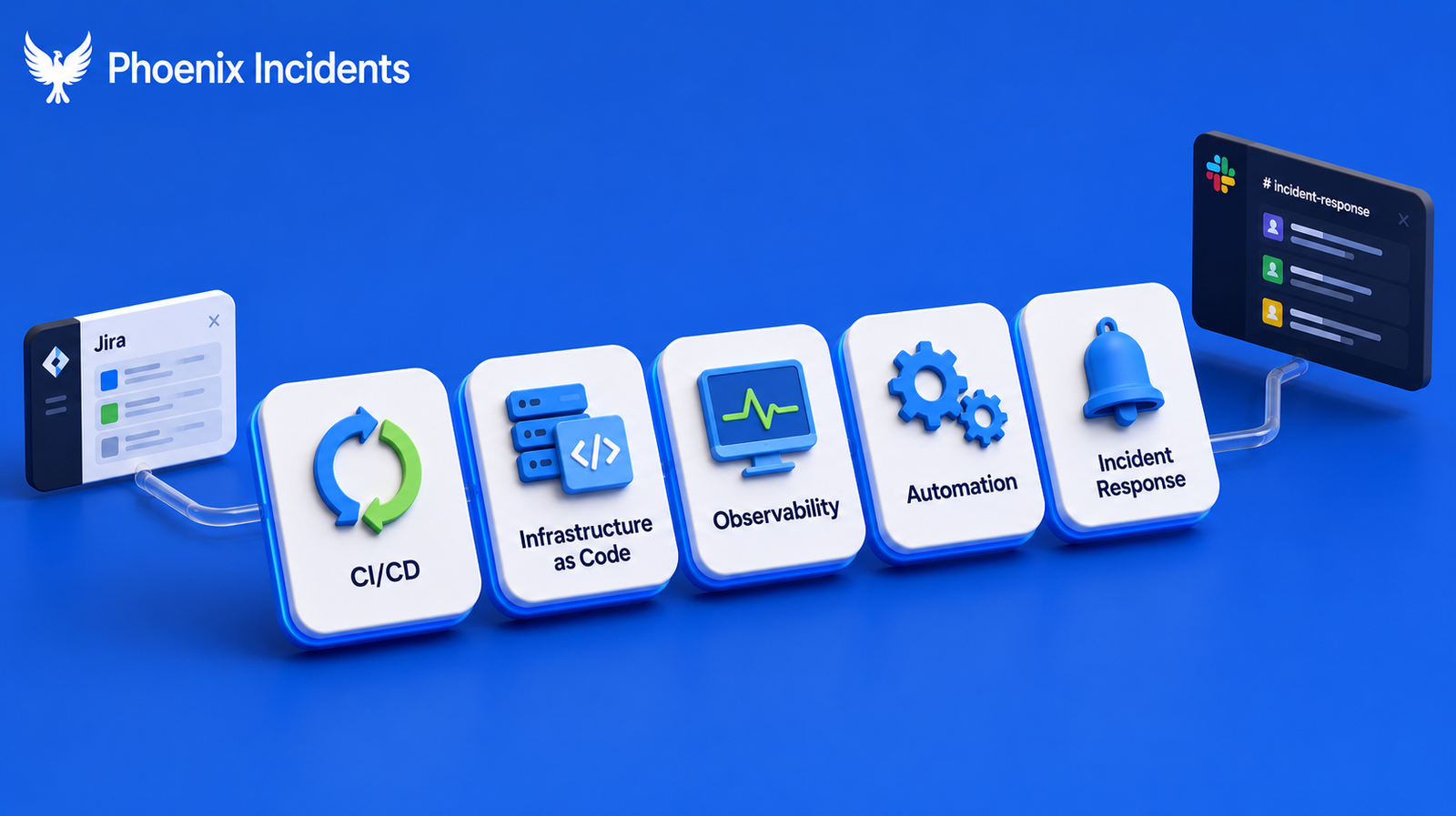
A handful of practices show up in nearly every working DevOps setup. The list is familiar, so what matters is how seriously a team treats the parts that involve running and shipping software.
- Continuous Integration and Continuous Delivery (CI/CD): CI/CD pipelines automate the process of building, testing, and deploying software so teams can release changes often, with confidence that each one was checked before it went out.
- Infrastructure as Code (IaC): Infrastructure gets defined and managed in version-controlled code rather than manual configuration, which makes environments consistent, repeatable, and auditable.
- Monitoring and observability: Metrics, logs, and traces give teams a live read on system health so they can catch problems while they’re still small.
- Automation: Repetitive manual work is the toil that wears teams down and introduces mistakes. Successful DevOps teams find the manual glue (repeated steps like server configuration and status updates), and replace it with code. The advantage is less wasted time and fewer human errors during high-stress moments.
- Incident response and learning: Failures get treated as information, not occasions for blame. The focus stays on fast detection, coordinated response, and feeding what you learn back into the system so the same failure does not recur.
DevOps and Incident Management
No matter how mature a practice gets, incidents still happen. What separates strong teams from struggling ones is what they do in the minutes and hours after that.
In a healthy DevOps environment, incident response has four qualities:
- Fast and well-coordinated
- Clearly owned and documented
- Built into everyday workflows
- Followed by genuine learning and improvement
The operate, observe, and learn stages all depend on the team being able to respond quickly and smoothly, and that breaks down the moment responders have to leave the tools they actually work in to deal with an incident.
If declaring an incident means logging into a separate platform, copying over details by hand, and juggling three windows while a service is down, the process gets in the way of the people using it at the exact moment they can least afford the distraction.
The teams that handle this well manage incidents where they already work, so response becomes a natural extension of daily engineering rather than a separate discipline with its own software to learn.
Running Incidents Where Engineering Teams Already Work
For most engineering teams, that means Jira and Slack. Jira already holds the work, history, and the ownership, while Slack is where coordination happens in real time. Running incidents in those two places, rather than a standalone tool, keeps responders in context. There is less switching between systems, better visibility for everyone watching, and a consistent process that runs the same way every time.
This matters more than it sounds because during an incident, attention is the scarcest resource on the team. And keeping the whole process in the tools people already know means the process supports the work instead of competing with it.
How Phoenix Incidents Supports DevOps Teams in Jira and Slack
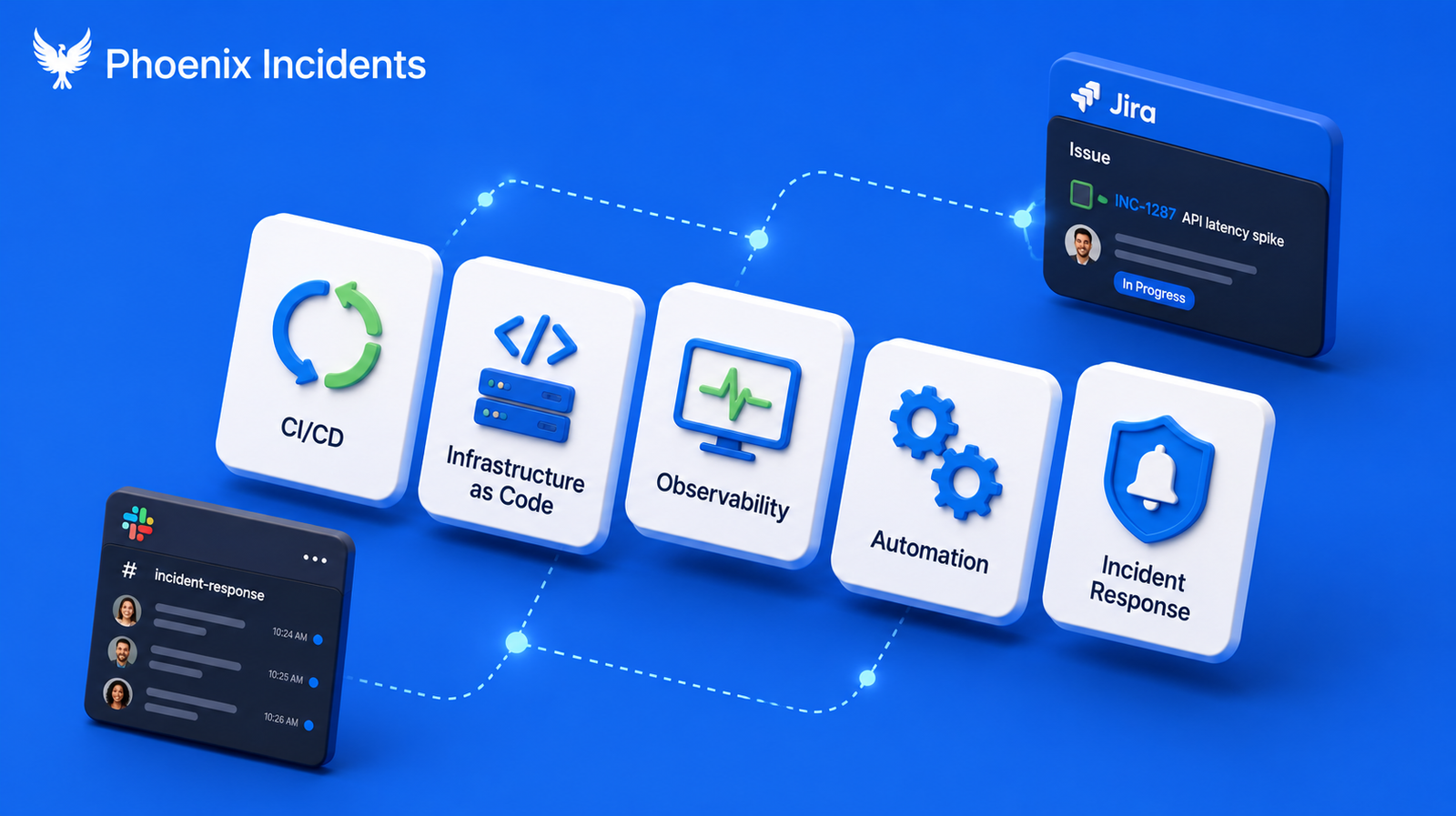
Phoenix Incidents is built on the idea above. Rather than adding another platform to learn, it runs incident management directly inside Jira and coordinates through Slack, so the tools adapt to how engineers already work instead of the other way around.
Incident Response Inside Jira and Slack
Phoenix Incidents handles response, coordination, and end-to-end management from inside Jira and Slack, with paging integrations including PagerDuty and Splunk On-Call. There's no new interface to learn mid-outage, and from incident declaration through review, the process stays consistent without forcing anyone to context-switch.
A few things this unlocks:
- Jira and Slack become the system of record for serious, customer-impacting incidents, so the history and coordination live where the team already works.
- Incidents can be declared manually by a human who senses something is wrong, rather than waiting on an automated trigger.
- Early escalation gets easier, because engineers have the psychological safety to raise a hand before they're completely certain something is wrong.
Coordinated Communication Without the Chaos
During an incident, Phoenix Incidents coordinates real-time communication across shared and incident-specific Slack channels while keeping Jira issues and paging systems in sync. The aim is to lower the mental overhead of remembering procedures, so responders can spend their attention on diagnosis and mitigation instead.
A few ways it does that:
- Status, ownership, and next steps stay current, which cuts the manual work of keeping stakeholders informed while people are heads-down fixing the actual problem.
- Reminders track the team's own SLA targets, nudging responders as a deadline approaches rather than pinging them constantly.
A Culture That Rewards Early Escalation
Mature teams treat early escalation as a sign of health, not weakness. If engineers are afraid to declare an incident because they might turn out to be wrong, they wait, and by the time they act the service is already down.
Phoenix Incidents supports the opposite instinct by normalizing the canceled incident:
- Cancelling an incident requires a short reason, which turns a false alarm into a useful data point.
- Those signals add up over time, helping the team tune its monitoring and sharpen its response, with no one punished for being proactive.
Structured Post-Incident Reviews
Once an incident is resolved, Phoenix Incidents walks the team through a Post Incident Review built to turn the outage into a source of improvement. This is the learning half of the DevOps lifecycle.
A PIR covers:
- Timeline building, reconstructing what happened and when.
- Root-cause tagging by theme, labeling the underlying cause of each incident so repeats become visible over time.
- Clearly defined, time-bound action items, rather than vague follow-ups that never get done.
Those action items are reinforced through Slack reminders and dashboards, so improvements actually land instead of fading once the pressure is off.
Visibility for Engineering Leaders
Phoenix Incidents includes reporting that gives leaders a clear read on how incidents are handled over time:
- Mean Time to Acknowledge (MTTA)
- Mean Time to Resolve (MTTR)
- SLA performance
- Recurring incident themes
- Overdue action items and mitigations
The value is seeing what is breaking, why it keeps breaking, and whether the team is fixing root causes.
DevOps Is a Practice That Has to Live in Your Tools
You don’t start doing DevOps by buying a dashboard. You do it by removing the distance between your people and the tools they work in, and by building a process that rewards escalation and values learning over blame.
When incident management lives in Jira and Slack, engineers stay in their working context even while things are breaking, which is exactly when that context matters most. Rather than asking your team to adapt to a separate, disconnected system during an outage, let the tools adapt to how they already work.
Build the process around the people, reward them for catching problems early, and treat every incident as something to learn from.
Frequently Asked Questions
1. What is DevOps in simple terms?
DevOps is a way of working where the people who build software and the people who run it share responsibility for the whole lifecycle, from writing code to keeping it healthy in production. The goal is to ship faster without making things less reliable.
2. What is the difference between DevOps and Agile?
Agile is about how teams plan and build software in small, iterative cycles. DevOps extends that thinking past the build stage into deployment and operations, so the same collaboration and fast feedback apply to running software in production, not just developing it. Most teams use them together.
3. What are the stages of the DevOps lifecycle?
The common stages are plan, build, test, deploy, operate, and observe and learn. They form a continuous loop rather than a straight line, with feedback from running systems feeding back into planning the next round of work.
4. How does DevOps handle incident management?
In a DevOps model, incident response is fast, clearly owned, built into everyday tools, and followed by a review that turns the outage into a learning opportunity. The most effective teams run incidents inside the tools they already use, like Jira and Slack, so responding does not mean switching to a separate system mid-outage.
5. Do you need special tools to do DevOps?
No single tool makes a team a DevOps team, since the core of it is culture and shared ownership. That said, the right tooling helps a lot. CI/CD pipelines, version control, monitoring, and incident management that fits into your existing workflow all reduce friction and let the practices actually take hold.
We created a free DIY guide to help Jira-native DevOps teams build a free incident management solution inside Jira. Get it now with this link 👉🏻 : Free Guide.