How Engineering Managers Balance Delivery Speed and System Reliability

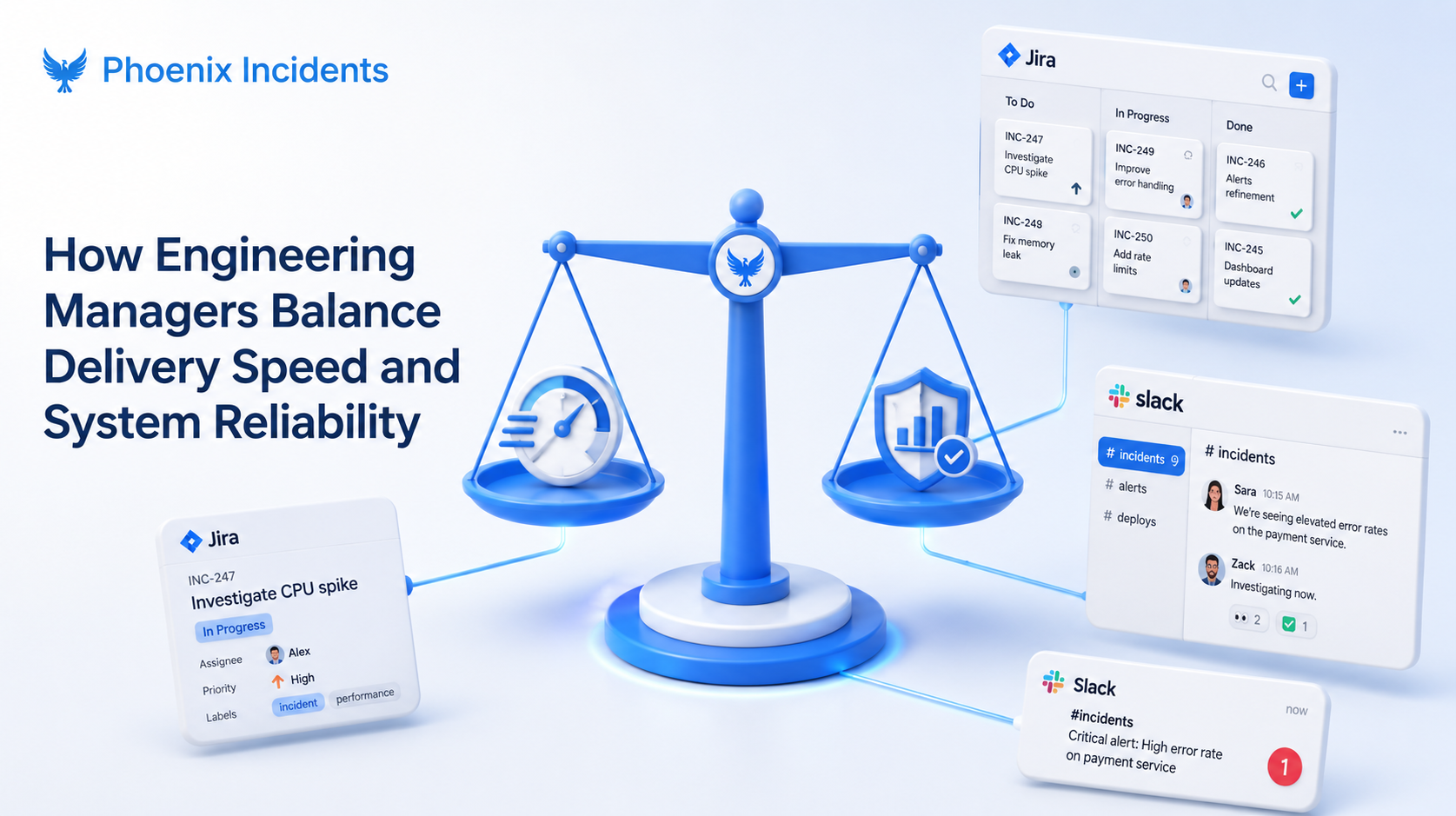
Product teams want faster deployments and leadership wants fewer incidents. And you sit in the middle, managing the deployment tools, shared infrastructure, and monitoring systems that make both possible, while everyone assumes you can deliver both at once.
The usual instinct is to treat speed and reliability as opposing forces, where you trade one for the other and your job is to find the least painful compromise. That framing is wrong, and it quietly costs teams a lot. The two are interdependent, and the lever most engineering managers overlook is how their team handles incidents.
This article lays out why the compromise is a false choice, the metrics that tell you whether you are balanced, a practical framework you can apply this quarter, and how the right incident management approach turns the whole thing from a tax into a force multiplier.
The Speed vs. Reliability Tension Engineering Managers Face Daily
- Product wants deployment frequency to climb, because shipping is how the business responds to the market.
- Leadership wants incident volume to fall, because every outage is visible, expensive, and uncomfortable to explain.
- You absorb the conflict between them, whether or not anyone names you as the owner.
It shows up hardest the moment an incident hits production, when your team carries the coordination weight:
- Engineers are deep in Jira, leadership is asking in Slack, and customer service needs to know who's affected.
- You become the translator keeping all of them in sync.
- Three hours later you have spent more time reconstructing what happened across threads and tickets than anyone spent fixing the actual problem, and a meaningful slice of the sprint is gone.
So the natural move is to slow down: add review gates, longer approval cycles, heavier processes.
But the problem is that process is not the same thing as reliability. Extra processes make work feel safer without actually making your systems safer. And the moment those steps slow engineers down, they find ways around them, which leaves you with less visibility and less control than before.
Now you're paying the full cost of the process without getting the reliability it promised, a cost that good incident management could have prevented.
How Poor Incident Management Quietly Kills Both
Incident management is the system that decides whether your team gets faster and more stable over time, or slower and more fragile, and most managers underestimate it until they add up the cost.
When it’s weak, it drains speed and reliability together, and it does so in ways that rarely show up on a single dashboard.
The drain runs both ways: unstable systems eat the hours your team planned to spend building new features, and a team stuck firefighting never reaches the work that would make the system stable in the first place.
The velocity tax comes first: Every incident without clear ownership and integrated tooling turns into a manual scramble, and the reconstruction work, who did what, when, and why, eats hours that belonged to delivery.
The learning gap comes next: The post-incident review either doesn’t happen or happens without teeth, action items land in the backlog, and they get quietly deprioritized because nothing enforces them.
Then the repeat-failure loop closes: Three months later the same pattern resurfaces for the same reason, because the root cause was documented but never actually fixed. Every incident becomes a choose-your-own-adventure exercise whose outcome depends entirely on who is on call and how much they happen to remember.
| Hidden cost | What it looks like | Impact on speed | Impact on reliability |
|---|---|---|---|
| Coordination overhead | Manual status updates copied across Slack and Jira | Sprint capacity drained | Slower resolution |
| No PIR enforcement | Action items rot untouched in the backlog | Rework returns later as new tickets | Repeat incidents |
| Tribal knowledge | Response quality depends on who is on call | Inconsistent and slow | Unpredictable outcomes |
| Manual reporting | Manager rebuilds timelines from memory | Manager time lost | Leadership flies blind |
The irony is that the manual heroics meant to protect reliability are what degrade it, because they keep the knowledge in people's heads instead of in the system, and people forget, rotate, and burn out.
The Metrics That Tell You Whether You're Balanced
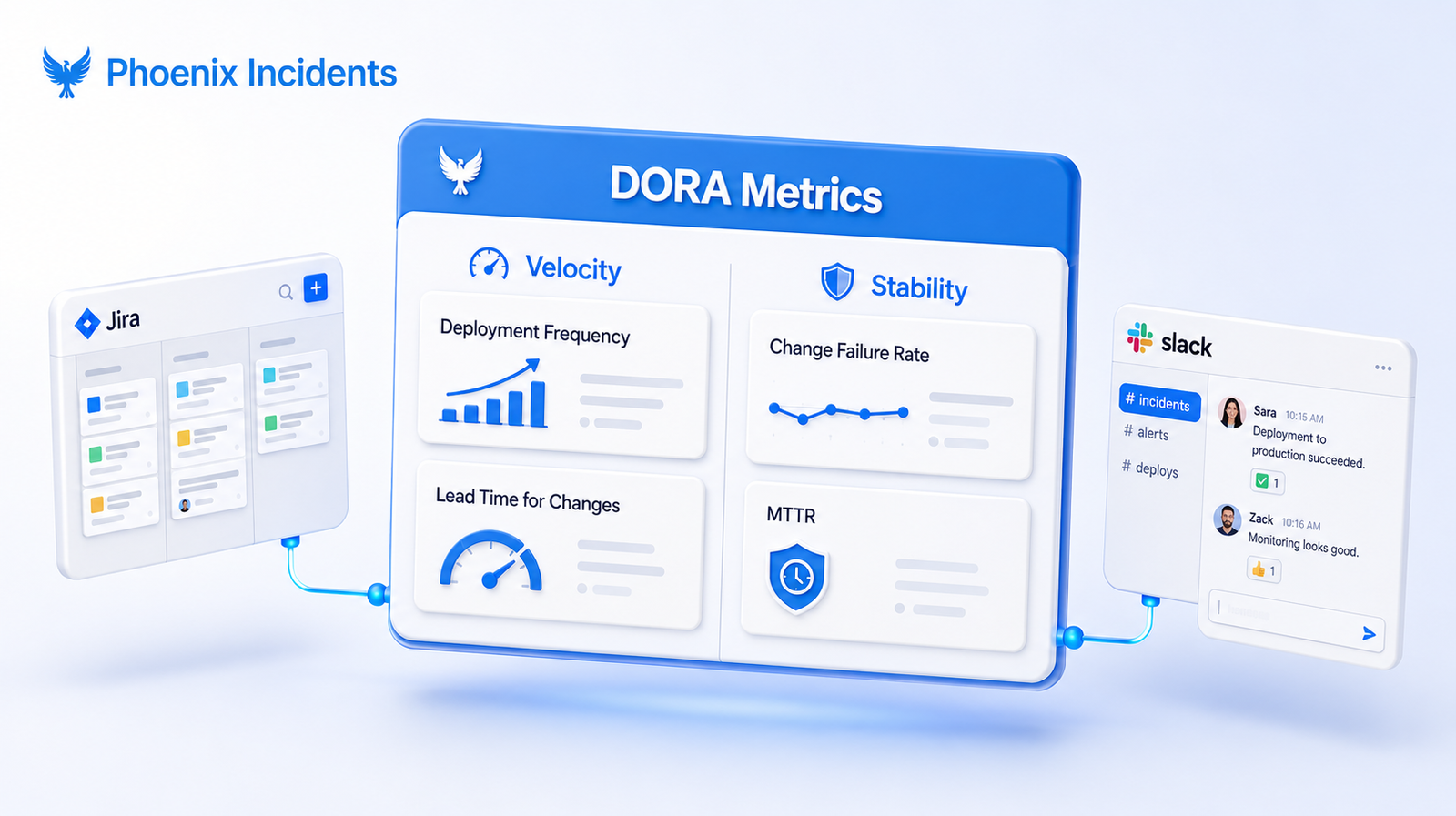
You cannot balance what you do not measure, and most teams measure speed and reliability in separate rooms with separate vocabularies. The fix is to put them on the same page.
The DORA metrics, developed by Google's DevOps Research team, do exactly that, which is why they have become the common language for delivery performance.
Two of them measure velocity and two measure stability, so reading them together gives you the balance at a glance rather than a flattering half of the picture.
| Metric | What it measures | What it signals | Velocity or stability |
|---|---|---|---|
| Deployment frequency | How often you successfully release to production | Delivery throughput | Velocity |
| Lead time for changes | Time from commit to running in production | Pipeline efficiency | Velocity |
| Change failure rate | Share of deployments that cause a production failure | Quality of that velocity | Stability |
| MTTR | Mean time to restore service after a failure | Response and recovery efficiency | Stability |
| MTTA | Mean time to acknowledge an alert | Detection and alerting health | Stability |
| Action item completion | Share of PIR follow-ups actually closed | Whether learning sticks | Stability |
The first four metrics in the table, deployment frequency, lead time for changes, change failure rate, and MTTR, are the DORA metrics. DORA groups them along the same speed-and-stability split this article is built on: the first two measure how fast you ship, and the last two measure how stable things stay when you do.
The final two rows, MTTA and action item completion, are not part of the DORA set, but they are where the quality of your incident management shows up. A slow MTTA means your team is taking too long to even notice something is wrong. A low action item completion rate means your post-incident reviews are producing fix items that never actually get done.
One thing to watch for in 2026: Ameya Kanitkar, Co-founder & CTO at Larridin, stated that, as AI writes a larger share of your code, deployment frequency and lead time can become misleading without additional context.
This is because they measure how fast code ships rather than whether it was worth shipping. MTTR and change failure rate hold up better, so lean on the stability metrics when you read the picture.
Don't Forget Error Budgets and SLOs
Metrics tell you where you are. SLOs and error budgets tell you what to do about it.
A service level objective (SLO) is the reliability target you commit to, for example 99.9% availability measured over a rolling window. You are not promising perfection, just that level. The error budget is the gap between that target and 100%, which is the amount of downtime or failure you are allowed before you break the promise. A 99.9% SLO works out to roughly 43 minutes of downtime a month, so that 43 minutes is your budget to spend on shipping boldly. Use it however you like, as long as you stay inside it.
The reason this matters for balance is - as Google's SRE team puts it - The error budget gives product and engineering one shared number and takes the politics out of deciding how much risk to take.
Now, the rule has become simple: while the budget remains, the team has clear permission to move fast and ship. Once the budget is spent, releases pause and the team focuses on stability until it recovers. The speed-versus-reliability debate stops being about who argues best and becomes about what the numbers allow.
A Practical Framework for Balancing Speed and Reliability
None of the above helps without a way to operationalize it. This is a five-part framework you can put in motion this quarter.
1. Make the Trade-off Explicit With SLOs and Error Budgets
Define an SLO for each critical service and let the error budget govern release pace. Healthy budget means ship; exhausted budget means harden. Writing down an error budget policy ahead of time, including what happens when the budget is gone and who has authority to call a freeze, is what keeps the policy from collapsing the moment it’s inconvenient.
2. Allocate Capacity on Purpose
Reliability work that competes with feature work loses every time. Reserve capacity for it deliberately. The 60-30-10 model is one well-tested split, roughly 60% delivery, 30% maintenance, and 10% improvement, and the ratio flexes to your reality. The point is that maintenance and improvement get a protected line in the budget rather than the scraps left after delivery.
3. Reduce Toil and Coordination Overhead
Toil is the repetitive manual work that scales with incident volume and teaches you nothing, and the coordination scramble during an incident is some of the most expensive toil you have. Automate the status updates, the channel creation, the cross-tool syncing. Every minute your engineers spend relaying information is a minute they are not spending on the fix, and that overhead is one of the few places you can win back velocity and reliability with the same change.
4. Treat Post-Incident Learning as Real Work
A post-incident review only pays off if its action items get the same rigor as feature tickets: owned, scheduled, tracked, and closed. The moment they become optional, your reviews turn into documentation of failures you are doomed to repeat. Enforcement is the difference between a team that learns once and a team that relearns the same lesson every quarter.
5. Make Visibility Automatic
Reporting that a manager assembles by hand is slow and stale by the time leadership reads it. The metrics that matter (MTTA, MTTR, deployment frequency, incident trends, and action item completion), should be generated from execution data automatically.
When visibility is a by product of how the team already works, leadership gets the truth without anyone stopping work to build a spreadsheet.
| Step | What it fixes | Primary payoff |
|---|---|---|
| SLOs and error budgets | Ambiguous risk decisions | Speed and stability negotiated on data |
| Capacity allocation | Reliability work crowded out | Protected time for improvement |
| Reduce toil | Manual incident overhead | Velocity and reliability recovered together |
| Enforce PIR learning | Repeat incidents | Failures fixed once |
| Automatic visibility | Manual reporting drag | Leadership trust without manager time |
How Incident Management Software Enables the Balance
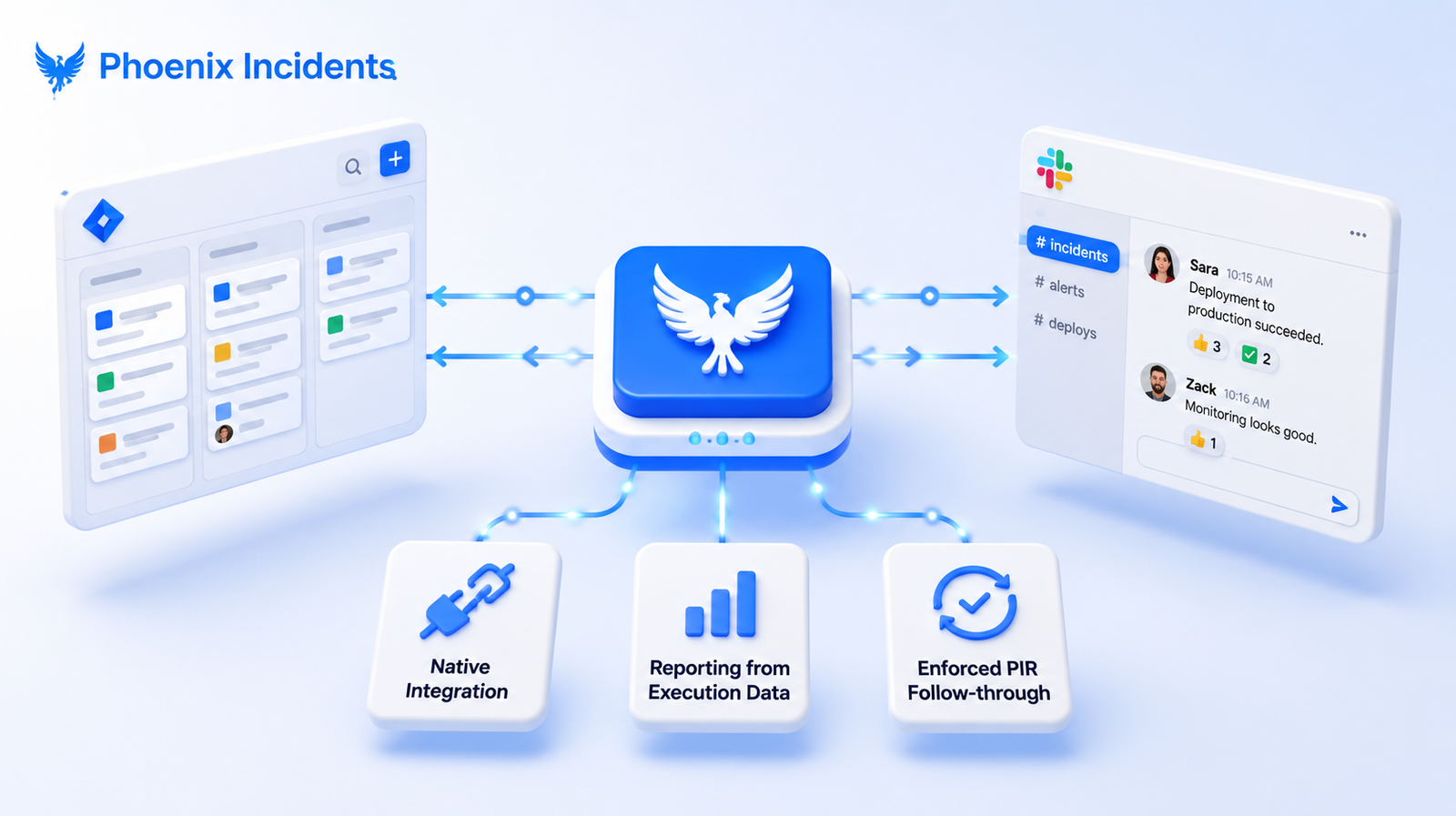
Discipline holds far better when your tooling reinforces it instead of fighting it, and that is where incident management software earns its place. Platforms vary a lot in what they actually deliver, so when you weigh one against another, three things separate the tools that help from the ones that just add another tab:
- Native integration with the tools your team already lives in: When the incident workflow runs inside Jira and Slack, engineers never leave their workflow to manage the incident, which is what kills the context-switching tax. ChatOps workflows let the team transition incident states, assign owners, and post updates from the same place they are already working.
- Enforced PIR follow-through: When an incident cannot fully close until its action items close, the learning loop stops being optional, and the fixes that prevent repeat incidents actually get done.
- Reporting built from real execution data: Visibility that generates automatically from how the team already works, rather than from a manager rebuilding timelines from memory, is the only kind that stays accurate and sustainable.
What This Looks Like With Phoenix Incidents
Phoenix Incidents is built around exactly these mechanics, and it lives inside Jira and Slack while integrating with your existing paging tools so engineers never have to leave their workflow.
- Stakeholders stay informed automatically: Phoenix Incidents spins up a dedicated Slack channel for each incident where customer-facing teams, product managers, and leadership can follow along without interrupting the engineers doing the work. Keeping everyone informed becomes automatic, so your team focuses on fixing while the system handles communication.
- Jira and Slack stay in sync: Engineers update once and everyone sees it. The translator role you used to play, relaying status between the people in tickets and the people in chat, stops being your job.
- Systemic learning that sticks: Action items from reviews are tracked with the same rigor as feature work, incidents stay in pending mitigation until every action item closes, Slack reminders surface when follow-through lags, and dashboards show which systemic fixes are overdue.
- Executive reporting without manager time: MTTA, MTTR, incident volumes, recurring themes, and action item completion generate from actual execution data after every incident, so leadership sees trends without asking you to stop work and build a report.
Each of these runs automatically, which is the difference between incident management that costs you time and incident management that gives it back.
What Engineering Managers Gain
When incident management is planned rather than improvised, the payoff lands in three places that compound over time.
| Gain | Before | After |
|---|---|---|
| Time | You are the single point of coordination, tracking PIRs and assembling reports by hand | The system handles execution and you spend your attention on patterns |
| Trust | Reporting gets questioned and incident response varies by who is on call | Reporting is grounded in execution data and response is consistent under pressure |
| Sustainable velocity | Incidents blow up sprint plans without warning | Overhead is predictable and contained, and fewer repeat failures mean less rework |
The trust gain is the one that quietly changes the most.
When product teams believe incidents will be handled competently, they become more willing to collaborate instead of building around a process they do not trust, and that willingness is itself a source of both speed and reliability.
See how Phoenix Incidents helps teams turn incidents into that kind of advantage.
Balance Speed and Reliability Without the False Choice
Speed vs reliability were never the real issue. The real choice is whether your incident process compounds learning or just documents failure, and that choice decides whether your team gets faster and more stable over time or stays stuck firefighting.
Get the incident layer right and the false choice dissolves: incidents become a source of improvement rather than emergencies that derail the roadmap.
See how engineering managers are reducing incident overhead while improving follow-through.
Frequently Asked Questions
1. Are speed and reliability actually opposed?
Not really. While they may seem to compete in the short term, reliable systems experience fewer incidents, giving teams more time to deliver new features. The best engineering teams invest in both.
2. What metrics help balance speed and reliability?
The four DORA metrics are the best place to start: deployment frequency, lead time for changes, change failure rate, and MTTR. You can also track MTTA and post-incident action item completion to measure how well your team responds and learns from incidents.
3. How do error budgets help balance speed and reliability?
Error budgets define how much failure is acceptable before teams pause feature releases to focus on improving reliability. They help product and engineering teams make release decisions based on data instead of opinion.
4. Does adding more processes improve reliability?
Not necessarily. More processes can slow teams down if they don't solve real problems. Reliability improves when teams learn from incidents, fix root causes, and consistently follow through on improvements.
5. How does incident management affect delivery speed?
Effective incident management helps teams recover faster, reduce repeated failures, and spend more time building new features. Poor incident management creates extra coordination work and takes valuable time away from development.