Blameless Post-Mortem Culture: Best Practices for Engineering Teams

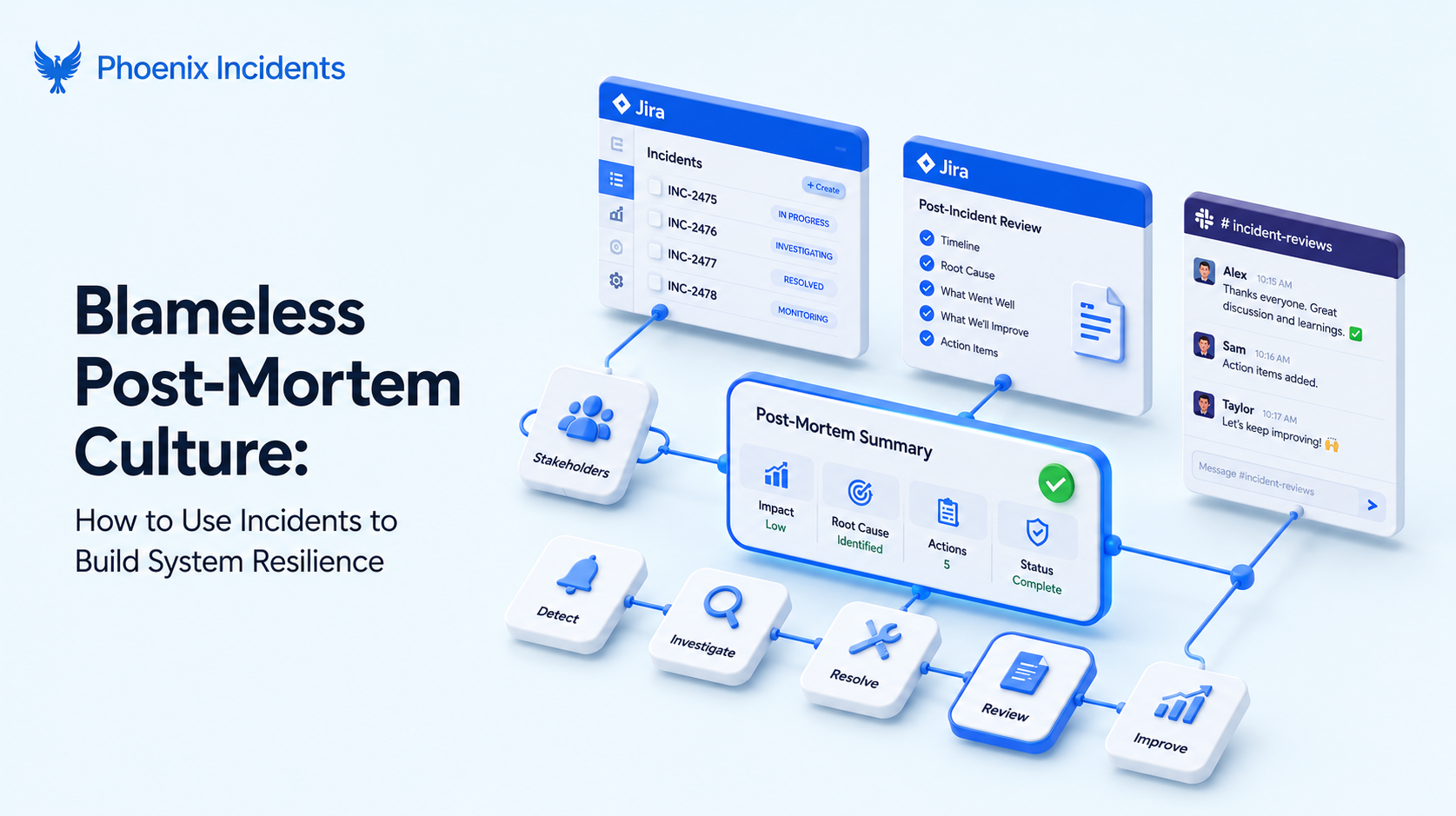
A blameless post-mortem culture is one that nearly every engineering leader claims to want, yet far fewer manage to hold onto when something breaks badly and customers feel it. Under the pressure of a major incident, the questions arrive fast and loaded:
- What happened?
- Why didn't we catch it sooner?
- Who was involved?
Blame usually slips in through the framing of the questions and the shape of the conclusions, and even teams with the best intentions drift toward it.
The argument running through this piece is simple. Blamelessness is not a mindset you announce once and assume has taken hold. It’s a discipline you build into your process, because an outage is never the product of one person's mistake. Systems fail because signals get missed, ownership is unclear, processes are brittle, and decisions get made with incomplete information in the moment.
This guide is for the SRE and DevOps teams who own incident response, and for the support and customer success teams who get pulled into the same reviews and are just as capable of shaping whether they stay blameless.
What Is a Blameless Post-Mortem?
A blameless post-mortem is an incident review that assumes everyone involved acted reasonably given the information and pressure they had at the time, and concentrates on how a failure happened rather than who caused it. It treats the system, including signals, ownership, tooling, and process, as the unit of analysis instead of the individual.
That framing changes what the review is for. The point is no longer to locate a culprit and close the case, but to understand the conditions that let a reasonable person make a decision that turned out to be wrong, so those conditions can be changed before they catch someone else.
Where the Practice Comes From
The idea did not start in software. It grew out of healthcare and aviation, fields where a single error can be fatal and where every mistake is treated as a chance to strengthen the system rather than punish the operator. Sidney Dekker's work on just culture gave the approach much of its intellectual foundation, reframing human error as a symptom of deeper trouble inside the system rather than the cause of it.
Software then adopted the practice through Etsy and Google. Etsy's then-CTO John Allspaw popularized the term in his 2012 essay Blameless PostMortems and a Just Culture, and Google later codified it as a tenet of SRE in its widely read postmortem culture chapter.
Between them they turned a safety-science concept into standard operating practice for teams running complex production systems.
What "Blameless" Does NOT Mean
The fastest way to lose a room is to let people assume blameless means consequence-free. It doesn't. Blamelessness redirects energy toward the system, but it keeps every bit of the responsibility for fixing what the system exposed.
| Blameless is | Blameless is not |
|---|---|
| Examining systems, signals, and process | Ignoring accountability or ownership |
| Redirecting energy toward fixes | Skipping corrective action |
| Being honest about what broke | Sugarcoating serious failures |
| Tracking improvements to completion | Letting the same problem repeat |
Why Blame Creeps Back In, Even on Teams That Want Blamelessness
Most teams that genuinely support blamelessness still struggle to sustain it, and the reasons are usually structural rather than personal.
When the context around an incident is thin, people fill the gaps with stories, and those stories tend to land on individuals. The table below maps the common triggers to what they actually point at.
| Trigger | Why it produces blame | What it actually signals |
|---|---|---|
| Incomplete incident timelines | Teams fall back on memory and patch the gaps with assumptions | Missing data capture |
| Fragmented tooling | Data doesn't line up across systems | No single source of truth |
| Executive pressure to explain what went wrong quickly | Speed favors naming a culprit over finding a cause | An unstructured review process |
| Fear of reputational damage in customer-facing outages | People go defensive and protect themselves | Low psychological safety |
Strip away the structure and people invent narratives, and narratives blame people. Good intentions are not a process, which is exactly why the rest of this guide is about building the scaffolding that keeps a review honest.
The Foundation: Psychological Safety
Everything else rests on whether people feel safe enough to speak plainly. Early escalation only happens when engineers believe that being wrong will not get them punished. The moment a false alarm carries a cost in embarrassment or scrutiny, people start to wait, and waiting is how small issues grow into a real incident.
Google's own research found psychological safety to be the single strongest predictor of effective teams, which is why it sits at the base of every durable post-mortem practice rather than an option.
How to Run a Blameless Post-Mortem: 5 Core Principles
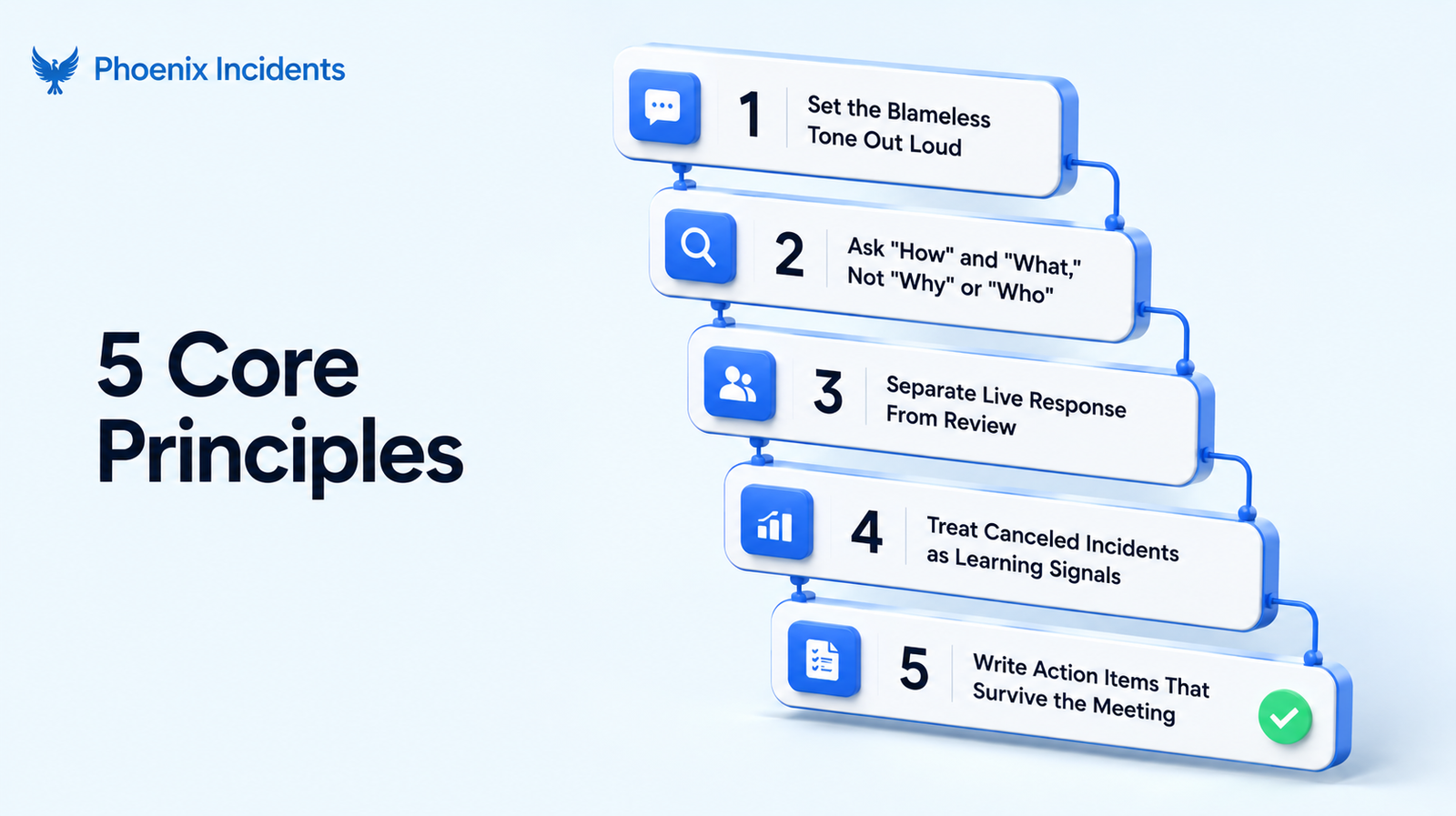
Definitions and history set the stage, but blameless culture is made or lost in how you actually run the review. These five principles are where the discipline lives.
1. Set the Blameless Tone Out Loud
Blameless reviews begin with clearer expectations, stated plainly before anyone digs into the timeline. The facilitator should open every review by naming the ground rules, something close to this:
This review is blameless. People make mistakes, and what we care about is how our systems, processes, tooling, and signals allowed a mistake to cause impact, and what we can improve going forward.
Saying it slows the rush to judgment, lowers defensiveness, and makes it easier for people to be honest about what they saw and what they assumed. The repetition however, is the part teams skip and the part that matters most. People need to hear something many times before it becomes instinct, so naming it out loud at the start of every review is a small habit that compounds into a genuine culture.
2. Ask "How" and "What," Not "Why" or "Who"
The words you use steer the whole conversation. "Why did you do that" puts a person on trial and invites them to defend a decision; "how did the process allow this" turns the same moment into an examination of conditions.
In The Infinite Hows, Allspaw makes the case that "how" and "what" questions get people describing the circumstances that made an action reasonable at the time, which is precisely the data a post-mortem exists to surface.
| Instead of (blame-prone) | Ask (system-focused) |
|---|---|
| Who pushed the change? | What signals were visible at the time? |
| Why did you do that? | How did the process allow this to happen? |
| Why didn't you catch it? | What made the right call hard to see? |
Saying "I noticed the alert fired after the deploy" feels different from "you caused this after the deploy." One is an observation, the other sounds like an accusation.
The goal is to get people to share what they actually did during the incident, not what they think they should have done. That means the alerts they ignored, the tools they didn't trust, and the shortcuts they took. You only get that honesty when people feel safe enough to be real.
3. Separate Live Response From Review
During an incident, people are under pressure and running on adrenaline. Ask "why did this happen" or "who decided that" in the middle of it, and you will get defensiveness from your team. While the system is still on fire, the work is narrow: fix what's broken, make sure the right people are talking to each other, and keep everyone informed.
Save every "why" for after things are stable. With the pressure off, people think more clearly and talk more honestly about what actually went wrong in the system, and the temptation to point fingers fades because nobody is scrambling anymore. Building this separation into your workflow protects blamelessness structurally, rather than leaving it to everyone's self-control in the worst possible moment.
4. Treat Cancelled Incidents as Learning Signals
This is the principle most teams overlook entirely. When an engineer or a support rep escalates something that turns out to be a false alarm, the instinct is to treat it as wasted effort. It is not.
A cancelled incident is data, not something to be embarrassed about, and reviewing why someone escalated tells you exactly where your escalation criteria are unclear.
Look at cancelled incidents systematically and they let you:
- Tune alerting thresholds that are firing on noise
- Clarify when an escalation is genuinely warranted
- Spot training gaps, especially among support staff and junior engineers
- Reduce noise without discouraging people from raising the alarm
How you respond to a false alarm teaches the whole team whether early escalation is safe. Punish it, even subtly, and people will hesitate next time, which is how the genuinely serious incident ends up sitting unreported.
5. Write Action Items That Survive the Meeting
A blameless review only matters if it leads to real change. And that only happens when action items are specific and time-bound. The post-mortem itself is for learning, and turning that learning into actual work with owners and deadlines is the end product.
Either way, every item that survives needs four things: a specific task, a named owner, a deadline, and somewhere visible it gets tracked.
| Weak action item | Strong action item |
|---|---|
| "Improve our alerting" | "Lower the CPU alert threshold to 80%, owned by @maria, due Mar 14, tracked in Jira" |
An action item without an owner and a date is a thought and a prayer. It gets buried under the next sprint and the same incident comes back around six months later wearing a different hat.
This is also where the right tooling earns its place. Phoenix Incidents keeps action items visible after the review closes, assigns ownership, and sends Slack reminders against deadlines, so improvements actually ship instead of dissolving back into the daily backlog.
The Anatomy of a Blameless Post-Mortem Document
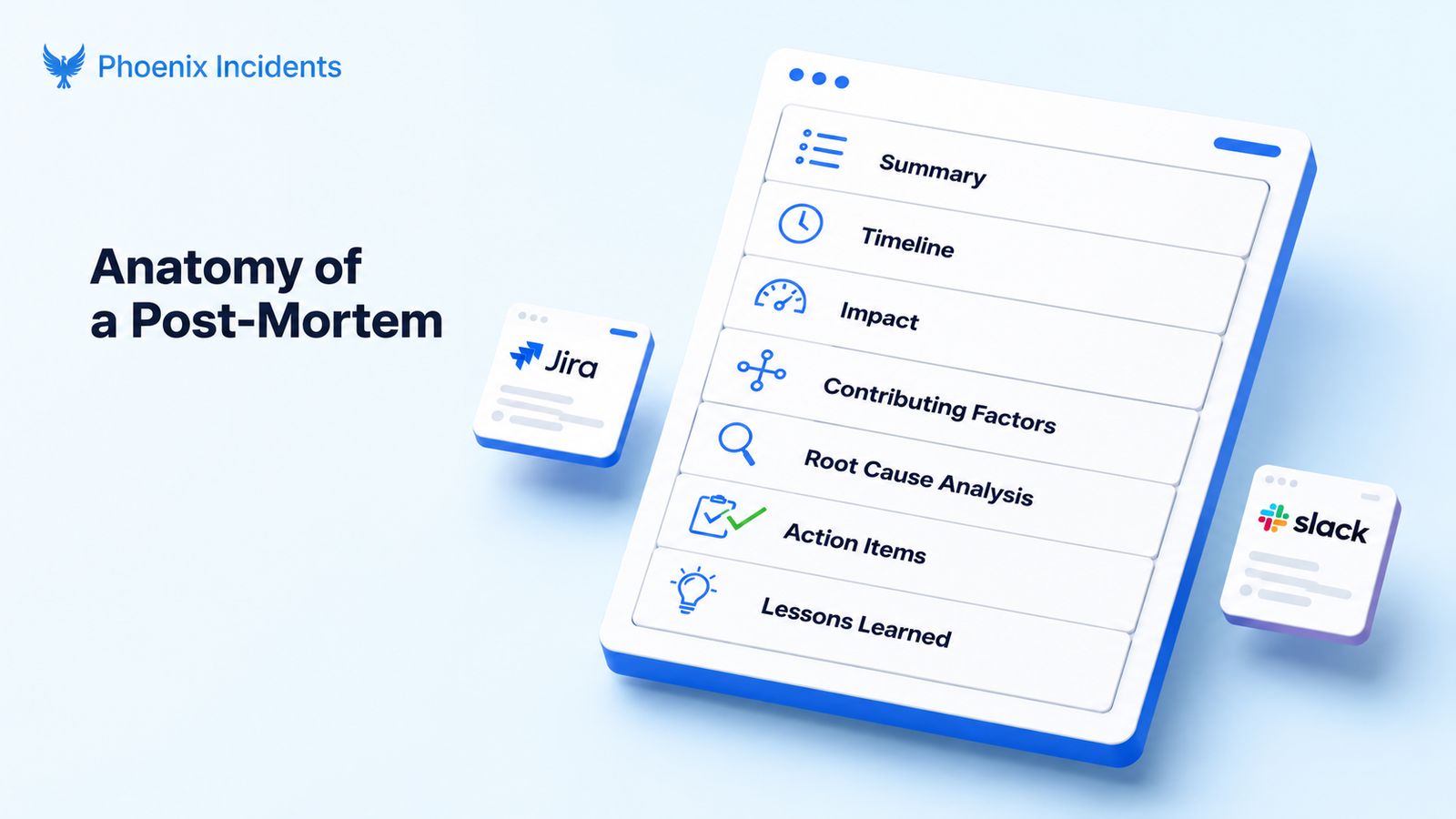
A consistent document structure does a lot of quiet work. It keeps reviews comparable over time, makes them searchable when a similar incident hits, and removes the in-the-moment guesswork about what to write down.
Most mature templates, including Google's, roughly agree on these sections.
| Section | What it captures |
|---|---|
| Summary | A one-paragraph, plain-language overview anyone can follow |
| Timeline | The objective sequence of what happened and when |
| Impact | Duration, users affected, and business or financial cost |
| Contributing factor | The systemic conditions that allowed the failure |
| Root cause analysis | The deeper investigation, anchored on systems rather than people |
| Action items | Specific, owned, dated, and tracked |
| Lessons learned | What the organization now understands that it didn't before |
Define Your Post-Mortem Criteria Before an Incident
Decide in advance what actually triggers a review, whether that's a severity level, a duration threshold, or a measure of customer impact.
Setting the bar ahead of time removes the awkward in-the-moment debate about whether an incident "deserves" a post-mortem, a debate that quietly discourages people from raising smaller issues that were worth examining.
Teams can also request a review from another team when they believe the same criteria are met.
Anchor Root Cause With the Five Whys
The Five Whys is a simple way to push past the first, most visible explanation by asking "why" repeatedly until you reach a systemic cause.
The discipline is keeping every answer pointed at the system:
- The checkout service went down. Why?
- A deploy shipped a config change that exhausted the database connection pool. Why did that reach production?
- The change passed review, but the reviewer had no way to see connection-pool limits in the diff. Why not?
- Pool limits live in a separate config repo that isn't surfaced during code review. Why is it separate?
Notice that each answer points at a process or a missing signal, never a person. The Five Whys is a good starting point, but real incidents usually involve several conditions that interact with each other.
That is why it helps to also ask how decisions were actually made in the moment, not just why things broke. Together, both approaches give you a fuller picture of what went wrong.
Common Myths About Blameless Culture
Most resistance to blameless reviews comes from a handful of misconceptions that are worth addressing head-on.
| Myth | Reality |
|---|---|
| Blameless means no accountability | It produces more accountability, because systemic issues become visible and fixes get tracked to completion |
| Blameless slows teams down | Teams that escalate early and learn consistently get faster over time, because the systems themselves improve |
| It's only for SRE teams | Support and customer success teams benefit just as much, particularly where they own escalation and customer communication |
The Role of Leadership in a Blameless Culture
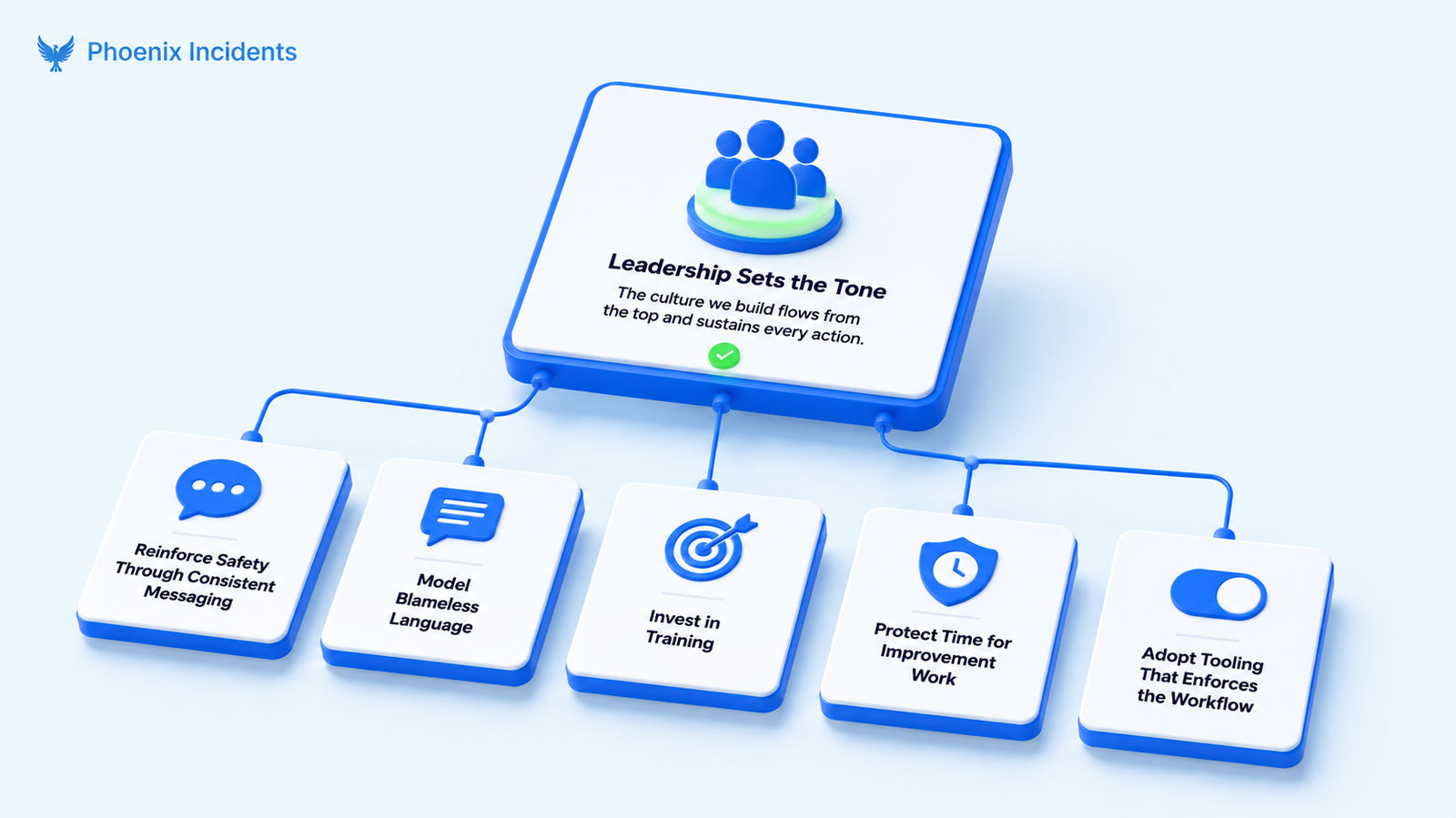
Leaders shape the culture whether they realize it or not. The way they talk about incidents, what they praise, and what they actually follow up on all send a signal to the rest of the team.
These are five actions that separate a blameless culture that sticks from one that slowly fades back into finger-pointing:
- Reinforce safety through consistent messaging: Say that reviews are blameless, and keep saying it. Publicly recognize people who escalated quickly even when the threat turned out to be minor, because that is the behavior you want repeated.
- Model blameless language: When discussing incidents with stakeholders, frame questions around system weaknesses rather than individual actions. The team takes its cues from how leadership talks about failure.
- Invest in training: Run regular incident drills and post-mortem practice so that blameless habits exist as muscle memory before a real outage tests them.
- Protect time for improvement work: Make sure engineers actually have time set aside to work on fixes that come out of reviews. If people feel like their suggestions will never make it onto the roadmap, they will stop bothering to raise them in the first place.
- Adopt tooling that enforces the workflow: Choose platforms that guide teams through structured response and review, so the blameless path is also the path of least resistance.
Make Blamelessness the Easy Behavior
A blameless culture doesn't arrive in a single meeting or a single memo. It gets built incident by incident, reinforced by consistent language and process, and sustained by tooling that makes the right behavior the easy behavior rather than the disciplined exception.
That last part is where most good intentions quietly fall apart. Phoenix Incidents helps DevOps and SRE teams make blamelessness a habit, by anchoring incident response and post-incident reviews inside Jira and Slack where teams already work, framing every review as blameless, and tracking action items until they actually close.
If you want a review process that holds up under pressure, book a demo and see how it fits the way your team already operates.
Frequently Asked Questions
1. What is the difference between a blameless and a blameful post-mortem?
A blameful post-mortem asks who caused the incident and treats human error as the root cause. A blameless one asks how the system allowed the failure, assumes people acted reasonably with the information they had, and targets the conditions that need to change.
2. How do you start a blameless post-mortem meeting?
Open by stating out loud that the review is blameless, before anyone touches the timeline. Name the goal as understanding how systems, processes, and signals let a mistake cause impact. Repeat this framing at the start of every review so it becomes instinct rather than a one-off.
3. Are blameless post-mortems only for engineering teams?
No. While they originated in SRE and DevOps, the same approach benefits any team involved in incident response, including customer support and success teams who handle escalation and customer communication. The core principle, examining systems instead of individuals, applies to any kind of failure.
4. What questions should you ask in a blameless post-mortem?
Favor "how" and "what" over "why" and "who." Ask what signals were visible at the time, how the process allowed the failure, and what made the right decision hard to see. These questions surface the conditions behind a decision instead of putting a person on the defensive.
5. Does blameless mean no one is held accountable?
No. Blamelessness removes punishment, not responsibility. By making systemic issues visible and tracking fixes to completion, a blameless process tends to create more accountability than a blameful one, because problems get surfaced and owned rather than hidden to avoid punishment.