The Major Incident Communication Template Every Response Team Needs

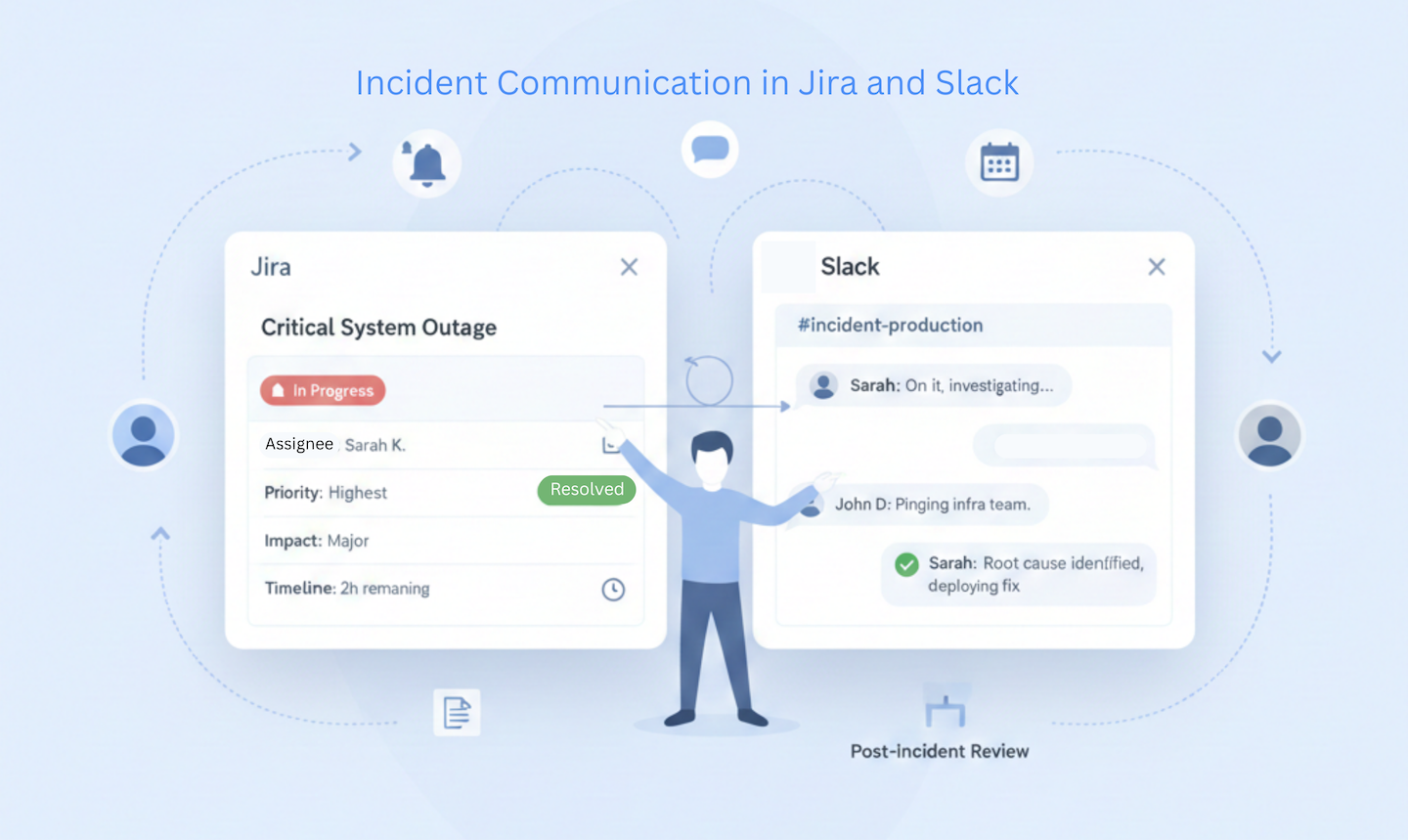
When a major incident hits production, communication is rarely the thing teams prepare for first, yet it’s often one of the things that causes friction once the incident is underway. Slack fills up with partial updates, and stakeholders ask for clarity while engineers are trying to diagnose the issue. Everyone is acting in good faith, but good intentions don't survive a P0. Without a forced structure, 'good faith' just leads to five different versions of reality floating around Slack.
In theory, everyone agrees that communication matters during incidents. In practice, most teams still rely on ad-hoc messages, copy-pasted updates, and tribal knowledge. The result is confusion, duplicated effort, and unnecessary stress, especially during high-severity incidents.
The Cost of Ad-Hoc Incident Communication
When teams don’t have a standardized incident response communication process, the same problems appear again and again:
- Inconsistent Updates: Different responders share different versions of reality across Slack, Jira, and email. No one knows which update is true.
- Excessive Interruptions: Engineers are repeatedly pulled away from investigation to answer stakeholder questions that should have been handled asynchronously.
- Missed or Late Updates: There’s no clear ownership or communication, so updates happen late or not at all.
- Post-Incident Confusion: After resolution, teams struggle to reconstruct what happened, who did what, and when decisions were made.
A communication template is the first step toward fixing this.
What Makes An Incident Major (and Why Communication Matters More)
A major incident isn’t defined by how long it lasts or what caused it. It’s defined by impact.
Typical signals include:
- Customer-facing disruption.
- Revenue or SLA risk.
- Executive visibility.
- Cross-team coordination.
In these situations, communication becomes part of the response itself. Clear updates reduce uncertainty, limit interruptions, and allow engineers to focus on mitigation instead of repeatedly re-explaining the situation. That’s why mature teams treat communication as a core incident management function, not a side task.
What a Major Incident Communication Template Looks Like
A major incident management communication template is a standardized structure for sharing incident information consistently, even while under pressure. Its purpose is not to provide perfect answers; it’s designed to:
- Create a shared understanding quickly.
- Reduce ambiguity.
- Set expectations for updates.
- Ensure everyone is working from the same source of truth.
The Standard Template Format
Based on practices from leading engineering teams at companies like PagerDuty, Atlassian, and Google SRE, here's the incident communication template format that mature response teams use:
Incident Status Update Template:
Incident ID: [Unique identifier]
Severity: [SEV-1, SEV-2, etc.]
Status: [Investigating | Identified | Monitoring | Resolved]
Reported at: [Timestamp in local timezone]
Impact:
- Who is affected:
[e.g., All users, Enterprise customers, Specific region] - What is affected:
[e.g., Login service] - Business impact:
[e.g., Users cannot access accounts]
What We Know:
[Brief description of the issue and symptoms observed]
What We're Doing:
[Current investigation or mitigation steps being taken]
Next Update and Update History:
[Expected time for next update, typically 30-60 minutes for SEV-1]
Some Pitfalls to Watch Out For While Using This Template
- Filling in "What We're Doing" Before You Actually Know What's Wrong: Teams often feel pressure to populate every field immediately, so they list generic actions like "investigating logs" or "checking servers" in the "What We're Doing" section. If you don't actually know what's happening yet, it's better to leave mitigation steps empty until you have a real hypothesis.
- Vague Impact Statements That Don't Help Stakeholders: From a stakeholder's perspective, vague statements creates more questions than answers: Without specifics, stakeholders can't make informed decisions or set appropriate expectations. Be specific.
Why Templates Fail Without Enforcement
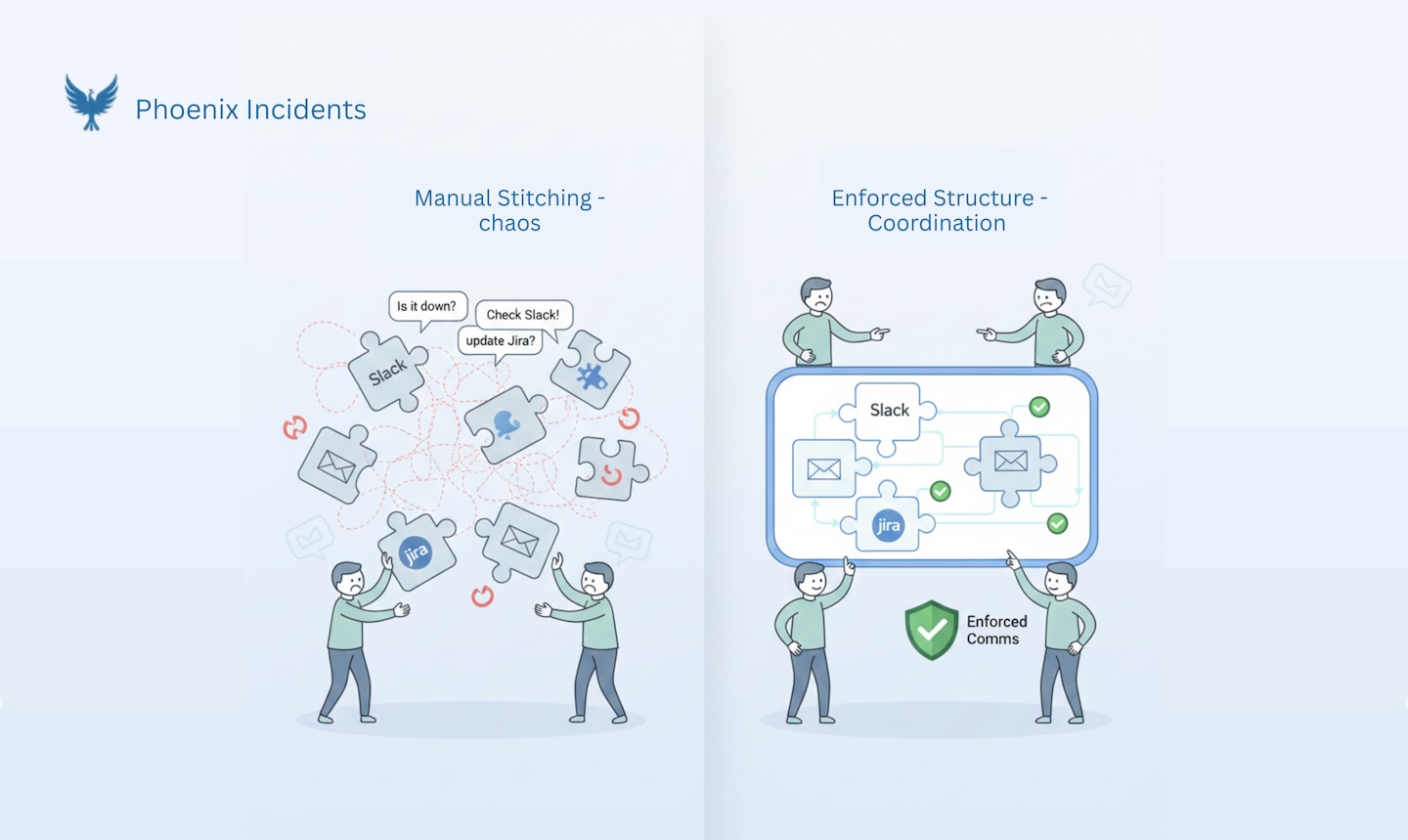
Teams attempt to achieve consistency by manually stitching together Slack messages, Jira comments, and copied formats from previous incidents. While the intent is right, this approach breaks down as incidents escalate. Under pressure, responders forget formats, updates drift between tools, ownership becomes unclear, and timing slips. Even well-designed templates fail when they rely on memory and discipline alone. This is why teams often feel they "have a template" but still experience communication chaos during real major incidents.
A good template, therefore, isn’t just something that exists. It’s something that’s enforced as part of the incident response itself.
Operationalizing Incident Communication in Jira and Slack
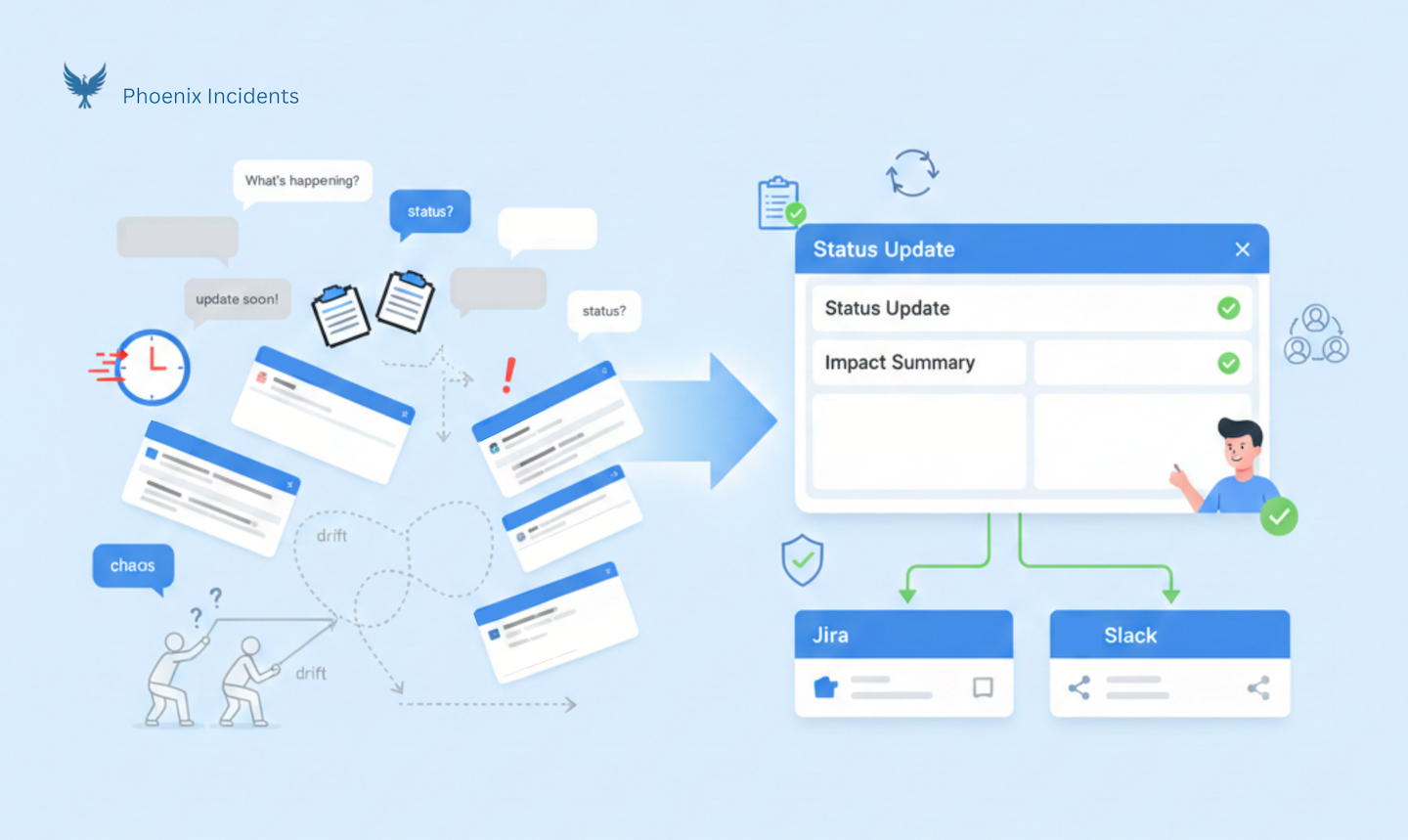
For communication templates to work during major incidents, they must be embedded directly into the response workflow. Phoenix Incidents is built around this principle, because Phoenix Incidents lives inside Jira and Slack, it:
- Guides responders through a clear incident process from creation to resolution.
- Coordinates communication in shared and incident-specific Slack channels.
- Keeps Jira, Slack, and paging integrations in sync.
- Uses SLA-based reminders to prompt timely updates.
Communication isn’t an extra task; it’s part of the flow of handling the incident.
Setting Up Better Post-Incident Reviews Through Clear Communication
If your comms are a mess during the incident, your PIR will be a disaster after it. You’ll spend hours doing 'manual archaeology'—scrolling through Slack timestamps trying to figure out who decided what and when. That’s more wasted engineering salary on paperwork that should have been automated. When updates are structured and consistent:
- Timelines are easier to reconstruct.
- Decisions are easier to understand.
- Post Incident Reviews (PIRs) become more effective.
Phoenix Incidents guides teams through a structured PIR process, helping turn incident communication into learning without adding heavy process overhead.
The Bottom Line
A major incident communication template isn't about writing better prose; it’s about creating clarity when it matters most. But a template buried in a Confluence page is just "shelfware"—it doesn't exist during a crisis because no one has the headspace to go find it.
The teams that handle major incidents best don’t wing it, and they don’t rely on memory. They standardize their communication and embed it directly into the tools where the work is happening.
Don’t let "good intentions" be your communication strategy. Use Phoenix Incidents to operationalize your templates directly inside Jira and Slack, ensuring your engineers can focus on the fix while the system handles the updates.