Incident Fatigue in Engineers: What It Is, What Causes It, and How to Fix It

It's 4:07 AM and somewhere on your engineering team, a phone is vibrating. The Slack channel is spiraling with five people asking if this is actually an incident.
And someone has lost sleep due to the mental load of deciding when to escalate, who to pull in, and whether they'll be judged for raising the alarm too early or too late. You won't see any of that in tomorrow's incident report. What you'll see is MTTR and whether SLAs were breached.
What you won't see is the slow accumulation of stress that made your engineer hesitate before responding, or the fact that this is the fourth time this month they've been woken up for a variant of the same problem.
That's the nature of incident fatigue. It shows up in quieter postmortems, slower responses, and eventually, resignation letters. By the time it's visible, it's already been building for months.
But the good news: there are early warning signs. This post covers what to look for, what's causing it, and how to fix incident fatigue before it breaks your team.
DON’T MISS THIS: We created A Free Guide On How You Can Build Incident Management Inside Jira.
What Is Incident Fatigue? (And How It Differs from Alert Fatigue)
| Alert Fatigue | Incident Fatigue | ||||
|---|---|---|---|---|---|
| Root cause | Too much noise from alerting systems | Repeated incidents with no visible improvement | |||
| What breaks | Engineer trust in alerts | Engineer belief that the work leads anywhere | |||
| How it shows up | Alerts ignored or dismissed | Slower responses, quieter postmortems, disengagement | |||
| Where to look | Your tooling and thresholds | Your process, culture, and feedback loops | |||
| How to fix it | Alert hygiene, AI grouping, and noise reduction | PIR follow-through, psychological safety, and blameless postmortems |
If your engineers are ignoring alerts, that's alert fatigue, but if your engineers are responding to alerts but doing it slower, with less urgency, going quieter in postmortems, and losing faith that any of it will lead to improvement, that's incident fatigue. And it's a much harder problem to fix.
1. Alert fatigue: happens when alerting systems generate more notifications than humans can meaningfully process.
Too many alerts and engineers become desensitised, not because they don't care, but because their experience has taught them that most pages don't need urgency.
2. Incident fatigue: is what happens when the incidents themselves become the problem.
When the same outage recurs for the third time. When post-incident action items get written down and then quietly deprioritised.
When engineers stop postmortem reviews because nobody believes it will change anything. This slow accumulation of futility is what breaks people. The reason this distinction matters is that the diagnosis and the fix are in different directions.
Alert fatigue points you toward your tooling: thresholds, grouping, correlation engines, while incident fatigue points you toward your process and culture: how action items are tracked, whether psychological safety exists, and whether postmortems actually lead to change.
Treating one when you have the other wastes time and leaves the real problem untouched.
Why Incident Fatigue Is Hard to See Until It's Too Late
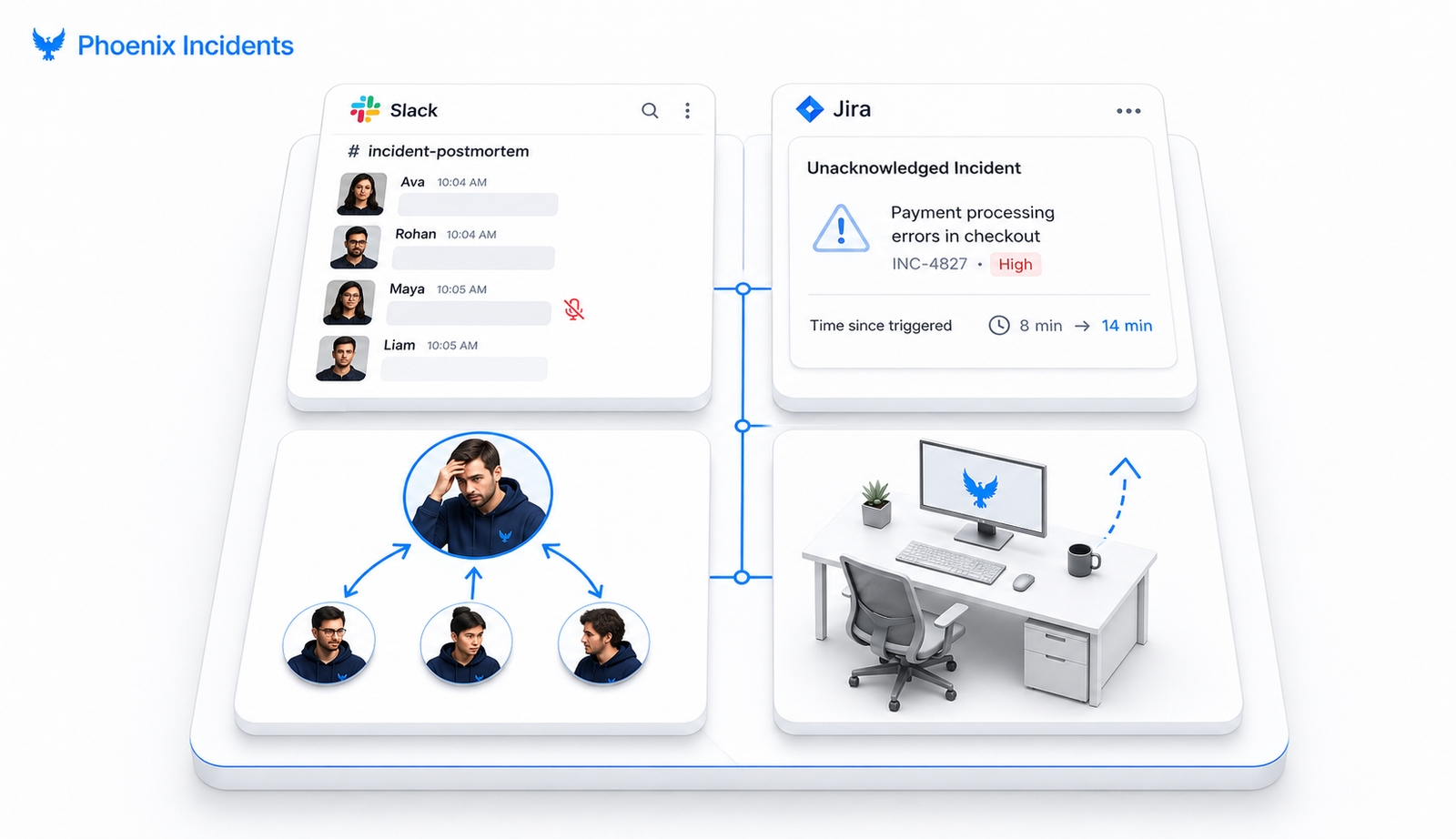
The reason incident fatigue catches most organisations off guard is that none of its early signs look like a reliability problem.
They look like a people problem.
- Engineers who were once vocal in postmortems go quiet and it reads as personality.
- Response times creep up by a few minutes and it looks like everyone’s busy.
- Senior engineers find themselves pulled into every escalation and it gets written off as "that's just how it works here."
Leadership is then surprised when engineers hand in their notice.
They're tracking MTTR, monitoring SLA breaches, and reviewing incident volume. When they should be tracking the slow behavioural shift happening in their teams.
By the time the pattern becomes undeniable, it's already been building for months. And the damage to team morale, institutional knowledge, and system reliability, has been compounding the entire time.
How To Detect Incident Fatigue
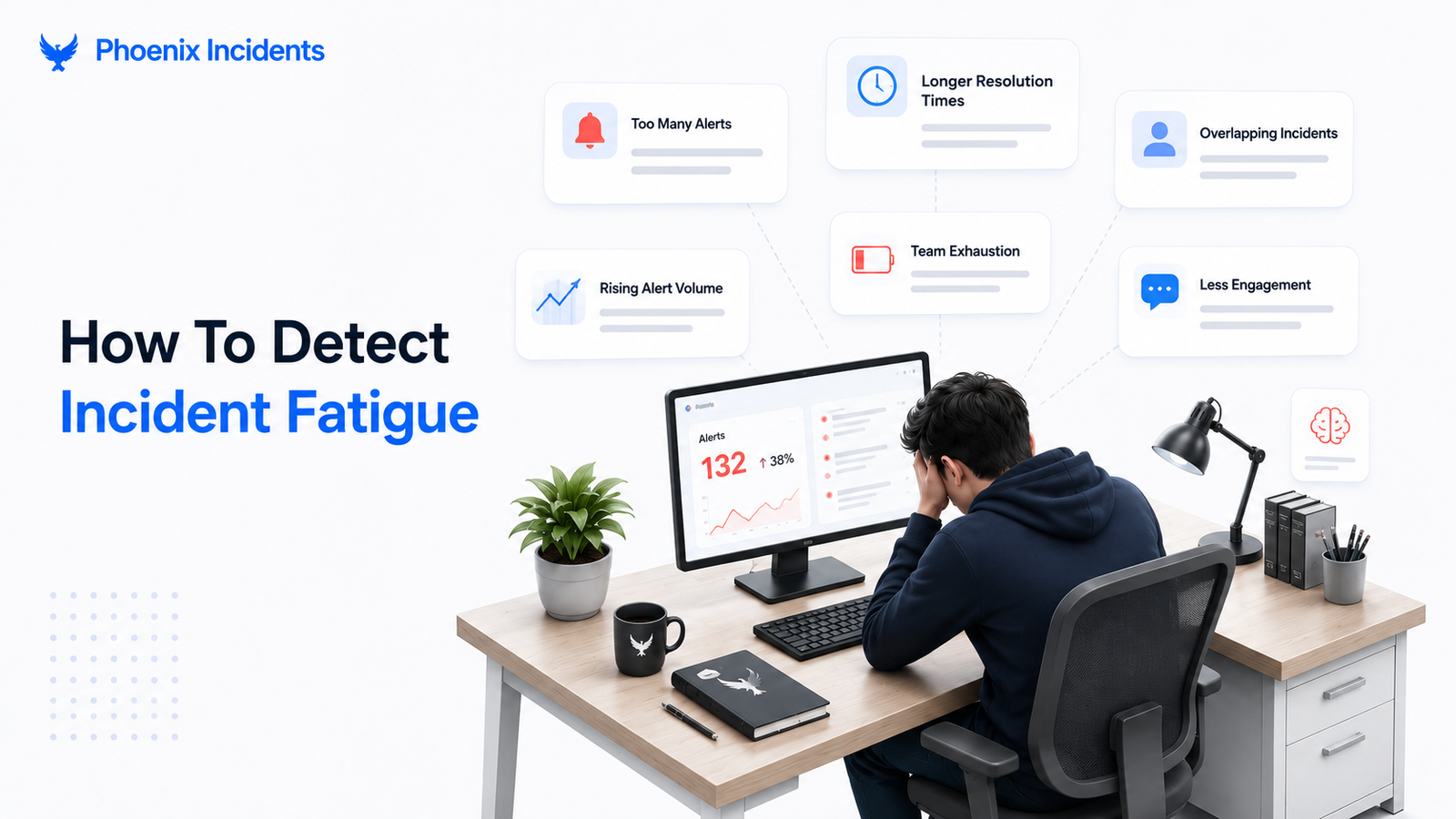
1. Engineers Go Quiet in Postmortems
Postmortems are often where incident fatigue becomes visible first. Reviews that once generated honest, detailed discussions turn into routine exercises where engineers simply fill out templates and assign action items.
This behavior isn't driven by disinterest. It's often a sign that team members no longer feel comfortable expressing their thoughts openly. Instead, they withdraw as a form of psychological safety, which research from Google's Project Aristotle identified as the most important factor in high-performing teams.
Phoenix Incidents builds guided post-incident reviews directly into the workflow, helping teams turn postmortems into meaningful learning opportunities rather than administrative tasks.
2. Acknowledgment Times Slow Down
MTTA (Mean Time to Acknowledge) measures how quickly an engineer responds to an alert after it fires.
In healthy teams, response times remain tight because engineers trust that alerts are meaningful and that incidents will be resolved and learned from. In fatigued teams, acknowledgment times begin to stretch. Experience teaches engineers that many alerts don't require immediate action, and over time hesitation becomes a habit.
Eventually, post-incident reviews lose their value because the same incidents keep recurring while the underlying problems remain unresolved. That's incident fatigue in action.
3. Senior Engineers Become the Permanent Escalation Point
Junior engineers escalating to senior engineers is normal. What isn't normal is when senior engineers become the default destination for every incident because junior team members never gain the confidence or support needed to resolve issues independently.
Over time, the most experienced engineers absorb a disproportionate share of the incident load, carrying both their own on-call responsibilities and everyone else's. Dasroot reports that this kind of "hero culture" contributed to 68% of senior engineers reporting clinical burnout symptoms in 2025.
4. Engineers Start Leaving
Experienced engineers rarely announce that incident fatigue is pushing them toward the door. More often, they adapt for a while, watch action items get deprioritized, conclude that nothing is going to change, and quietly move on.
The cost of replacing experienced DevOps and SRE talent is high. Hiring takes time, onboarding takes effort, and valuable institutional knowledge walks out the door.
New hires then inherit fragile systems and incomplete context, which often increases incident volume and operational risk in the short term. The cycle continues unless the underlying causes of incident fatigue are addressed.
What Causes Incident Fatigue?
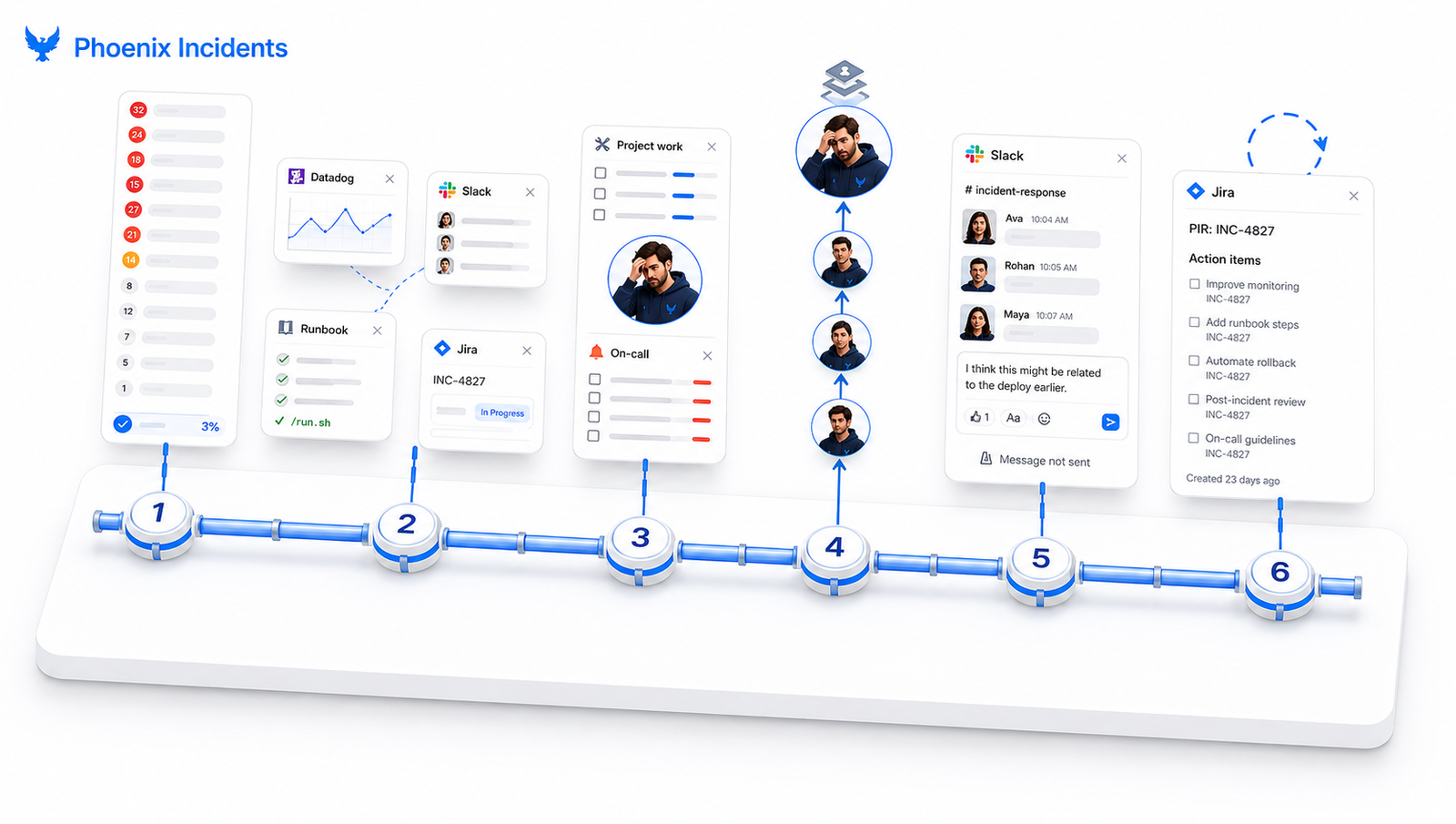
Incident fatigue rarely has a single root cause. It builds from several compounding failures happening simultaneously. Which is also why fixing just one of them rarely produces lasting improvement.
1. Alert noise, false positives, and poorly tuned thresholds
When alerting systems fire too often and too indiscriminately, engineers learn to treat pages as background noise. Research from incident.io shows teams receive more than 2,000 alerts per week, with only 3% requiring immediate action. At that ratio, desensitization becomes a rational response to a broken system.
2. Integration sprawl and context switching during incidents
A study reported by Business Wire found that 83% of engineering teams navigate four or more tools during a live incident. Every switch between a monitoring platform, Slack, a runbook, and a ticketing system adds mental load. Over time, that constant context switching compounds into stress and exhaustion.
3. No separation between on-call and project work
Google's SRE model recommends reserving at least 50% of engineering time for project work rather than firefighting. When on-call responsibilities bleed into sprint goals and delivery timelines, engineers feel perpetually behind, even when they're performing well. Recovery time disappears and the workload never truly eases.
4. Junior engineers escalate everything to senior engineers
When junior engineers aren't given the support and confidence to resolve incidents independently, every escalation lands on a senior engineer. Seniors solve the immediate problem, but the underlying readiness gap remains. With 67% of SREs reporting they don't have enough time for technical training, junior engineers stay underprepared while senior engineers remain overloaded.
5. Absence of psychological safety
When escalation carries social risk, whether it's fear of raising a false alarm or being blamed for an incident, engineers hesitate to speak up. They send private messages instead of declaring incidents publicly and try to solve problems alone before involving others.
Small issues can become major incidents because the perceived cost of speaking up feels higher than the cost of staying silent. According to Hyperping, teams with high psychological safety are 47% more likely to engage in process improvements and 64% more likely to report near misses. The absence of psychological safety doesn't just affect morale, it increases incident volume and severity.
6. PIR action items that never get completed
Post-incident reviews identify root causes and generate action items. Then those action items get deprioritized, buried in backlogs, and forgotten until the same incident happens again. When engineers repeatedly see known issues resurface despite being flagged months earlier, they stop believing the process leads to meaningful change.
That loss of confidence is where incident fatigue takes root.
Phoenix Incidents addresses this directly by keeping action items linked to the incident inside Jira until they're completed. Instead of disappearing into a document nobody revisits, they become part of the team's normal workflow.
The Cost of Incident Fatigue: Beyond Downtime
1. The financial cost of downtime is just the beginning:
According to Mev, over 90% of mid-size and large enterprises say one hour of IT downtime costs more than $300,000, and 41% put it between $1 million and $5 million per hour. But those numbers assume the team is responding at full capacity; with urgency, focus, and a clear process. But with a team experiencing incident fatigue, a full capacity is not exactly possible.
And according to a Medium article written by Michal Bojko, Director of R&D at Dynatrace, industry benchmarks show median MTTR ranging from 22 minutes for highly automated teams to over 4 hours for manually-operated systems. Which shows that, when your engineers are desensitised, hesitating, or burned out, your organisation sits much closer to the four-hour end of that range, and pays for it.
2. Engineering capacity is being quietly consumed:
Incident management is supposed to be part of engineering work, not the entirety of it. And with metrics from Swarmia stating that the reality is that many teams spend 40–50% of their time on maintenance and unplanned work — time that isn't building products, closing technical debt, or improving the systems.
Runframe also stated that operational toil rose to 30% in 2025, the first increase in five years, and 78% of developers spend at least 30% of their time on manual toil. That means, when incident load consumes that much engineering bandwidth, fatigue has turned into a capacity crisis with a direct line to missed roadmap commitments and compounding technical debt.
3. Losing experienced engineers is a compounding cost:
Engineering retention rates have declined sharply, driven by systemic organisational failures. And this creates significant technical debt and operational instability because important company knowledge leaves with departing staff.
And with senior DevOps or SRE engineer commanding between $145,000 and $195,000 in annual salary, think about the full cost of replacing one. Including recruiting, onboarding, and the ramp-up period where incident load typically increases, that cost already exceeds the annual salary itself.
New hires will then inherit that fragile system and incomplete context causing the incident load to further increase while they find their footing.
4. When psychological safety breaks down, postmortem culture collapses with it:
BETSOL stated that organisations with mature postmortem cultures experience 50% fewer repeat incidents and recover 43% faster from outages. But that only holds when engineers trust the process enough to engage with it honestly.
And when psychological safety isn’t prioritized, PIRs lack results.
- Root causes get documented but not fixed.
- The same incidents recur.
- The team absorbs the cost of that repetition on top of everything else they're already carrying.
The cruel irony is that incident fatigue doesn't just cost money, it degrades the people and processes you need most to recover from it.
Try It For Free: Install Phoenix Incidents For Jira
How to Measure and Track Incident Fatigue in Your Team
Most organisations discover incident fatigue the hard way: through a resignation letter or a missed P1. But the signals appear much earlier.
These are 5 metrics to start tracking incident fatigue, and what the numbers actually mean:
| Metric | What to measure | Healthy range | Fatigue signal | |||
|---|---|---|---|---|---|---|
| Alert-to-actionable ratio | Percentage of alerts that result in a meaningful action | Incident.io states that healthy systems achieve 30–50% actionable alerts | Below 10% actionable alerts and engineers are swimming in noise and learning to ignore it | |||
| MTTR trend over time | Whether resolution time is stable, improving, or creeping upward | Stable or declining over rolling 90 days | Consistently rising MTTR is one of the earliest measurable signs that urgency is fading | |||
| Escalation rate (junior → senior) | Percentage of incidents that junior engineers escalate rather than resolve independently | Declining over time as juniors build readiness | A flat or rising rate means seniors are absorbing escalations indefinitely - 40% of SREs already handle more than 5 incidents per month, and unmanaged escalation load accelerates burnout | |||
| Postmortem action item completion rate | Percentage of PIR action items completed within their assigned sprint or deadline | Above 80% of PIR completion rate | As the engineering blog Dev Journal puts it, the majority of teams complete less than 40% of postmortem action items. | |||
| On-call shift density per engineer | Number of actionable incidents per engineer per shift | Google's SRE Workbook recommends a maximum of 2 actionable incidents per 12-hour on-call shift | Above 5 incidents per shift consistently, means your engineers are not recovering between incidents, and the load is compounding | |||
| Repeat incident rate | The percentage of incidents that share a root cause with a previous incident in the last 12 months. | According to KPI Depot benchmarks, ideal repeat incident rate targets typically fall below 5%, signaling a robust operational framework. | As incident.io says, if your repeat incident rate is above 30%, your postmortems are producing documentation, not learning. |
These metrics reviewed together on a monthly basis, tell you exactly where your team is on the spectrum before someone hands in their notice.
How to Stop Incident Fatigue (Tooling + Culture + Process)
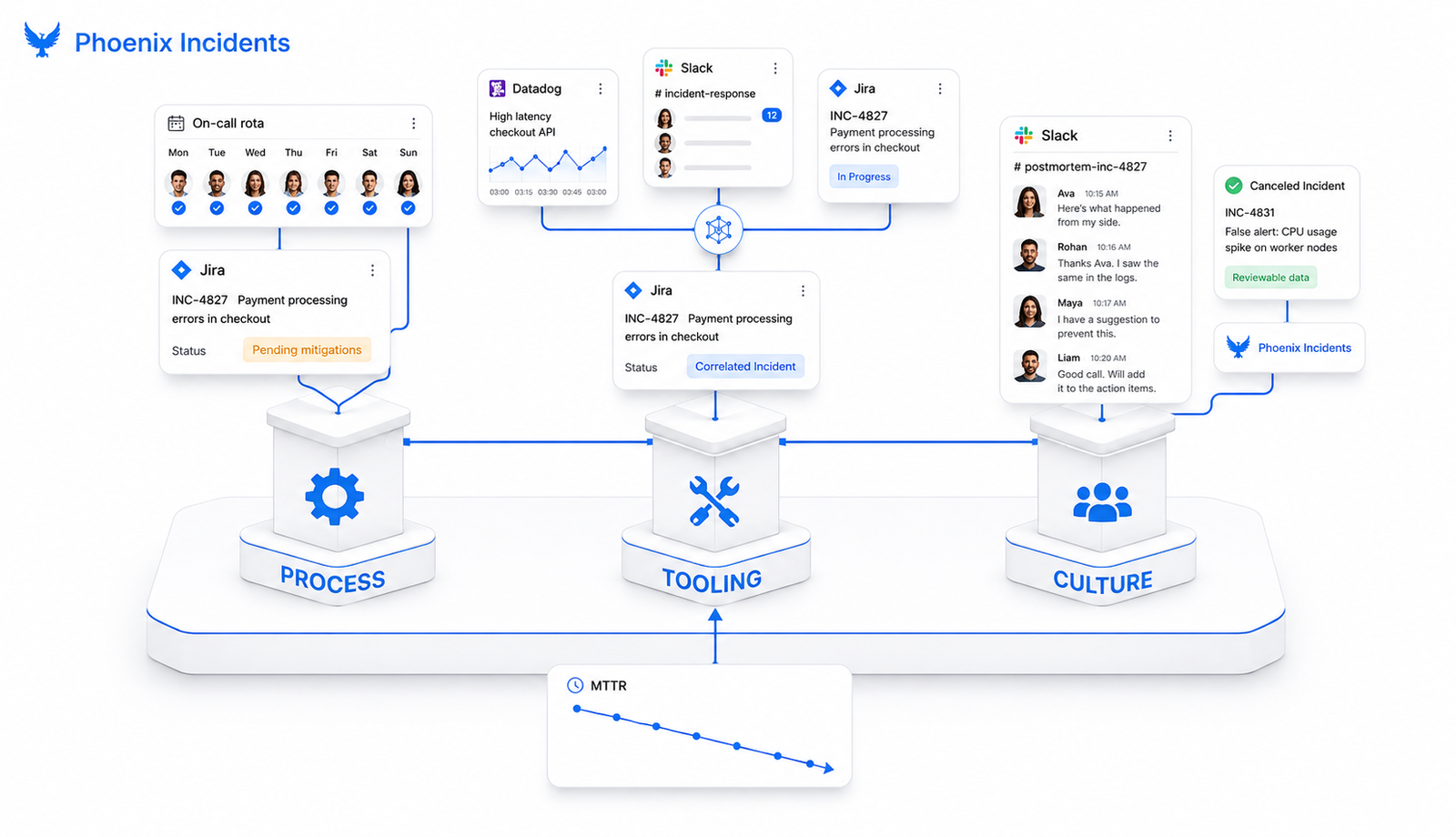
There is no single fix for incident fatigue. It builds from compounding failures across process, tooling, and culture which means lasting recovery requires addressing all three together.
Fixing alert noise without fixing postmortem culture means the same incidents keep recurring. And building psychological safety without fixing on-call rotations means engineers feel safe but still exhausted.
Below is how you fix the culture, tooling and process:
Process
| Fix | Why It Works | |||
|---|---|---|---|---|
| Right-size on-call rotations | Datadog recommends rotations of six to eight engineers so that each serves on-call duty no more than once per month. | |||
| Enforce separation between on-call and project work | Google's SRE model reserves at least 50% of engineering time for project work, with no more than 25% spent on-call. | |||
| Follow-the-sun scheduling | DevOps recognized that for teams distributed across three or more time zones, follow-the-sun scheduling can reduce on-call duration per engineer by as much as 67% because no one works overnight. | |||
| Keep incidents in pending mitigation until all PIR action items are completed | This design choice sends a clear signal that learning is part of the response. And when action items must be closed before an incident is marked resolved, they stop becoming deprioritised. |
Tooling
| Fix | Why It Works | |||
|---|---|---|---|---|
| AI-powered alert grouping and correlation | According to findings from Openobserve, intelligent grouping cuts alert volume by 80–90% by consolidating related events into single incidents. | |||
During an incident, cognitive load can be the enemy, but when there is a clear repeatable workflow your team is used to, decision-making will no longer stress engineers out. The workflow explains how to declare an incident, who commands, where communication happens, and how updates flow, which removes friction when you can least afford it.
3. Enforce Follow-Through on Action Items
Nothing fuels cynicism faster than repeated incidents caused by known issues. After every incident is resolved, if action items aren't tracked, enforced, and actually completed, teams learn that post-incident reviews don't matter. Try leaving incidents in a pending mitigation state until all action items are done. This sends the signal: learning is part of the response, not optional cleanup work.
4. Give Teams Visibility and Recognition
Incident work is invisible until something breaks, and executive reporting on MTTA, MTTR, and incident volume helps leadership see the real operational load teams are carrying. It creates space to recognize effort, not just uptime. People hold up better when they feel seen.
How Phoenix Incidents Help Reduce Incident Fatigue
Phoenix Incidents lowers the cost of handling incidents by ensuring post-incident action items don’t get forgotten, so the same outage don’t reoccur. Phoenix Incidents meets Jira-native engineers where they already work, so they have no need to learn a new tool. Incidents are human-initiated, intentional, and structured from the start.
- It creates dedicated Slack channels to centralize real-time collaboration and communication, Jira handles durable tracking, ownership, and history, while paging tools like PagerDuty and VictorOps keep doing what they do best.
- It ensures SLA-based reminders remove the need for manual follow-up, and guided post-incident reviews help teams reflect without bureaucracy. Action items stay attached to incidents until they're completely done.
- Most importantly, Phoenix Incidents makes canceled incidents explicit and reviewable. That single design choice reinforces psychological safety, encourages early escalation, and creates a learning loop most teams never build. The system carries the friction, so people don't have to.
Keep This In Mind
- Incident fatigue is a systems failure.
- Constant firefighting lowers morale, retention, and response quality.
- Psychological safety determines whether teams escalate early or wait too long.
- Canceled incidents are a powerful signal when treated intentionally.
- Structured incident management reduces cognitive and emotional load.
Incident fatigue doesn’t show up on dashboards, but it shapes every response. Teams last longer, learn faster, and respond better when the system supports them under stress.
Reducing burnout is not about asking engineers to care less; it is about building incident processes that carry the weight for them.
See how Phoenix Incidents helps teams reduce incident fatigue and build healthier response cultures. Book a demo today, and we will walk you through it.