Why Structured Incident Management Is Foundational to Building Engineering Teams

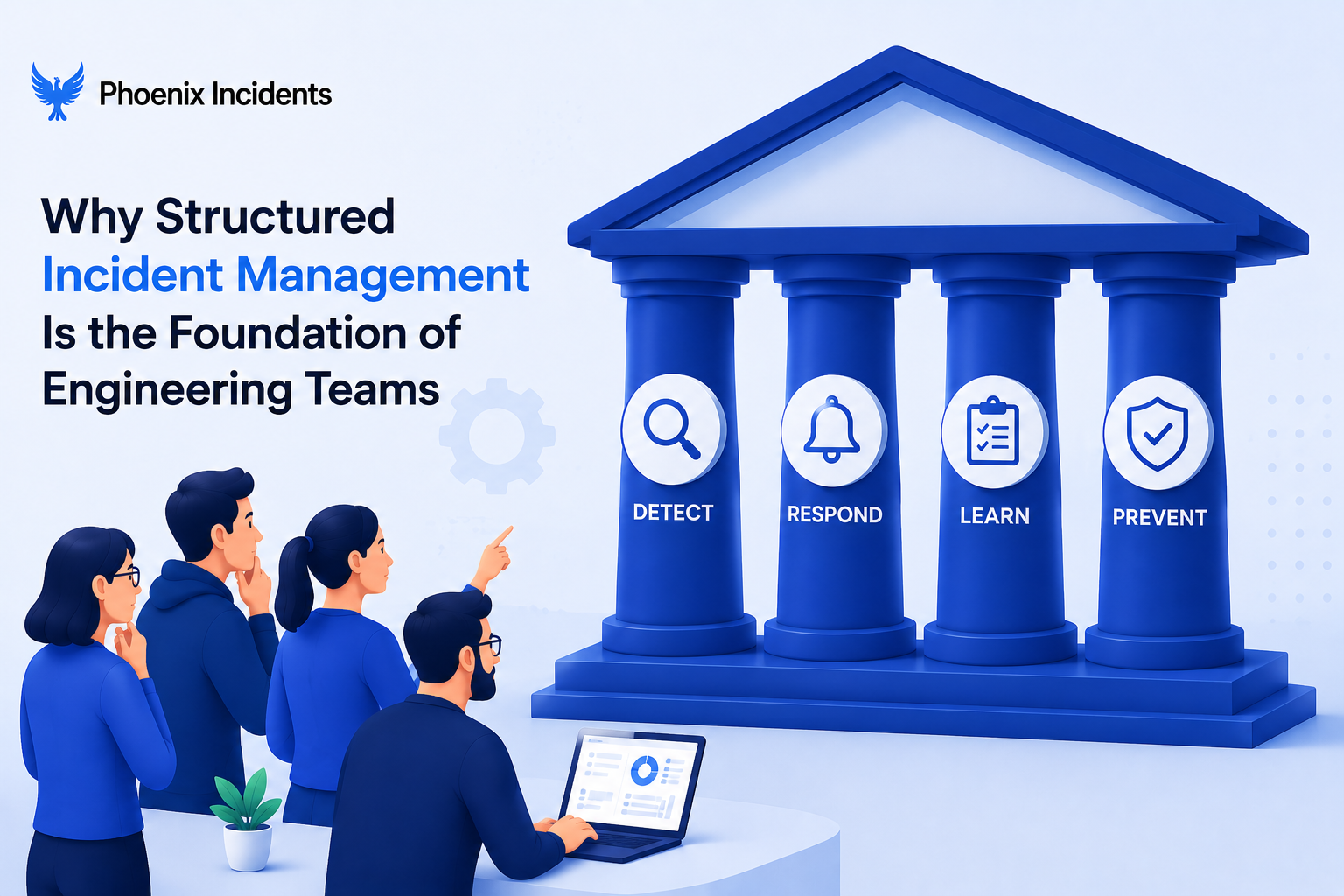
A small engineering team can manage incidents informally. Everybody knows each other, so shared context is high. When something breaks, the right person finds out quickly, fixes it, and moves on. The system works not because the process is good, but because the team is small enough to compensate for the absence of one.
But then the team grows, and new engineers who join don’t have years of context about how the system behaves. Services multiply, more stakeholders need updates and on-call rotations stretch across time zones.
The informal process that worked for five engineers starts to show cracks with fifteen engineers, and totally breaks down at fifty. What looks like a people problem at this stage is almost always a structure problem.
About 65% of engineers reported experiencing burnout in the past year, with on-call stress cited as a major contributing factor that compounds quickly when rotations are poorly designed and there’s no automation to catch the routine problems. That number doesn’t improve on its own. It improves when the structure changes.
Structured incident management is one of the simplest signals of engineering team maturity and one of the most consequential investments a growing team can make.
What is Structured Incident Management?
Structured incident management is a deliberate, enforced way of responding to production incidents so teams don’t have to invent coordination under pressure. The word enforced matters.
A process that exists in a wiki but doesn’t run automatically is not a structured process. It’s documentation that a stressed engineer has to remember to follow at 2am while simultaneously debugging a P1.
Good structure means the right things happen by default: the channel gets created, the Incident Commander is assigned, stakeholder updates go out, and the timeline gets captured, regardless of who’s on call, how experienced they are, or how overwhelming the situation feels.
If your team executes the same manual step twice during an incident, that step should be automated. Eliminating this kind of repetitive manual work is a core SRE principle. The distinction between a process that lives in documentation and one that’s embedded in workflow, is the difference between reliability that scales with the team and reliability that breaks as the team grows.
What Structured Incident Management Is Not
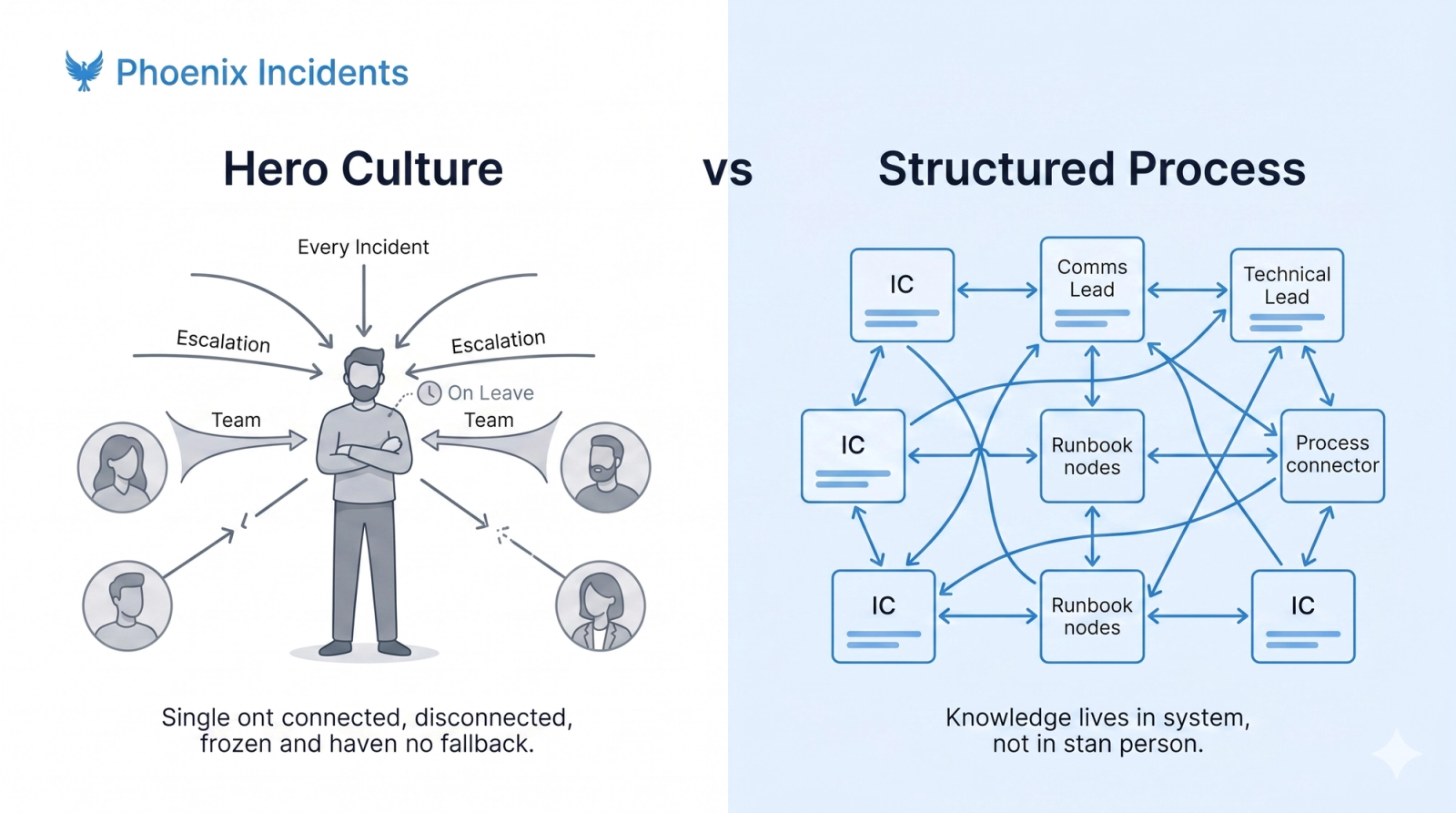
Before getting into the pillars, it’s worth naming the thing that structured incident management is designed to replace: hero culture.
In an IT hero culture, individual accomplishments are celebrated over teamwork. The question to ask is simple: does your organization put personalities over process? When a midsize organization has a cyber-incident, do people email a specific person, or do they email an incident channel? If it’s the former, you have a hero culture problem, and hero culture has a predictable shelf life.
Hero culture glorifies the firefighter personality who rushes in and saves the day, but it ignores the quiet stability created by proactive prevention. Mature organizations shift recognition toward those who design resilient systems and reduce the likelihood of incidents in the first place. The engineer who always saves the day is also the single point of failure for the team that built everything around their individual knowledge.
When they go on holiday, get sick, or leave the company, the informal process leaves with them. Overreliance on IT heroes leads to burnout, high turnover, and a divisive workplace where only a select few are recognized, affecting team dynamics and collaboration across the board.
In a structured team, the system defines the roles. Knowledge is embedded in runbooks and processes, not individuals.
The Maturity Model: Where Does Your Team Sit?
Most engineering teams don’t move from informal to structured overnight. The transition happens in stages, and knowing where your team sits on the maturity curve is the starting point for knowing what to invest in next.
| Stage | Characteristics | Typical On-Call Experience | Primary Gap | |||
|---|---|---|---|---|---|---|
| Ad-hoc | Incidents resolved by whoever notices first; no consistent process or documentation; no learning loop | Chaotic; relies on tribal knowledge; new engineers freeze | No defined roles, no escalation path, no PIR | |||
| Repeatable | Basic process exists, severity levels, some escalation paths, Slack channels, but execution varies by engineer | Inconsistent; varies heavily by who’s on call | Process lives in docs, not in tooling; post-mortems happen sometimes | |||
| Defined | Clear process with assigned roles, defined communication channels, documented runbooks, consistent post-incident reviews | New engineers can go on-call independently within days | Manual enforcement; process breaks under scale | |||
| Managed | Automation enforces the process; MTTA, MTTR, and recurrence tracked and reviewed; action items tracked to completion | Predictable and reliable regardless of who’s on call | Continuous calibration of thresholds and runbooks | |||
| Optimized | Incident management embedded in engineering culture; early escalation is the norm; post-mortems drive architectural decisions | Incidents feel like structured exercises, not emergencies | Ongoing focus on compound improvement from PIR data |
Most engineering teams sit somewhere between Repeatable and Defined. The gap between Defined and Managed is where structured tooling makes the biggest difference because it’s where manual process adherence breaks down under scale.
The 6 Pillars of a Structured Incident Response Process
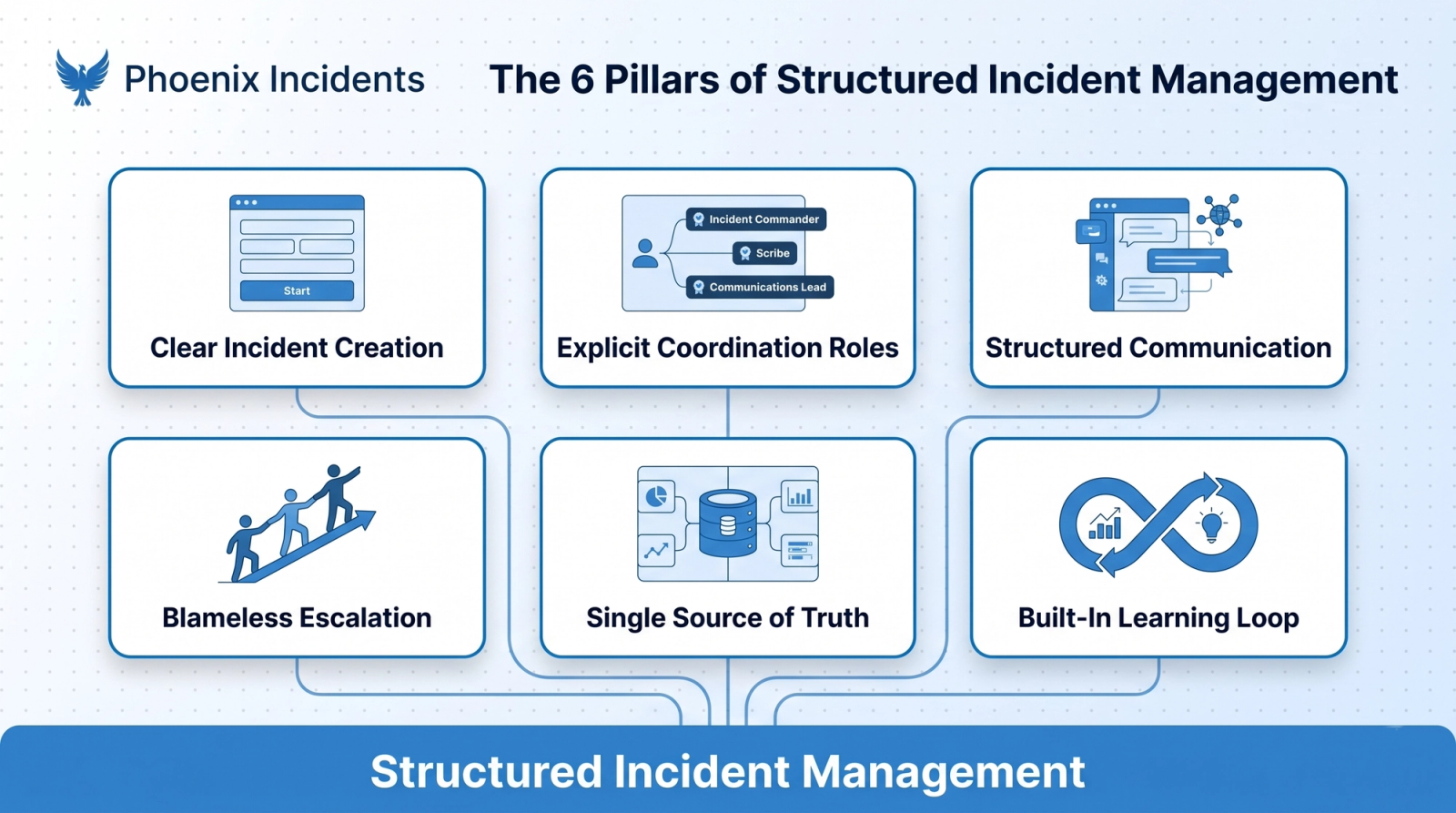
The following characteristics define what structured incident management looks like in practice. When any one of these is missing, teams feel it immediately during high-pressure outages.
1. Clear Incident Creation and Acknowledgment
Raising an incident shouldn’t feel like a social gamble. If an engineer has to wonder ‘will I look stupid if I escalate and I’m wrong?’, they will wait. And waiting is how a minor bug becomes a SEV1. A structured system removes the negotiation from escalation. Engineers don’t ask for permission to raise an incident, they trigger a process. The system captures the moment of acknowledgment. This matters because Mean Time to Acknowledge (MTTA) is often the truest reflection of how quickly a team recognizes reality.
The test that reveals whether your incident management process actually works: a P1 fires at 3am and the on-call engineer joined six months ago. Do they know exactly what to do, or do they freeze? If the answer is ‘they’d probably panic and text a senior engineer,’ your process exists in someone’s head, not in your system.
A structured incident creation process also means normalized escalation and cancellation. Cancelled or downgraded incidents should be treated as expected, healthy outcomes. Engineers who know that being wrong about an escalation carries no penalty will escalate earlier, and earlier escalation means lower MTTR.
2. Explicit Coordination Roles
In an unstructured team, the person who shouts loudest or has the most context becomes the de facto leader by default, usually while also debugging the problem. This means your best engineer is simultaneously trying to fix the system and manage the response, doing both poorly under pressure.
Structured incident management explicitly separates these functions. The Incident Commander (IC) owns the process, not the technical work. They coordinate response activities, manage escalations, keep communication flowing, and ensure documentation stays accurate.
The single most critical rule for ICs is that they do not touch the keyboard. The IC asks sharp questions, sets priorities, delegates tasks, and keeps the timeline moving. The moment the IC starts debugging code or running queries, they lose oversight of the full incident and that’s when things cascade. With explicit coordination roles, your best debugger is actually debugging.
3. Communication That Doesn’t Rely on Memory
In an unstructured incident, stakeholder updates happen when someone remembers to send them. That usually means they happen sporadically, inconsistently, and often not at all when the engineering situation is most intense, which is exactly when leadership and customer-facing teams need them most. Structured incident management handles communication systematically:
A dedicated working channel for responders where all technical discussion is centralized
A separate public status channel that stakeholders across the company can follow without interrupting the response team
SLA-based update reminders that prompt the IC at regular intervals so communication happens on a cadence, not as an afterthought
On-call burnout is exacerbated by messy tooling where responders have to waste time setting up meetings or channels rather than solving the problem. Tools designed around existing workflows, rather than added on top of them, reduce this friction significantly. When communication is structured, stakeholders stop reaching out to on-call engineers for updates, and on-call engineers stop carrying the cognitive burden of keeping everyone informed. For more on this, see the major incident communication template.
4. Early Escalation Without Fear of Blame
Early escalation is one of the most powerful levers for reducing MTTR, and also one of the most culturally difficult to build. Engineers trained in environments where raising a false alarm carries social costs, learn quickly to wait until they’re certain. That delay is often measured in the minutes that matter most.
When escalation is treated as a procedural mechanism rather than a judgment of competence, tension evaporates and collaboration strengthens. This requires two things: a blameless culture and a process that normalizes false positives.
Cancelled incidents should be logged, treated as useful data, and recognized as a sign that the system is working as intended. Google’s SRE research shows the goal of blameless post-mortems is systemic improvement, focusing on what failed in the system or process. An engineer who escalates early and turns out to be wrong should be thanked. That behaviour is exactly what keeps small problems from becoming large ones.
According to DORA research, teams with high psychological safety are 47% more likely to engage in process improvements and 64% more likely to report near-misses. That’s not a soft culture metric, that’s a reliability metric.
5. A Single Source of Truth During the Incident
During an active incident, information needs a home. Without one, context lives in scattered DMs, half-logged Zoom calls, and competing Slack threads, none of which can be reconstructed cleanly after the fact.
For teams running on Jira and Slack, the division is clear: Slack is for real-time coordination; Jira is for the incident record. The system keeps both in sync so engineers aren’t repeating themselves or losing context as the response evolves.
A single source of truth serves two purposes simultaneously. During the incident, it keeps the response team aligned. After the incident, it becomes the foundation for the post-incident review: the timeline, the decision log, the hypothesis record, and the resolution path all in one searchable place.
Teams that maintain a clean source of truth during incidents write better post-mortems, and in a fraction of the time. Post-mortems that previously took three to five days to complete can be closed within 24 hours when the groundwork is laid during the incident itself.
6. A Built-In Learning Loop After Resolution
Incidents don’t end when the system comes back up. That’s when the most important work begins. The post-incident review (PIR) or postmortem is where an incident becomes organizational learning.
A team that resolves incidents but doesn’t learn from them is perpetually reactive, cycling through the same failure patterns and writing the same action items they’ll abandon within a fortnight.
A structured PIR captures: what happened and when, using the incident record rather than reconstructed memory; why it happened, using structured root cause analysis; and what will change as a result, captured as tracked Jira work items with named owners and due dates.
When action items live as Jira issues linked directly to the post-mortem, they enter the team’s normal workflow. They get prioritized, estimated, assigned sprints, and reviewed in stand ups. They don’t disappear. That’s how a post-mortem actually improves reliability rather than just documenting what happened.
How the 6 Pillars Map to Team Outcomes
| Pillar | What Breaks Without It | Measurable Outcome When Present | |||
|---|---|---|---|---|---|
| Clear incident creation | Engineers hesitate to escalate; small issues become major outages | Lower MTTA; earlier escalation; fewer false-alarm-to-P1 conversions | |||
| Explicit coordination roles | Duplication of effort; coordination overhead consumes technical focus | Faster time-to-diagnosis; IC frees engineers to debug | |||
| Structured communication | Stakeholder interruptions disrupt responders; updates arrive late or not at all | Fewer on-call interruptions; better stakeholder trust | |||
| Blameless escalation culture | Engineers wait; delayed escalation extends MTTR | Faster MTTA; higher near-miss reporting; lower incident severity at declaration | |||
| Single source of truth | Post-mortem takes days; context is reconstructed imperfectly from memory | PIR completed in 24 hours; timeline is accurate and complete | |||
| Built-in learning loop | Same incidents recur; action items evaporate after post-mortem | Declining incident recurrence rate; completed PIR action items |
Why This Matters for Engineering Team Building
Hiring is expensive, but losing engineers to burnout or a lack of operational confidence is more expensive, and both are directly affected by how incidents are managed. Research on incident responder burnout found that over half of participants experience burnout, linked specifically to high workload, limited control, poor teamwork, and inadequate recognition.
All four of those factors are directly improved by structured incident management: workload is distributed through clear rotation and automation, control is restored through defined roles and runbooks, teamwork is built through blameless culture and explicit coordination, and recognition comes from a process that attributes outcomes to the team rather than heroic individuals.
When new engineers join a team with mature incident management, they can go on-call confidently and faster. They have runbooks. They know who the IC is. They know where to find past incidents. Teams have cut new-engineer on-call ramp time from two weeks to three days when runbooks are structured, service ownership is clear, and escalation paths are documented in the tooling itself rather than buried in a wiki. See on-call best practices for a detailed breakdown.
Common Objections and What the Data Says
| Objection | Why It Feels True | What the Data Shows | |||
|---|---|---|---|---|---|
| "Our team is too small to need this" | Informal coordination works when everyone knows each other | 65% of engineers report burnout, informal processes compound stress even on small teams. Structure reduces, not adds, cognitive load. | |||
| "We don’t have time to set it up" | Implementing process feels slower than just fixing incidents | One-time setup prevents weeks of recurring MTTR overhead. Teams with structured workflows report setup ROI in under 30 days. | |||
| "Our engineers know what to do" | Experienced engineers can improvise under pressure | Improvisation fails at scale and under stress. Even elite teams benefit from explicit roles and automated enforcement. | |||
| "We already do post-mortems" | Post-mortems are happening | Inconsistent or blame-adjacent PIRs are common. The question isn’t whether post-mortems happen, it’s whether action items get completed. |
How Phoenix Incidents Embeds Structure Into Your Existing Workflow.
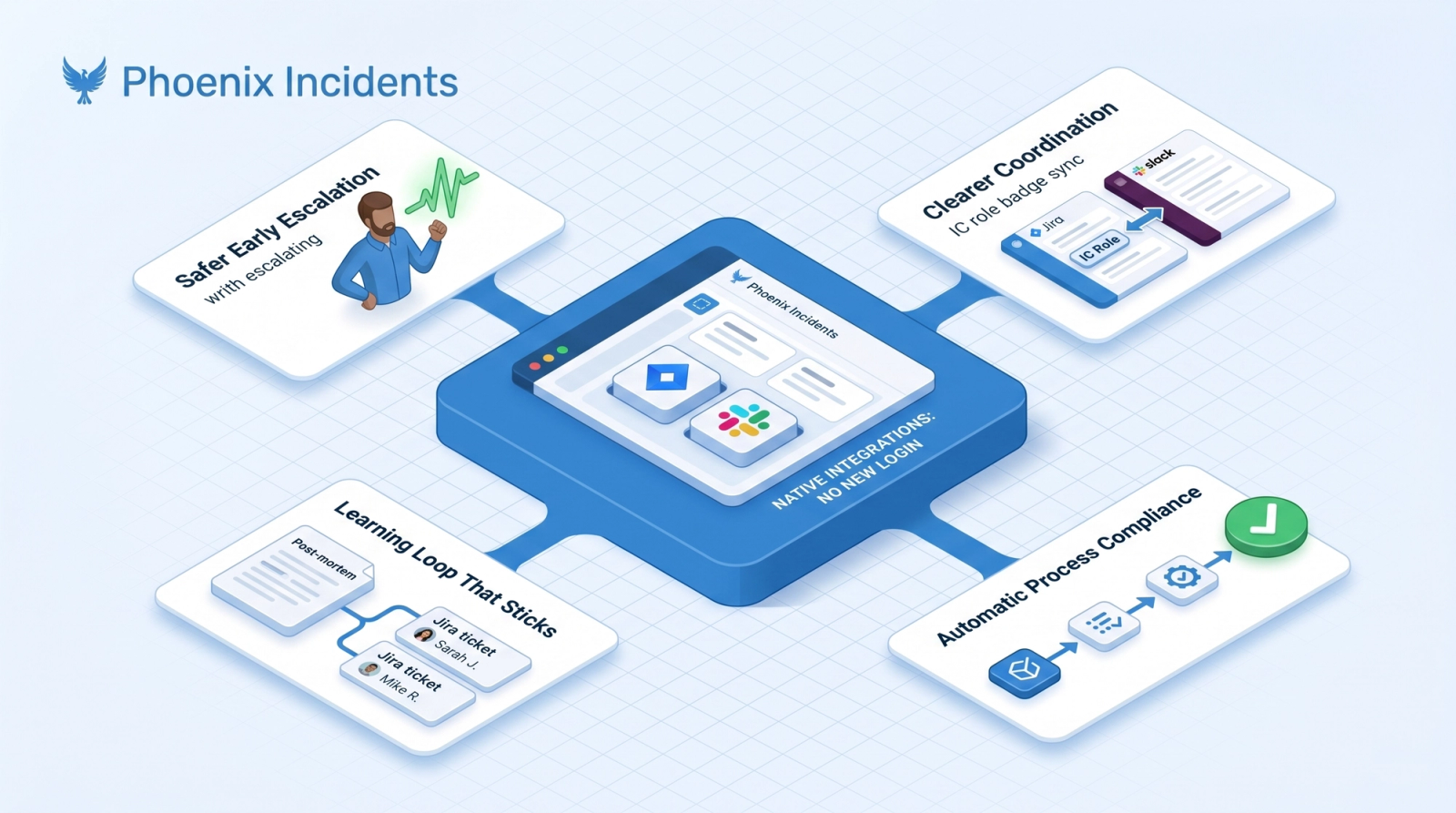
Most incident management platforms ask engineering teams to adopt a new tool. Phoenix Incidents does the opposite. Phoenix Incidents is a truly native Jira incident management platform built to run entirely within the Jira and Slack environment your developers already use.
There’s no new login, and the automation layer sits on top of the tools your team already relies on and enforces the six pillars above by default.
- Making Early Escalation Safer: Engineers can raise incidents early without fear of scrutiny. Phoenix Incidents normalizes false alarms and cancelled incidents as expected outcomes, not failures. Hesitation doesn’t turn small issues into large outages.
- Making Coordination Clearer: Roles, responsibilities, and communication channels are defined and synchronized across Jira, Slack, and paging tools. There’s no duplicated effort, no lost context, and no missed handoffs during active incidents.
- Making the Learning Loop Stick: Post-Incident Reviews are built directly into the workflow with structured Five Whys and AI-supported root cause analysis. Action items become Jira issues with owners and due dates, tracked automatically until they’re resolved.
- Enforcing Process Compliance Without Cognitive Load: Channel creation, IC assignment, stakeholder updates, decision logging, post-mortem scheduling, happen automatically. The process enforces itself.
This is what allows reliability to improve as teams grow; the system works with them, not against them. Building engineering teams isn't just about hiring. It's about creating conditions where people can act decisively without fear, even when things are breaking. Structured incident management is one of those conditions.
Conclusion
Structured incident management is not a luxury; it’s a foundational condition for building engineering teams that are reliable, mature, and resilient under pressure. By embedding coordination, escalation, and learning into the workflow, teams stop relying on heroics and start building repeatable outcomes.
Phoenix Incidents makes this possible for engineering teams in Jira, so teams can escalate safely, coordinate clearly, and turn incidents into durable learning moments.
To see how a structured incident can support your team’s workflow, book a demo to explore how Phoenix Incidents supports reliability and team maturity in your engineering team.
Frequently Asked Questions
1. What is structured incident management?
Structured incident management uses defined processes, roles, and workflows to ensure incidents are handled consistently. It reduces confusion during outages and helps teams respond effectively under pressure.
2. Why does incident management matter as engineering teams grow?
As teams scale, coordination becomes more difficult and knowledge becomes more distributed. A structured incident process keeps response consistent, reduces onboarding time, and prevents reliability from depending on a few experienced engineers.
3. What is hero culture in engineering?
Hero culture happens when incident response relies on a handful of individuals to solve critical problems. While it can work in the short term, it often leads to burnout, knowledge silos, and slower long-term improvement.
4. What is an Incident Commander?
An Incident Commander (IC) is responsible for coordinating the response, managing communications, and making escalation decisions during an incident. By separating coordination from technical troubleshooting, teams can resolve incidents more efficiently.
5. How does Phoenix Incidents differ from other incident management tools?
Unlike many incident management platforms, Phoenix Incidents works directly within Jira and Slack. It adds automation and process enforcement without requiring teams to adopt another standalone tool.
6. What should a good post-incident review include?
A useful post-incident review should document the timeline, identify root causes, and create clear action items with owners and deadlines. The goal is to turn lessons learned into measurable improvements.
7. How do I know if my team has outgrown informal incident management?
Common signs include recurring incidents, rising on-call burnout, slow post-mortems, and heavy reliance on senior engineers during outages. If these problems sound familiar, it's usually time for a more structured approach.