Top 12 SRE Skills in 2026: Essential Competencies for Site Reliability Engineers

Most articles about site reliability engineering read like a shopping list. Learn Kubernetes, pick up Go, memorize the four golden signals, and you are ready. The reality on the ground looks different. The engineers who keep systems online are not the ones who collected the most certifications. They are the ones who stayed calm while revenue was on fire and knew exactly who to pull in, what to check, and how to communicate while they did it.
That gap matters more in 2026. Systems are more distributed, the surface area for failure is wider, and the teams running these platforms are stretched thinner. The skills still count, and we will cover the twelve that matter most. But the engineers who stand out know something their job descriptions never mention: that talent only pays off when the system around it lets that talent move. So let's start with what separates a strong SRE from a competent one.
What Makes a Successful SRE in 2026?
What defines an SRE is simple: instead of doing manual operations work by hand, you write code that removes the work entirely. That one shift is what separates SRE from traditional operations, and it shapes every skill that follows.
For platform and infrastructure managers, the difference shows up in how the team spends its day. A traditional ops team reacts to problems. An SRE team engineers reliability into the system so there is less to react to.
In practice, that comes down to three habits:
- Writing code to remove toil instead of repeating the same fix over and over.
- Owning reliability as a measured outcome, tracked against service level objectives rather than gut feel.
- Treating incidents as data, feeding every outage back into the system through postmortems and follow-up work.
Each skill below is valuable on its own. But the engineers who deliver the most are the ones who connect these skills into a working system instead of collecting them as a pile of competencies. Here are the twelve that matter most in 2026.
The Top 12 SRE Skills in 2026
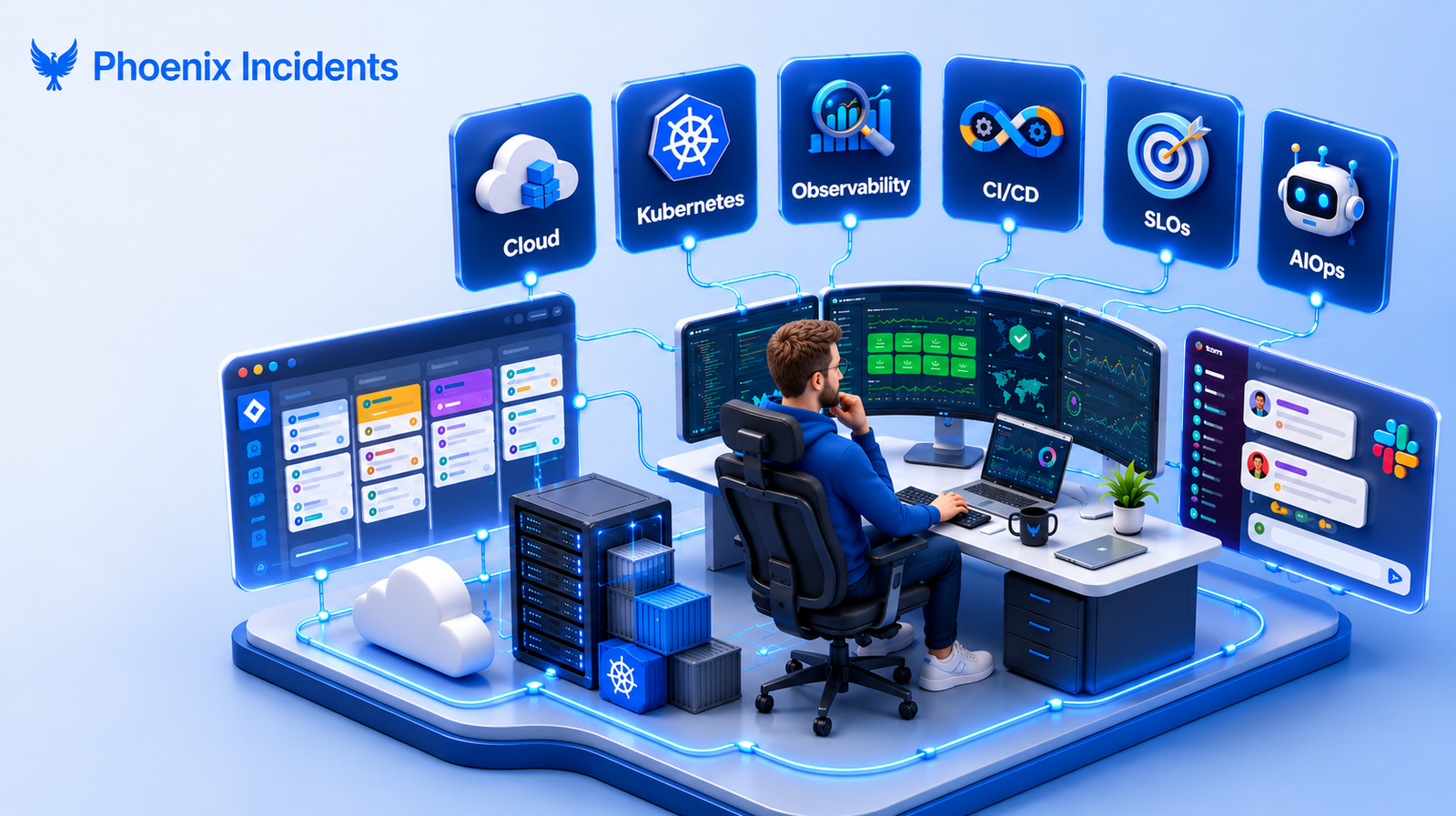
Before we go deep on each one, here is the full list at a glance. If you are auditing your own skills or hiring against this role, this table is the quick reference.
| Skill | Why it matters | Core tools and signals | |
|---|---|---|---|
| 1 | Cloud Platform Expertise | Reliability is built on cloud architecture decisions | AWS, Azure, GCP |
| 2 | Container Orchestration | Kubernetes is the default for scaling workloads | Kubernetes, Docker |
| 3 | Observability and Monitoring | You cannot fix what you cannot see | Prometheus, Grafana, OpenTelemetry, Datadog |
| 4 | Programming and Automation | Code removes toil; manual ops do not scale | Python, Go |
| 5 | CI/CD Pipeline Engineering | Ship fast without breaking reliability | Progressive delivery, fast rollback |
| 6 | Incident Response and Management | Recovery speed defines customer trust | Structured incident command systems and clear comms |
| 7 | Infrastructure as Code | Consistency and disaster recovery at scale | Terraform |
| 8 | SLOs and Error Budgets | Data-driven permission to ship or stop | SLIs, burn-rate alerts |
| 9 | Security and Compliance | Breaches cause outages too | Shift-left security and compliance automation |
| 10 | Communication and Stakeholder Management | Reliability competes for budget | Status updates and executive translation |
| 11 | On-Call and Operational Sustainability | Burnout is a reliability risk | Humane rotations and clear escalation |
| 12 | AI and AIOps | The 2026 differentiator | Anomaly detection and assisted remediation |
1. Cloud Platform Expertise
Cloud infrastructure is the foundation everything else sits on, which makes deep platform knowledge non-negotiable. SREs need real fluency across AWS (Amazon Web Services), Microsoft Azure, and GCP (Google Cloud Platform). The valuable skill is architectural judgment: knowing how to design for failover across availability zones, where the cost traps hide, and which managed service actually fits the reliability target you are chasing. An SRE who can build for scale while making sure one failure does not take down everything else becomes the person every team wants in the room during a migration.
2. Container Orchestration and Kubernetes Mastery
Kubernetes won. It is the standard tool for running containers at scale, which makes it core SRE territory rather than a nice-to-have. Knowing how to deploy an app to Kubernetes is the starting point. The real skill is everything underneath: networking models, resource limits, self-healing behavior, and the rollout and rollback mechanics that decide whether a bad deploy becomes an outage. Engineers who can run clusters that use resources efficiently without putting reliability at risk are solving one of the hardest problems in modern infrastructure.
3. Observability and Monitoring Excellence
You cannot fix what you cannot see, and observability is what turns a black box into a system you can reason about. The discipline rests on three pillars, metrics, logs, and traces, and the modern toolchain to deliver them is well established: Prometheus for metrics, Grafana for dashboards, OpenTelemetry for instrumentation and tracing, and platforms like Datadog when teams want it consolidated. Good observability does not just tell you something broke. It tells you why, and how the pieces interacted on the way down, which is the difference between a thirty-minute incident and a three-hour one.
4. Programming and Automation Proficiency
This is the skill that separates SRE from ops. An SRE's job is to write the code that removes manual work, so fluency in Python or Go is the price of entry. The point is to stop being the human who restarts the service or clears the logs by hand, and start building the system that does it automatically. Manual operations do not scale, and as a platform grows, automation is the only way to hold reliability steady without endlessly growing the team.
5. CI/CD Pipeline Engineering
Continuous integration and deployment (CI/CD) pipelines are how code actually reaches production, which puts them squarely in SRE scope. The challenge is balancing speed against safety. Teams that ship often with few failures outperform the ones that ship often with lots of failures, because shipping fast without safety checks just pushes bugs to users faster. The skill is building pipelines with real automated testing, the ability to release a change to a small group of users before everyone, and fast rollback, so the team gets speed and stability instead of trading one for the other.
6. Incident Response and Management
When something breaks, incident response is what protects customer trust. Strong SREs run incidents with structure: clear roles, a defined incident commander, fast detection, and communication that keeps everyone aligned while the fix is in progress. Incidents are inevitable in any complex system, but what separates high-performing teams is how quickly they detect, coordinate, and recover, which is exactly what a tight grip on MTTR and a repeatable on-call process is built to improve.
7. Infrastructure as Code (IaC)
Infrastructure as code means you define your servers and networks in files, the same way you write application code, instead of setting them up by hand. With a tool like Terraform, your whole setup becomes something you can version-control, test, and recreate on demand. That matters because manual setups slowly fall out of sync.
Two environments that should match end up different, nobody remembers the quick fix someone made at 2 a.m., and recovering from a disaster turns into detective work. IaC keeps every environment consistent and makes rebuilding from scratch a routine task instead of an emergency.
8. SLO Design and Error Budget Management
Service level objectives (SLOs) are the numbers that define what "reliable" actually means for your system. Instead of arguing over whether things are healthy, the team sets a concrete target, like 99.9% of requests succeeding, and measures against it. That target becomes a shared agreement between the developers shipping features and the SREs keeping the system online.
The connected tool is the error budget: the small amount of failure the SLO allows before the team has to stop and fix things. Without it, teams swing between two extremes, over-investing in reliability and stalling the roadmap, or shipping recklessly and causing outages. A well-set SLO tells the team when it is safe to move fast and when it is time to slow down and shore things up.
9. Security and Compliance Integration
Security is no longer a separate team's problem that arrives after the system is built. A breach takes a service down just as hard as an infrastructure failure, and a compliance violation can carry business-ending consequences.
Modern SREs build security into the lifecycle from the start, shifting checks left into the pipeline and automating compliance wherever possible. Folding security and reliability into the same practice protects the organization from technical and regulatory risk at the same time.
10. Communication and Stakeholder Management
Technical skill alone doesn’t get reliability work funded. Reliability projects compete with new features for budget and engineering time, and leadership usually funds the features unless someone explains why the reliability work matters in terms they care about.
That means translating engineer language into business language. "Our error budget is exhausted" means nothing to most executives. "We are one bad week away from an outage our customers will notice" lands immediately. SREs who can explain reliability in terms of business risk, and who work well with other teams, get the support they need to actually do the work.
11. On-Call and Operational Sustainability
On-call is where reliability gets real, and it is also where teams quietly burn out. A rotation that pages people constantly, lacks clear escalation, or treats 3 a.m. heroics as normal does not produce reliable systems.
Sustainable on-call is a genuine skill: designing humane rotations, setting escalation paths that make sense, and protecting engineers from the kind of incident fatigue that drives good people out. It’s a direct reliability risk, because tired engineers make slower, worse decisions during the exact moments that matter most.
12. AI and AIOps
This is the skill that separates a 2026 SRE from a 2023 one. AI is now part of how teams run their systems. It can spot unusual behaviour before a human would, decide which alerts are worth waking someone up for, and even suggest fixes during an incident.
SREs who know how to use these tools well get a real edge: they catch problems faster and cut down on the flood of useless alerts. But the limit matters as much as the capability. AI can point to a problem and propose a fix, but it does not make the final call.
The strongest teams keep a person in charge of the decisions that count, using AI to move faster without handing over judgment. That balance, leaning on automation while keeping people in command, is exactly what gets tested the moment an incident starts.
How SRE Skills Show Up During an Incident
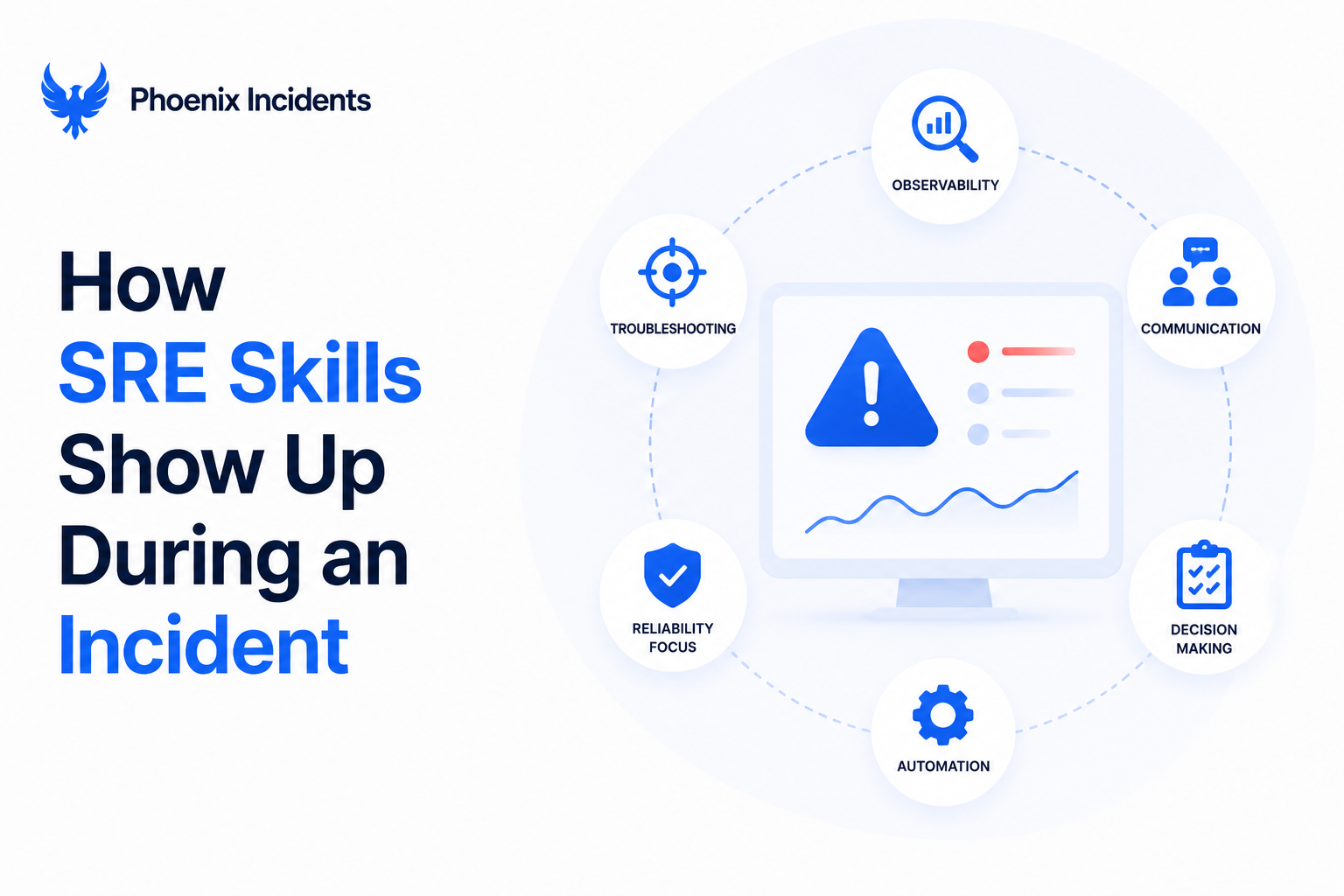
A list of skills stays abstract until something actually breaks. An incident is the moment all twelve get used at once, and you can see immediately whether they connect or collide. Each phase of the response draws on a different set.
Detecting leans on observability and AI. Diagnosing pulls in programming, cloud, and Kubernetes knowledge. Coordinating the response depends on incident management and communication. Recovering safely relies on IaC and CI/CD. And the learning afterward runs on SLOs and postmortems.
| Incident phase | Skills in play | What good looks like |
|---|---|---|
| Detect | Observability, AI/AIOps | The problem surfaces before customers report it |
| Diagnose | Programming, cloud, Kubernetes | Fast root-cause isolation and safe fixes |
| Coordinate | Incident response, communication | Clear roles, stakeholders kept informed |
| Recover | IaC, CI/CD | Safe rollback and controlled restoration |
| Learn | SLOs, postmortems | Action items tracked through to done |
Read down that table and something stands out. Every phase depends on a handoff. Detection has to reach the right person. Diagnosis has to flow into coordination. The fix has to connect back to the follow-up work.
The skills are real, but so are the seams between them, and those seams are where most incidents actually go wrong.
Why Skilled SREs Still Fail: The Coordination Gap
Here is the uncomfortable part. You can hire the most talented SREs on the market and still lose the incident, because most system failures are not really skill failures. They're coordination failures. Picture what actually goes wrong in the room:
- The page goes to the wrong person, and minutes bleed away before the right one sees it.
- Three engineers debug the same thing without realizing the others are on it.
- A critical step gets skipped because everyone assumed someone else owned it.
The talent was in the room the whole time, but the system around it just got in the way.
The data backs this up. In the 2024 DORA State of DevOps report, elite teams recover from failed deployments in less than an hour and hold a change failure rate at or below 5%, yet only about 19% of surveyed teams reached that elite tier. The gap between those teams and everyone else is rarely raw talent, it’s how well the response is organized when something breaks. The difference between a one-hour recovery and a six-hour one is usually coordination, not competence.
For engineering teams specifically, the cost has a name: the context-switching tax. When an incident hits, your engineers live in Jira and Slack. Forcing them to abandon those tools and fight the crisis inside an unfamiliar incident platform adds friction at the exact moment friction is most expensive. Cognitive load is already high, and every tool they have to learn under pressure is attention stolen from the actual problem.
That points to the real fix. Consistency cannot live in individual memory, because memory fails under stress. It has to live in the workflow itself, so the right steps happen automatically whether or not anyone remembers them. That’s the gap Phoenix Incidents was built to close.
How Phoenix Incidents Closes the Coordination Gap
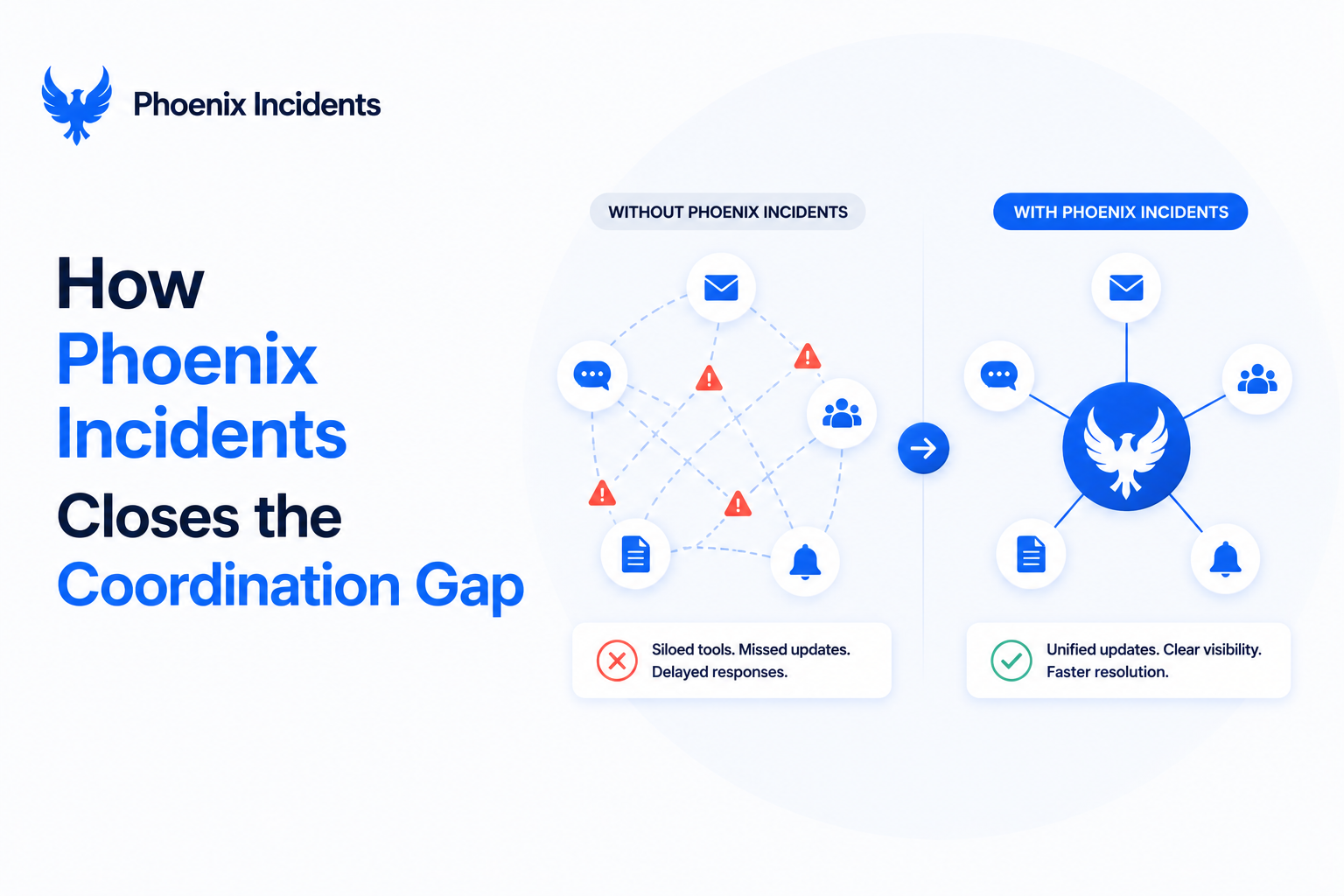
Phoenix Incidents is a Jira-native incident management platform, which means it does not ask your engineers to leave the tools they already work in.
Instead of adding another window to manage during a crisis, it embeds the entire incident lifecycle inside Jira and Slack, so the coordination layer is already there when you need it. Here is how that maps to the failure modes we just walked through.
| Coordination problem | How Phoenix Incidents solves it |
|---|---|
| Tool-switching under pressure | Declare and run incidents directly inside Jira and Slack, with zero context-switching |
| Manual setup steals focus | Roles are assigned, channels are created, and Jira stays in sync automatically |
| Stakeholders left in the dark | Status updates and a full timeline are captured and pushed automatically |
| Postmortems get skipped | Guided root-cause analysis turns the Slack timeline into a factual record, with action items created as native Jira tickets |
| Reliability targets stay invisible | SLA and SLO tracking ties incident impact back to your reliability goals |
| Alert noise creates false incidents | Human-in-the-loop declaration means alerts inform the decision and a person makes the call |
That last row is worth sitting with, because it is a deliberate design choice. Phoenix Incidents does not auto-create incidents from monitoring alerts. Alerts tell you something looks wrong and a human decides whether it is actually an incident.
Paging integrations like PagerDuty and Splunk On-Call still fire when they should, but the declaration stays a human judgment call. That keeps your team from drowning in false alarms while still moving fast when a real incident lands.
Built for Jira-Native Engineering Teams
What makes this work for engineering teams, rather than IT Ops, is where the data lives. When incident history sits alongside your code and sprint planning, reliability becomes part of the development lifecycle instead of a separate reactive task. Postmortem action items land as Jira tickets in your existing backlog, not in a document nobody reopens, so the next sprint can actually act on them.
This is the part most reliability advice misses. You can hire brilliantly and train relentlessly, but if your engineers fight a chaotic process every time something breaks, that talent is wasted. The skills get you ready. The workflow is what lets them land.
Don't Just Hire for Reliability. Build It Into Your Workflow.
Hiring great SREs is necessary, but it is not sufficient. The teams that stay online are the ones that build reliability into how they work, so consistency becomes the default instead of something that depends on whoever happens to be on call.
Phoenix Incidents gives engineering teams that workflow by keeping the entire incident lifecycle inside Jira and Slack, removing the coordination tax that wastes even the strongest engineers.
If you want to see what that looks like in practice.
Frequently Asked Questions
1. What are the most important SRE skills in 2026?
The most important SRE skills include cloud platforms, Kubernetes, observability, programming, automation, CI/CD, incident response, infrastructure as code, SLOs and error budgets, security, communication, and AI. If you're just starting, focus on programming and observability first.
2. What is the difference between SRE and DevOps skills?
DevOps is a broad approach to building and delivering software, while SRE focuses on keeping systems reliable using engineering practices like automation, SLOs, and error budgets. Although the tools are often the same, SRE places greater emphasis on production reliability.
3. Do SREs need to know how to code?
Yes. Programming is a core SRE skill because it helps automate repetitive tasks and improve system reliability. Languages like Python and Go are commonly used.
4. What tools should an SRE learn first?
Start with a cloud platform, Kubernetes, Prometheus, Grafana, Terraform, and a scripting language like Python. More importantly, understand the core concepts behind automation, observability, and infrastructure as code.
5. How do SRE skills help during an incident?
SRE skills help teams detect, diagnose, and resolve incidents quickly. Observability tools identify issues, programming and infrastructure knowledge support troubleshooting, and communication keeps everyone aligned until service is restored.