How to Run Effective Post-Incident Reviews In Jira And Slack

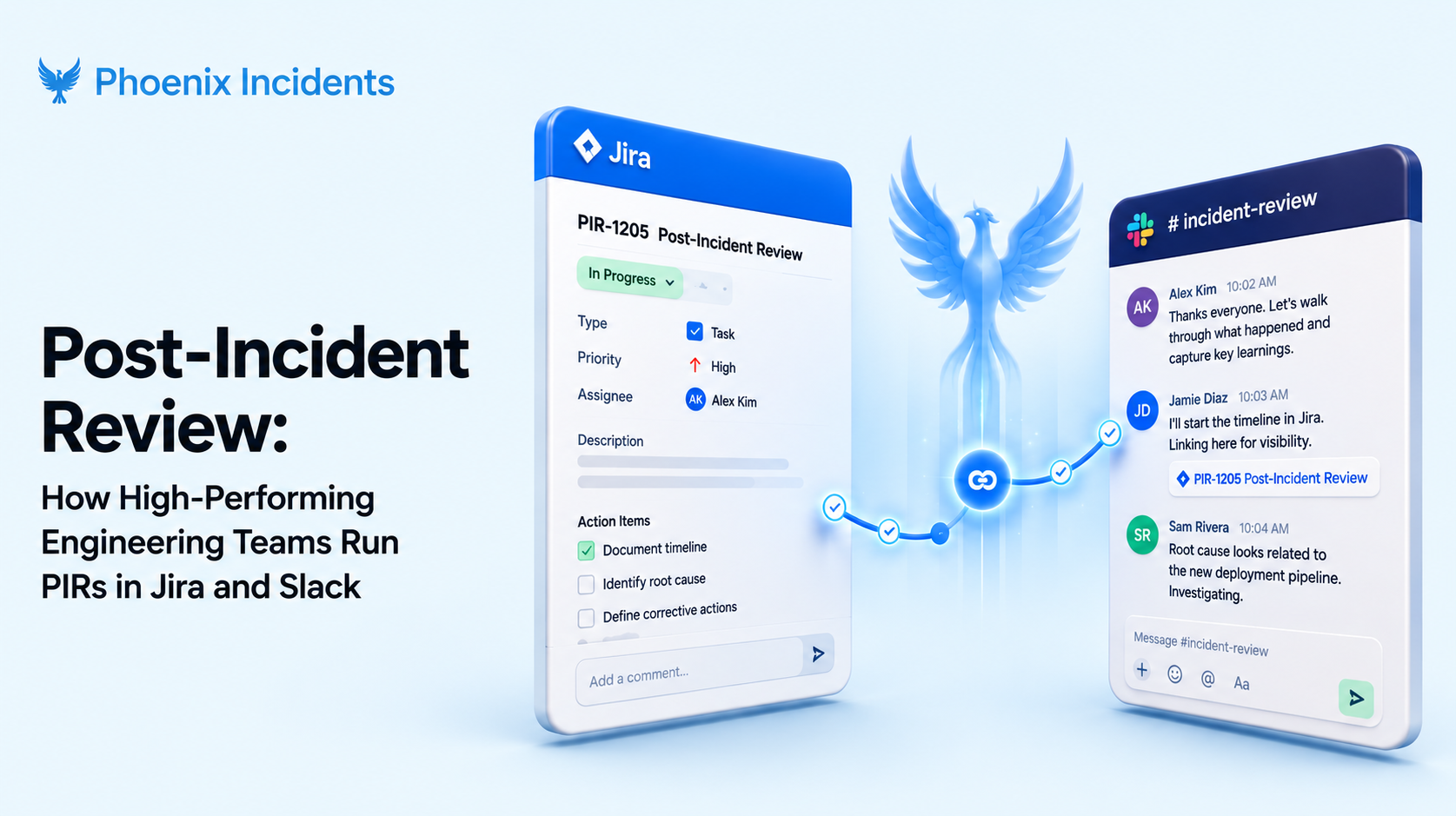
A post-incident review is where an engineering team decides whether an outage becomes a one-off disruption or a problem they keep meeting again. Yet as important as this step is, many teams rush through their reviews, skip them entirely when the sprint is tight, or treat them as a compliance checkbox. Then a few months later, you're responding to a version of the same outage, back in the same Slack channel, asking the same questions.
This guide is for the engineers who would rather not relive their outages, and focuses on the decisions that matter during and after a review, what to examine, what to write down, and what to change. And it does so inside the tools most engineering teams already live in, namely Jira and Slack, without piling on procedural overhead.
What Is a Post-Incident Review (PIR)?
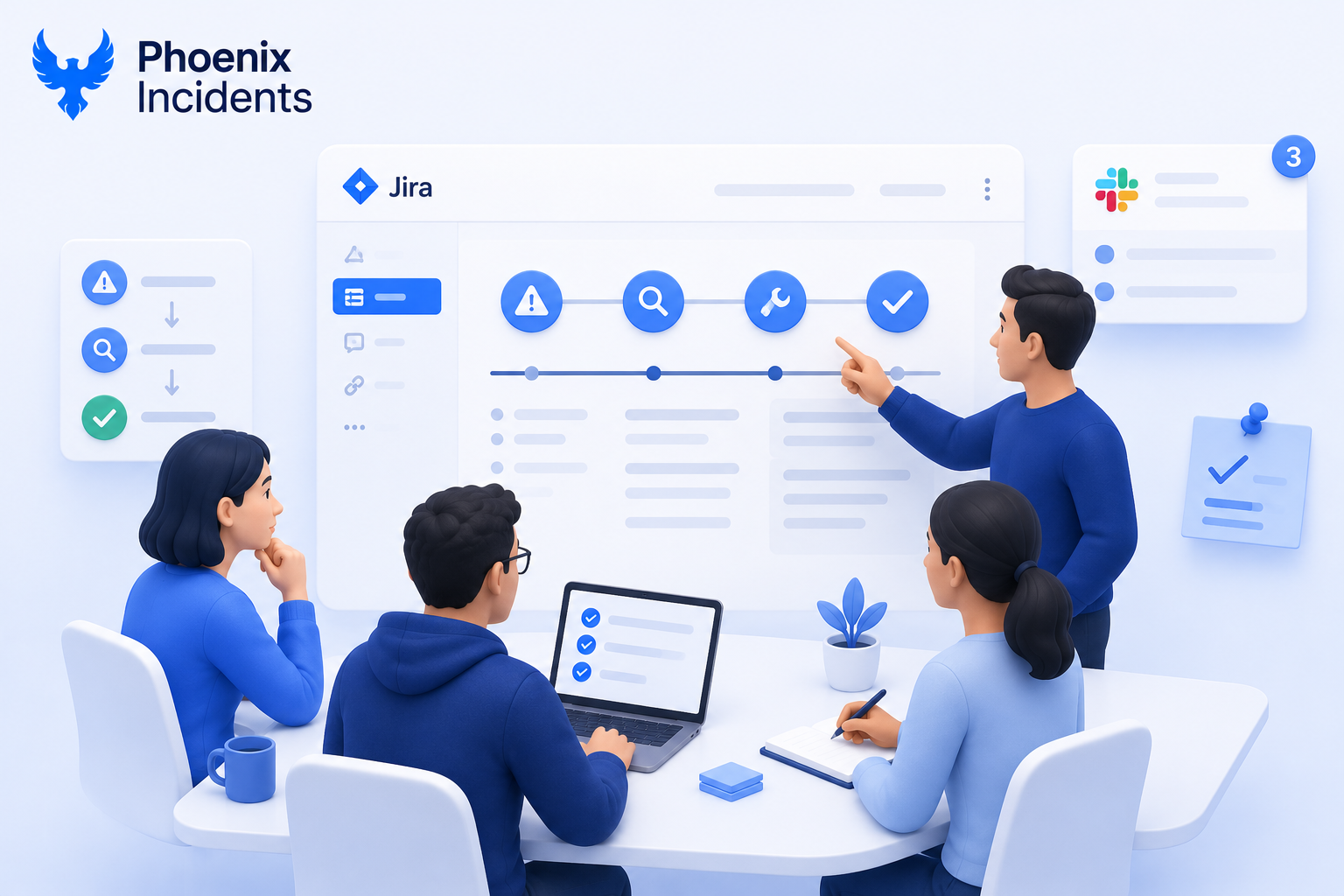
A post-incident review is a structured look at what went wrong during a production incident, carried out after the problem is resolved. Its job is to establish what happened, why it happened, and what should change to lower the risk of it happening again.
The output usually includes:
- A timeline
- An analysis of contributing factors
- And a short list of action items with owners
A good review is not a blame exercise or a document written to satisfy an audit. The strongest reviews balance rigor with empathy and speed. They also go deep enough to surface real systemic problems, stay honest enough that people will actually say what they saw, and finish quickly enough that the details are still fresh and the team still cares.
PIR vs. Postmortem vs. Root Cause Analysis
These terms get used interchangeably, which causes more confusion than it should. They are related but not identical, and knowing the difference helps you scope a review correctly.
| Term | What it refers to | Notes |
|---|---|---|
| Post-incident review (PIR) | The full process after an incident: the analysis, the meeting if there is one, the document, and the follow-up | Increasingly the preferred term in engineering orgs |
| Postmortem | The same thing as a PIR, with roots in SRE and software culture | Some teams avoid the word because it implies something died, which sets a grim tone before anyone has spoken |
| Root cause analysis (RCA) | A technique used inside a review, not a replacement for it | Narrowly focused on identifying underlying causes; a review is broader |
| Retrospective / after-action review | Alternative names for the same practice | Vary by industry and team culture |
The practical takeaway is that a review is the tool box, and root cause analysis is one of the tools inside it. Treating RCA as the whole exercise is how teams end up with a single named cause and a false sense that they understand the incident.
Which Incidents Actually Need a PIR?
Not every incident earns a full review. A brief error that self-resolved and touched no users doesn’t need an hour of several engineers' time. And forcing a heavy process onto every minor event is also the fastest way to make people resent the reviews. So, match the depth of the review to how big the incident was and who it affected.
A full review is usually worth running when:
- The incident hit a meaningful severity threshold, such as a Sev1 or Sev2.
- Customers or revenue were affected, or an SLO budget took a real hit.
- It repeats a pattern you have seen before, which signals an unfixed underlying problem.
- It was a near miss or a cancelled incident that exposed a gap worth understanding.
Smaller events often need nothing more than a short note in the incident channel. The skill is calibrating the response so the reviews you do run carry weight, rather than blurring into a stack of identical low-value documents.
What Makes a Post-Incident Review Useful
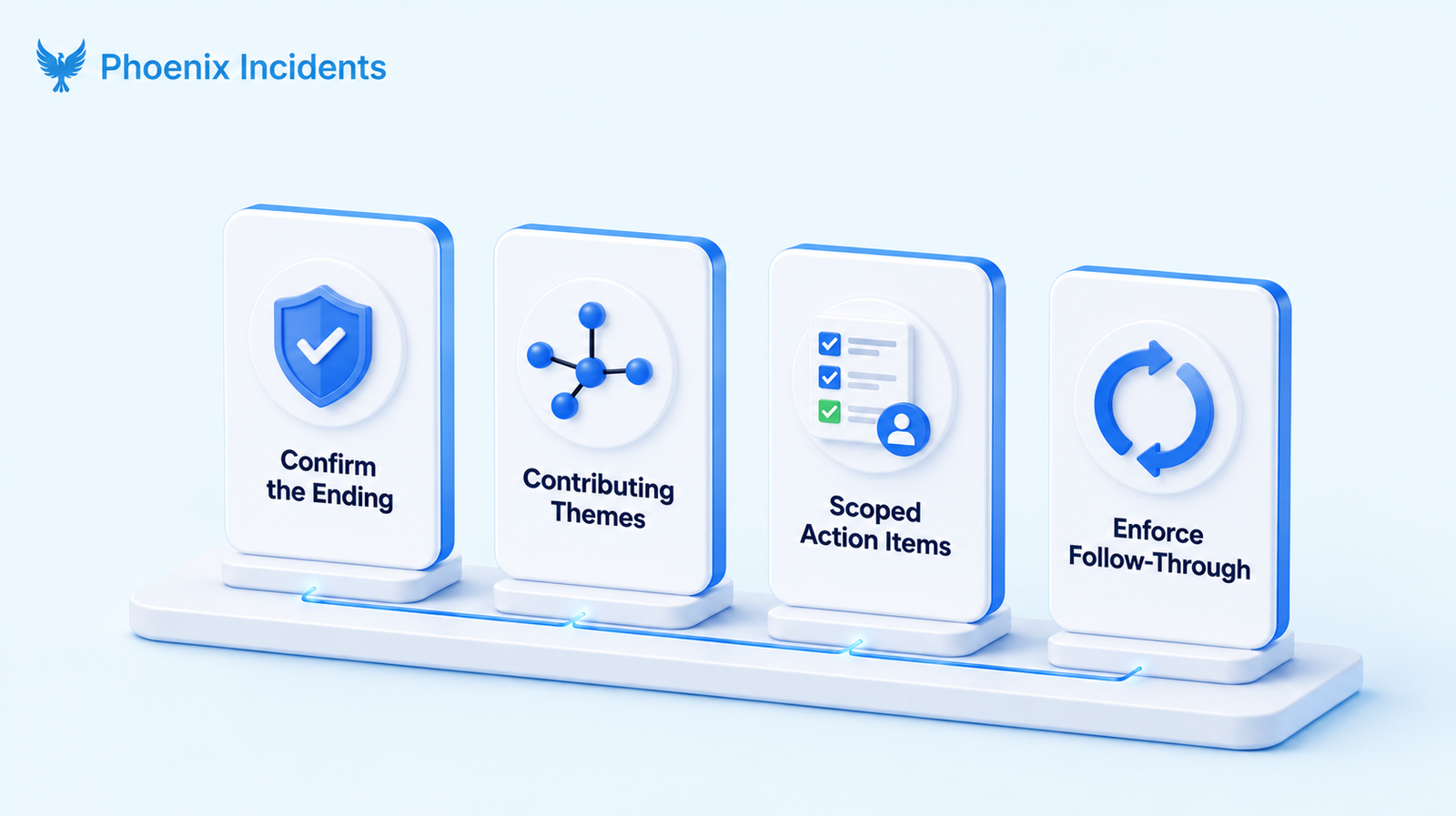
A review earns its keep through four pillars done well. Skip any one of them and the exercise tends to collapse into documentation that changes nothing.
1. Confirm How the Incident Ended, Including Cancelled Incidents
A strong review starts by stating plainly how the incident ended, whether it was resolved, mitigated, or cancelled. That last category is the one almost everyone ignores. Cancelled incidents, the false alarms and the ones that turned out to be something else, get closed and forgotten, yet they are some of the richest learning material a team has.
A cancelled incident often means an alert fired when it should not have, or someone hesitated over whether a real problem was worth raising. Both are worth understanding. An alert that cries wolf trains people to ignore it, and hesitation to escalate is exactly what slows down the next real incident.
2. Identify Contributing Themes, Not a Single Root Cause
Once the timeline is clear, the goal is to find the contributing themes rather than hunt for one root cause. Most guides still frame the job as locating a single point of failure, but serious incidents rarely work that way.
They emerge from several technical and organizational factors lining up at once:
- A brittle dependency.
- Gap in monitoring.
- An ambiguous ownership boundary.
- Or a deploy that happened to land at the wrong moment.
Even Atlassian's own postmortem handbook talks in terms of contributing root causes in the plural, because mapping the combination is what actually tells you where the system is fragile. Pin everything on one cause and you fix one thing while the rest of the conditions sit quietly waiting to recur.
3. Define a Small Number of Scoped Action Items
A useful review produces a handful of action items that represent real commitments, not a wish list. Each one needs:
- A specific owner.
- Concrete and verifiable outcome.
- And a realistic deadline.
By the way, "Improve monitoring" is not an action item because no one can tell when it is done. But, "add a saturation alert on the payments queue, owned by Priya, by the end of next sprint" is.
When a review generates fifteen action items, follow-through collapses, and the list becomes noise. But three things that actually get done beat fifteen that decorate a document.
3. Enforce Follow-Through So Action Items Don't Die in the Backlog
This is where most reviews quietly fail. The meeting feels productive and the write-up looks thorough, but then the action items slip into a backlog and never get done. The reason is structural, not a matter of willpower. When improvement work sits in a separate review document instead of the same board the team plans sprints from, it loses every priority contest to new feature work.
The teams that beat this make follow-through impossible to ignore. The action items live in the team's real tracker, the overdue ones show up where people will actually see them, and closing an item becomes a deliberate decision: it either gets done, or it gets dropped for a stated reason that goes on the record. What never happens is the slow fade into nothing.
The Blameless Foundation
None of the four pillars (above) hold without a blameless culture underneath them, and this is the part teams most often underestimate in practice. The mechanism is simple. When people believe that speaking honestly will cost them, they give the sanitized version of events, and the sanitized version hides exactly the information the review needs. You cannot map contributing themes if half the room is managing their own reputation instead of describing what they saw.
Blamelessness is not a soft value invented for comfort. It comes from the culture in aviation and healthcare, where the cost of people hiding mistakes is measured in lives, and it was carried into software by Google's SRE practice. The premise is that people generally make reasonable decisions given the information they had at the time, so the review examines the systems and conditions that made a bad outcome possible rather than litigating individual judgment. Atlassian frames it bluntly in its own handbook: when the risk to someone's standing outranks their employer's interest in the truth, blame jeopardizes the entire process.
There is a direct line from this culture to the cancelled incidents mentioned earlier. People only raise incidents freely, including the ones that turn out to be nothing, when raising a false alarm carries no penalty. A blameless environment is what makes that safety real, which is what gives you the cancelled-incident data worth reviewing in the first place.
Why Good PIRs Make the Next Incident Easier
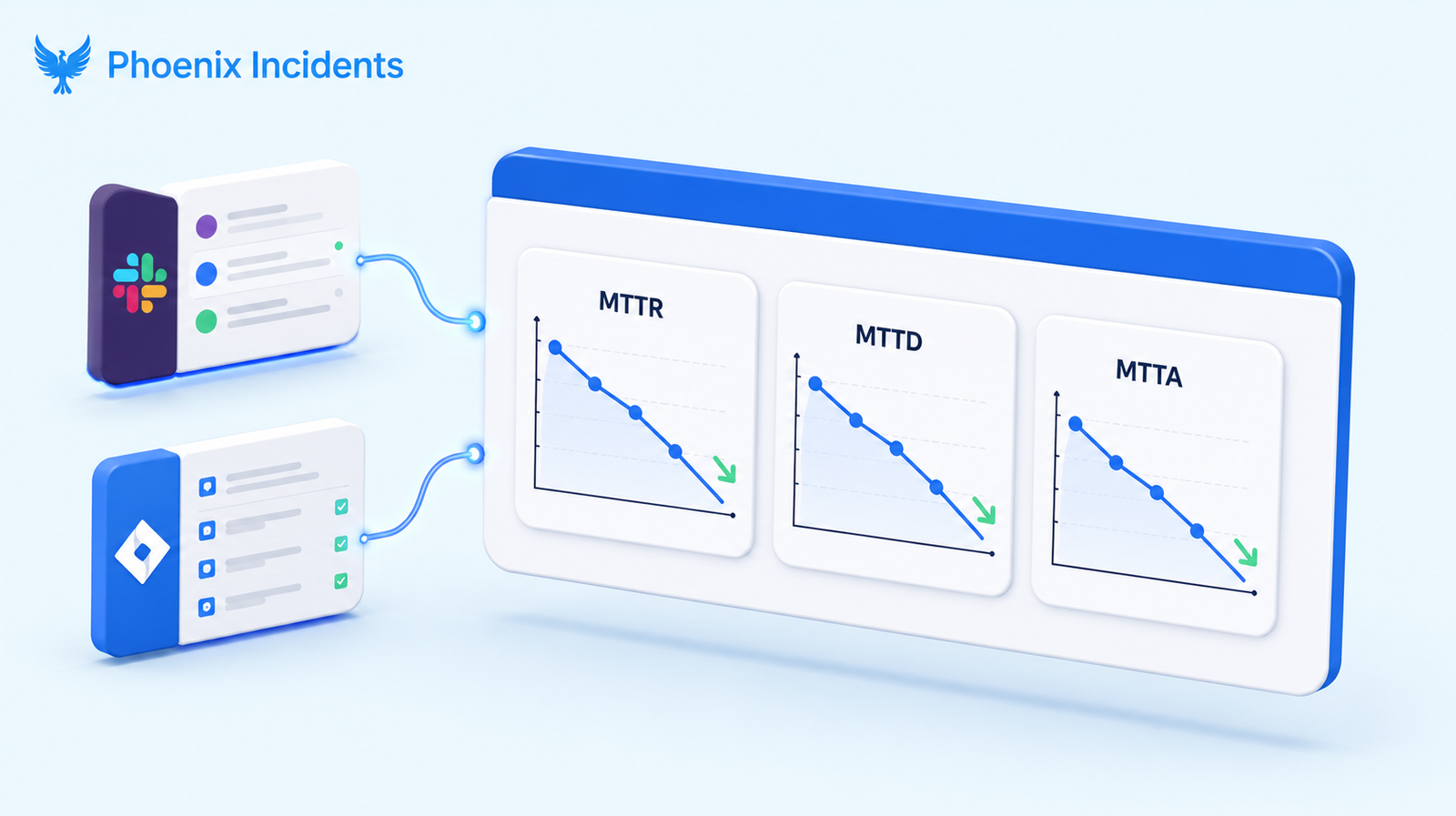
The value of a review is the way it changes how the team behaves during the next incident. Done consistently, reviews build a feedback loop that improves response speed, cuts confusion, and lays down organizational memory for handling production problems.
This is where those gains show up:
| Benefit | What drives it |
|---|---|
| Faster response | Pattern recognition across repeated themes |
| Fewer repeat incidents | Action-item completion |
| Clearer coordination under pressure | Communication gaps made visible and fixed |
| Measurable MTTR, MTTD, and MTTA gains | Closing coordination, ownership, and detection gaps |
| Higher team confidence | Engineers see their feedback turn into real change |
1. Faster Response Through Pattern Recognition
Teams that review incidents consistently start to recognize how problems tend to unfold. When the same contributing themes show up across several reviews, engineers learn where the fragile parts of the system are before the next page arrives. That recognition turns into speed during a live incident, because the team is matching a familiar shape rather than diagnosing from scratch.
2. Fewer Repeat Incidents Through Action-Item Follow-Through
The strongest link between reviews and better performance runs through completed action items. When a team defines a scoped mitigation and actually ships it, they remove a whole class of future incidents rather than patching one instance.
This is measurable when you track two numbers against each other:
- Repeat incident rate: The share of incidents that share a root cause with a previous one.
- Action-item completion: The share of review follow-ups that actually get done.
The relationship between them is plain: teams that close their follow-ups see their repeat rate fall, sometimes dramatically.
3. Clearer Communication and Coordination Under Pressure
Reviews improve coordination by making communication breakdowns visible enough to fix. When a timeline shows that stakeholders went 45 minutes without an update during a customer-facing outage, or that three engineers were independently working the same fix without knowing it, the team has something concrete to change.
Those gaps are what lead a team to set clearer update intervals, set up an incident command system with a designated incident commander, or improve status broadcasting in Slack.
4. Measurable Outcomes: MTTR, MTTD, and MTTA
The clearest gains show up in the incident metrics most teams already track. Reviews move three in particular:
- MTTR (mean time to resolve): How long an incident takes to fix once it begins. When reviews close the coordination, ownership, and knowledge gaps that slowed the last response, resolution gets faster the next time.
- MTTD (mean time to detect): How long it takes to notice something is wrong. This improves when reviews go looking for detection gaps and the team tunes the noisy alerts that hid the signal.
- MTTA (mean time to acknowledge): How long before someone picks up the incident. This drops when reviews sharpen escalation criteria and remove the fear around raising an incident, so people respond sooner.
The catch is that none of these move on their own. The metrics improve because the underlying behavior changed, which is the only reason any of these numbers ever genuinely shift.
5. Higher Team Confidence
There is a human benefit that doesn’t fit in a metrics table. Engineers who watch their review feedback turn into real process changes feel more capable and less stressed when the next incident lands. They know the system is being improved underneath them and that raising a problem leads somewhere. That confidence is self-reinforcing, because a team that trusts the process engages with it more honestly, which makes the next review better.
None of this happens on its own. It takes consistent execution, genuine follow-through on action items, and a real organizational commitment to treating incidents as something to learn from rather than something to assign fault for.
Why PIRs Compound Over Time
The longer a team practices structured reviews, the more each one is worth. Early reviews tend to catch the obvious gaps: monitoring that was missing, an on-call procedure nobody understood, a runbook that was never written. Once those basics are fixed, the next reviews start surfacing subtler problems, like how teams coordinate, how they hand off work to each other, and where the architecture itself is fragile.
So a team running its fiftieth review is working at a higher level than it was at its first. Not because the engineers got smarter, but because the organization has learned something from every incident and built those lessons back into how it operates. That is why reviews are best treated as a long-term investment, not a box to tick after each incident.
How to Run a Post-Incident Review in Jira and Slack
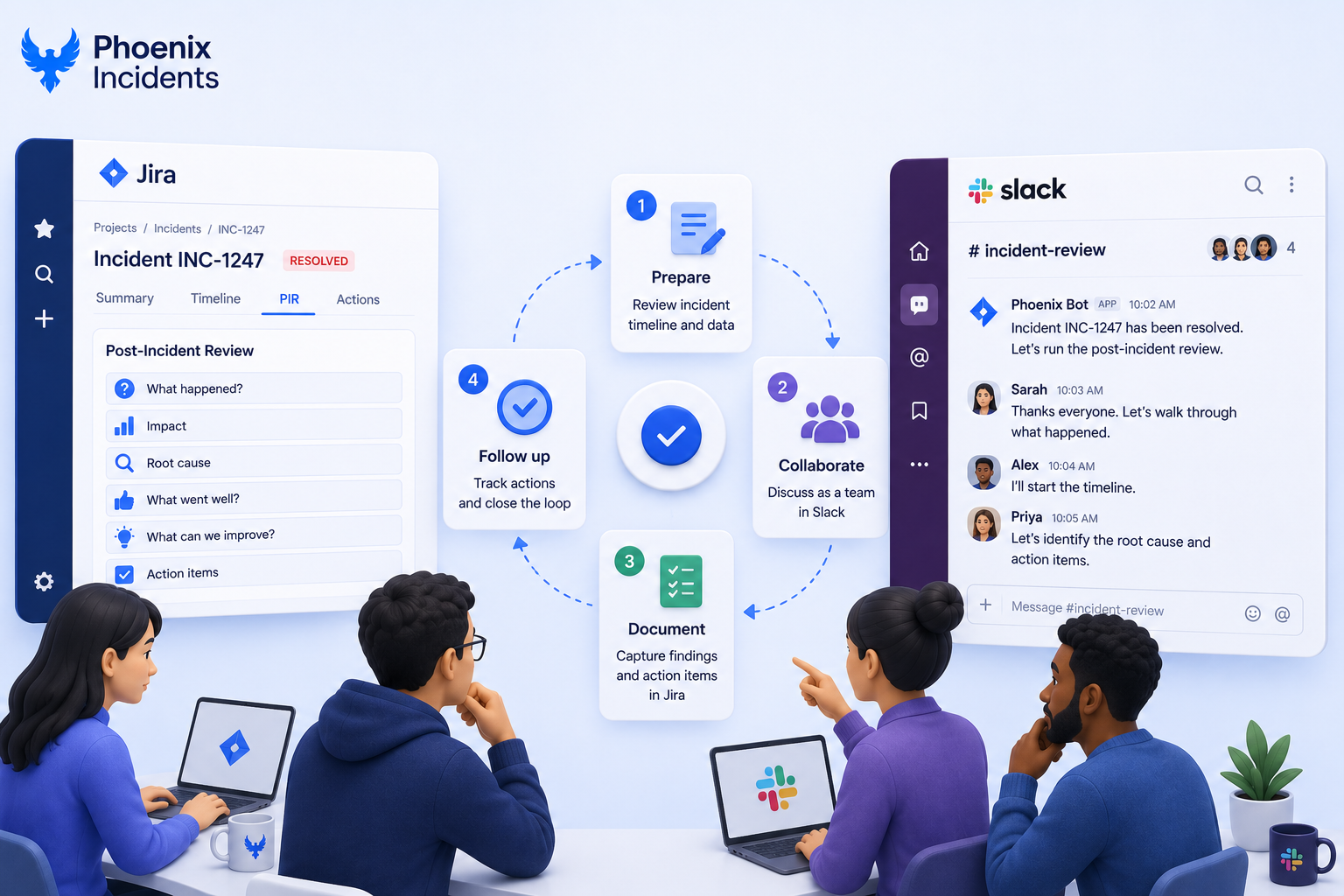
Reviews usually fail for a reason that has nothing to do with rigor. They fail because the context is scattered. The incident unfolds live across a Slack channel and a Jira issue, and then the review happens days later, when the details have blurred and the story has to be reassembled from memory and fragments.
For teams on Jira, a review works best when Jira is the system of record rather than the place the whole story gets reconstructed from scratch.
The trick is knowing what each tool is good for:
- Jira holds the durable parts: Ownership, action items, and the outcomes you need to track for weeks after the incident closes.
- Slack holds the live story: The real-time back-and-forth where someone notices the error rate climbing and someone else makes a call under pressure.
Context leaks away when Slack discussions, status updates, and coordination calls get summarized by hand days later. The result is a shallow review with an incomplete timeline and action items that miss what actually slowed the team down.
Start the Timeline When Impact Began, Not When the Ticket Opened
One of the most common timeline mistakes is starting the clock when the Jira ticket was opened. The real timeline begins when users were first impacted, and there is almost always a gap between that moment and the moment someone formally declared an incident.
That early window, the period before the ticket existed, is one of the easiest stretches to improve and one of the most frequently ignored. It’s also precisely where the Slack record matters most, because the first "is anyone else seeing this?" message usually lands in a channel well before Jira knows anything is wrong.
Reconstruct the timeline from when impact started and you will often find your biggest detection and escalation gaps hiding in those first few minutes.
Three Principles for a Context-Rich Review
Whatever tooling you use, the teams that run accurate reviews tend to hold to the same three principles:
- Preserve the real-time discussion rather than rewriting it from memory.
- Run the review off what really happened in Slack and Jira, not a recollection of it.
- Cut down on hand-copying details from Slack into Jira.
When a review is grounded in what actually happened instead of what people remember happening, it gets faster, more accurate, and far easier for engineers to take seriously.
A Note on Plain Jira vs. Jira Service Management
It is worth being clear about a Jira detail that trips teams up. Jira Service Management has a native post-incident review feature, but as of October 16, 2024 it sits behind the Premium plans, having moved out of Standard.
Teams that used the feature during the transition window got a 12-month grace period, but that period has since expired, so reaching for the built-in PIR tooling now means paying for JSM Premium.
That matters because most engineering teams do not run their work in JSM. They live in Jira Software, plan in the same boards they use for everything else, and coordinate incidents in Slack. The good news is that running a strong review does not require the JSM feature or any ITSM tier.
Everything that makes a review useful, an honest timeline, contributing themes, scoped and tracked action items, blameless culture, can be done in plain Jira Software and Slack. The structure does the work, not the product tier.
How Phoenix Incidents Supports a Better PIR Process
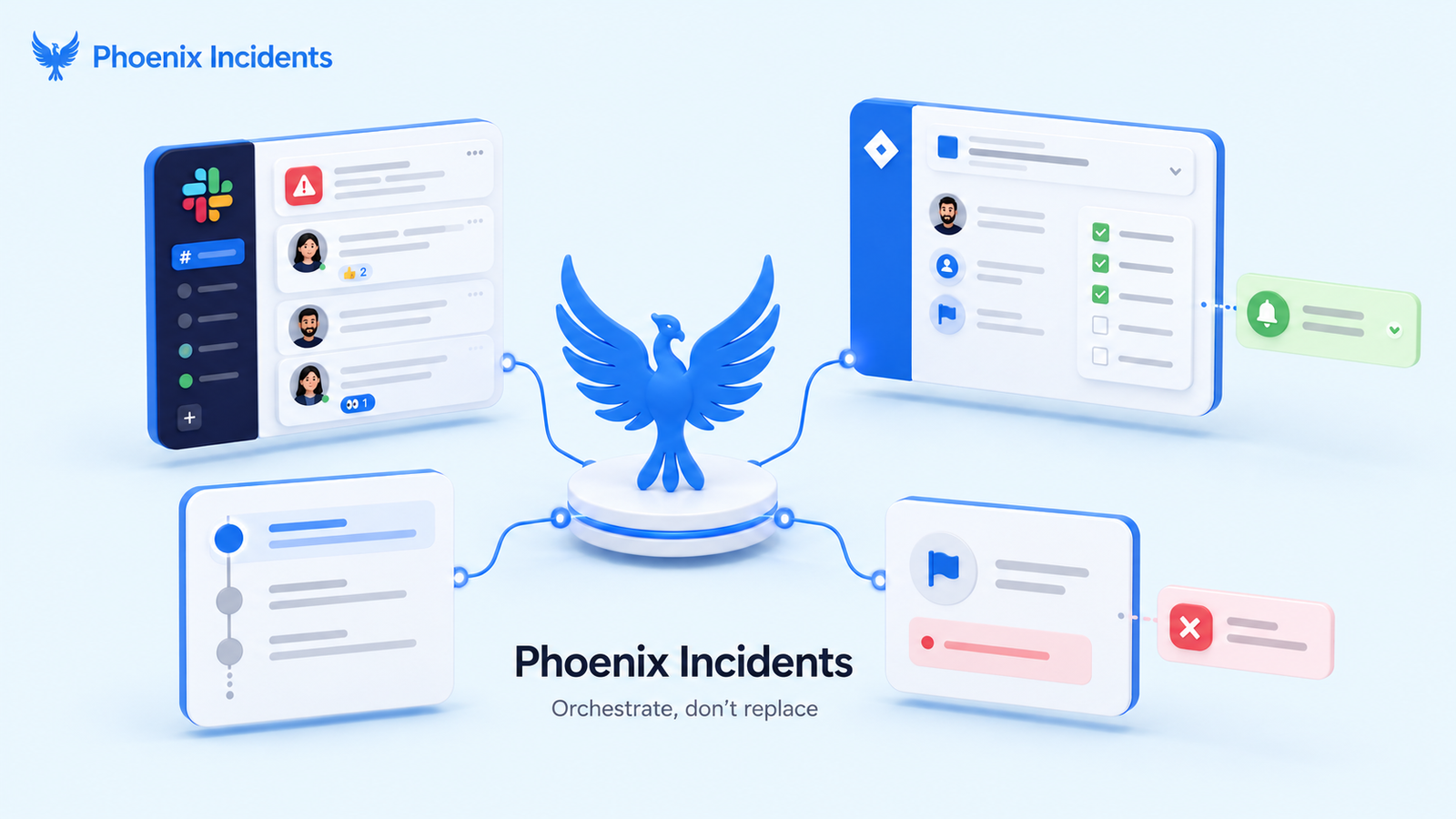
Phoenix Incidents is built to make reviews more structured and accurate inside Jira and Slack, the tools engineering teams already use, rather than asking them to adopt a separate platform and learn it. The idea is to orchestrate what you have, not replace it. For the review itself, that means structured guidance at each step.
Phoenix Incidents helps reconstruct the timeline from real Slack and Jira activity rather than from memory, capture contributing themes consistently across incidents, and produce action items that are concrete and time-bound.
Those action items are then backed by Slack reminders, which closes the follow-through gap that sinks most reviews.
| Traditional PIR approach | With Phoenix Incidents | |
|---|---|---|
| Timeline | Reassembled by hand from memory days later | Reconstructed from real Slack and Jira activity |
| Contributing themes | Captured inconsistently between incidents | Captured consistently with structured guidance |
| Action items | Vague, not time-bound or tracked | Concrete and time-bound, tracked in Jira |
| Follow-through | Drifts into the backlog, rarely revisited | Enforced with Slack reminders |
Cancelled Incidents as a First-Class Learning Source
The clearest example of the difference is how Phoenix Incidents handles cancelled incidents. Teams are encouraged to raise incidents without fear of being wrong, and when one is cancelled, the cancellation is recorded with a required reason. That turns the false alarms most tools throw away into a reviewable dataset.
Patterns surface from it:
- An alert that keeps going off when nothing is actually wrong, so its settings need adjusting.
- Recurring hesitation that points to unclear escalation criteria.
- A training gap in who knows how to respond.
This formalizes a best practice plenty of teams talk about and almost none execute, learning from the near misses and the not-quite-incidents instead of only the outages that hurt.
Run Reviews Where Incidents Happen
A post-incident review is only as good as the reality it is built on. When it’s grounded in what actually happened, captured from the tools where the incident really unfolded, it turns an outage into something the team is measurably better for. But when it’s reassembled from memory days later, it produces just a document and nothing else.
What really moves a review from reporting to improvement is the structure: an honest timeline that starts when impact began, contributing themes instead of a single root cause, a few scoped action items that actually get done, and a blameless culture that keeps everyone honest.
If your reviews feel inconsistent, easily forgotten, or disconnected from the real incident work, the fix is to keep them where incidents already live.
See how Phoenix Incidents helps engineering teams run better post-incident reviews directly inside Jira and Slack, without adding another tool to the stack.
Frequently Asked Questions
1. What is the difference between a post-incident review and a postmortem?
They refer to the same practice. Postmortem is the older term, rooted in SRE and software culture, while many teams now prefer post-incident review because postmortem implies something died and sets a negative tone. Root cause analysis is different again: it is a technique used inside a review, not a replacement for one.
2. Who should attend a post-incident review?
Everyone who detected, diagnosed, or resolved the incident, plus anyone whose systems or processes were involved. That usually means the on-call engineers and incident commander, and often support or product when customers were affected. Keep it focused, but resist trimming the list to save face, since the people closest to the failure hold the most useful detail.
3. How long after an incident should you run a PIR?
Soon, while the details are still fresh, typically within a few business days of resolution. Waiting too long means memories fade and context is lost, especially the real-time decisions that never made it into a ticket. The tradeoff is giving people enough distance to review calmly rather than mid-firefight.
4. What should a post-incident review document include?
At minimum: a summary, a timeline that starts when user impact began, the contributing factors, the impact on users or the business, and a short list of action items with named owners and deadlines. A brief lessons-learned section covering what worked and what did not rounds it out and makes the document useful to people who were not there.
5. Do you need Jira Service Management to run post-incident reviews?
No. JSM has a native PIR feature, but since October 16, 2024 it requires a Premium or Enterprise plan. A strong review depends on structure rather than a specific product tier, and everything that makes one effective can be run in plain Jira Software and Slack, which is where most engineering teams already work.
6. Should you run a PIR for a cancelled or false-alarm incident?
Often, yes. Cancelled incidents are some of the most overlooked learning material a team has. A false alarm usually means an alert fired when it should not have, and hesitation before raising a real one points to unclear escalation criteria. Reviewing cancelled incidents, with a recorded reason for each, helps you tune alerting and tighten the escalation path.