Why Most Incident Postmortems Fail (And How to Fix Them)

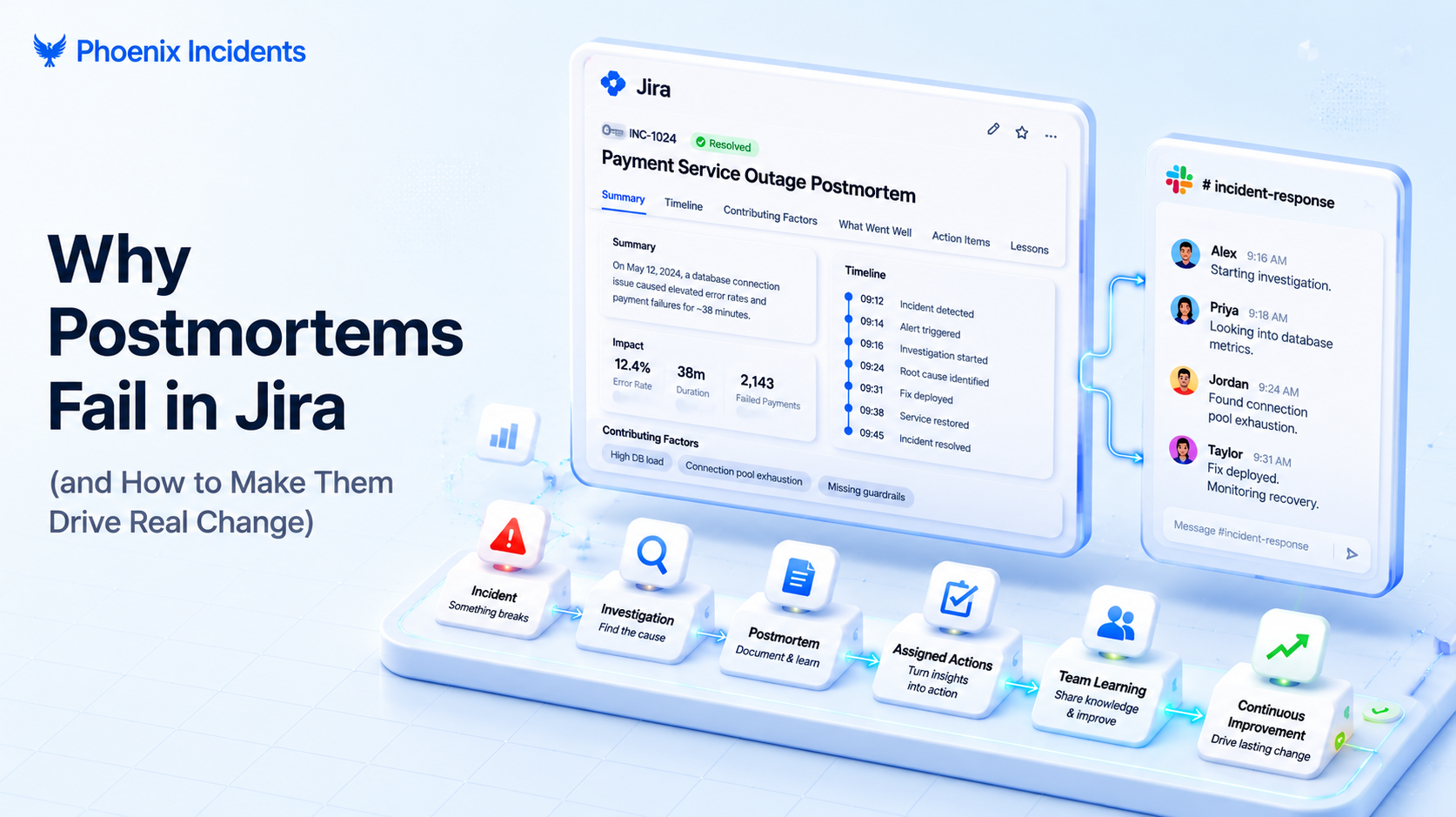
"How did this happen again? Didn't we already fix this?"
No engineering leader wants to read that message, especially after a full quarter of careful planning. But there we were during a traffic spike, watching a service our customers rely on slow down until it was barely usable.
The customers getting hurt were the same ones we had reassured the last time it happened. For the next few days, senior executives were personally apologizing to frustrated accounts and promising, again, that we would finally fix the root problem.
The truth was that our architecture needed real refactoring and our infrastructure was long overdue for investment. What we did instead was scale hardware, apply patches, and clear the tickets we could actually close. We solved everything except the thing that kept breaking, and not for lack of trying. The team knew what the fix was. The organization just never made room for it.
If that sounds familiar, you’re in good company. This pattern rarely comes from teams skipping postmortems, because most teams run them faithfully. The hard part is the follow up that tends to slip away in the gap between the meeting and the next sprint, in a doc nobody reopens or a Slack message that scrolls out of view, far from Jira where the work actually gets scheduled.
And whether you’re the on-call engineer getting paged for the same fault at 3 a.m. or the leader explaining the repeat outage upward, the weight of it lands on you. The good news is that this gap is closable, and the rest of this piece is about how.
Why Repeat Incidents Are a Problem for Engineering Leaders
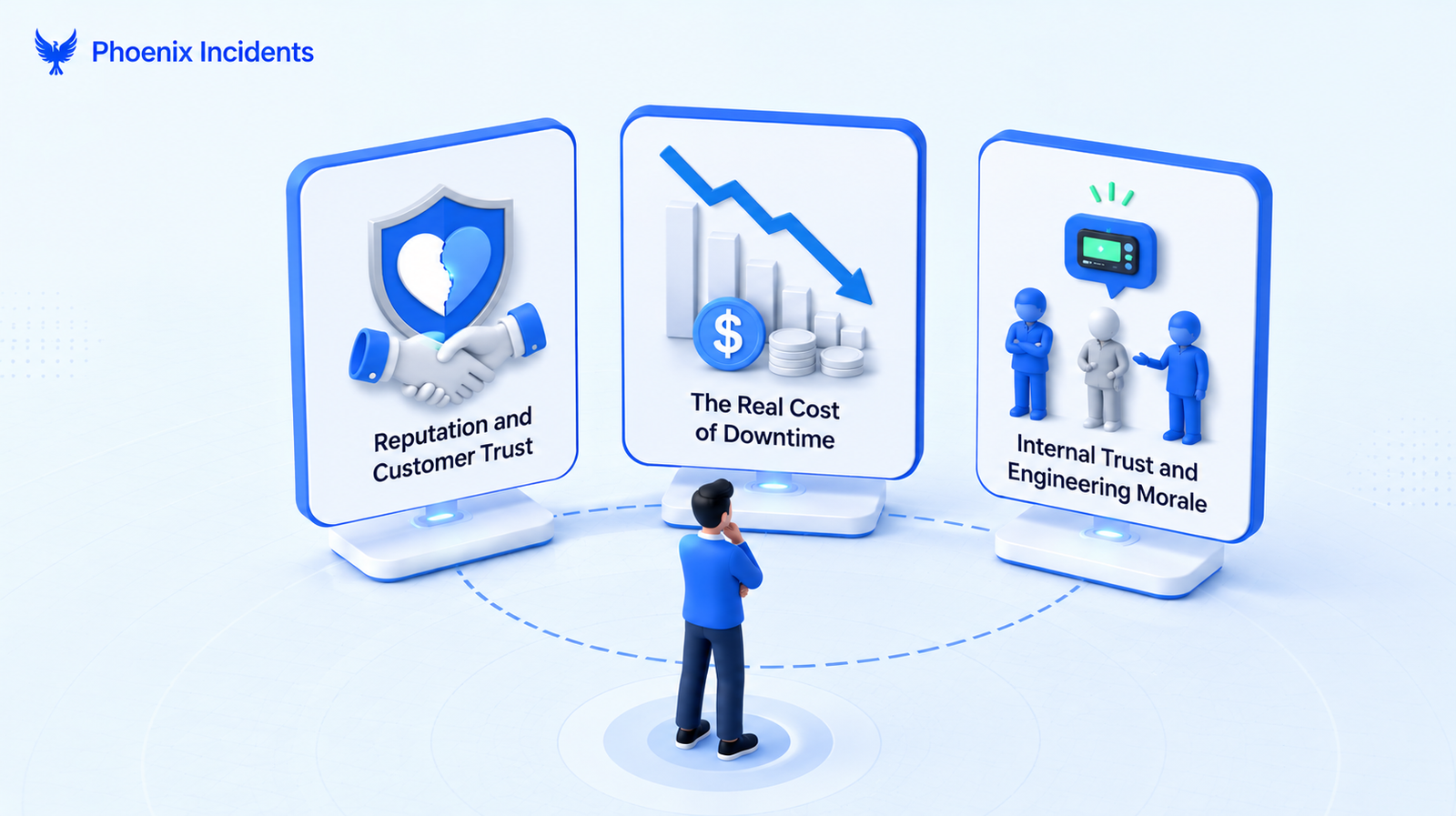
At the leadership level, the worry is rarely the raw incident count. It’s what those incidents do to the things that are hard to rebuild: customer trust, revenue, and the morale of the people on call.
1. Reputation and Customer Trust
Customers will usually forgive a single outage. What wears down their confidence is the same problem happening again and again, because it starts to look like the team cannot learn from its own mistakes. The data backs this up. In PagerDuty's 2024 incident study of 500 IT leaders at large organizations, the trust signals are hard to ignore:
- 90% of IT leaders said outages or disruptions have reduced customer trust in their organization
- 59% reported that customer impacting incidents had increased, growing by an average of 43% over the previous year
- 24% said outages had negatively affected their share price
For a leader, reputation feeds directly into renewal rates, investor confidence, and whether you get to focus on growth or spend your time answering for repeat outages.
2. The Real Cost of Downtime
The financial picture from the same study is steep, and it replaces the older per minute downtime figures that have been quoted for years. PagerDuty put the estimated cost of downtime at $4,537 per minute, with an average incident taking 175 minutes to resolve, which works out to nearly $794,000 per customer impacting incident.
Across an average of 25 high priority incidents a year, that reaches just under $20 million per organization.
| Metric | Figure |
|---|---|
| Estimated cost of downtime | $4,537 per minute |
| Average incident resolution time | 175 minutes (~3 hours) |
| Cost per customer impacting incident | ~$794,000 |
| High priority incidents per organization, per year | 25 |
| Cumulative annual cost per organization | ~$19.8 million |
Every repeat incident is a line item in that total. Reducing recurrence is one of the most direct ways to protect both the budget and the customer relationships.
3. Internal Trust and Engineering Morale
The damage is not only external. When the same problems keep surfacing, the teams that depend on engineering start to lose faith too, and the people closest to the pager feel it first. PagerDuty found that 35% of IT leaders had seen higher levels of employee burnout tied to incidents, and that 69% believed their own board and management were failing to invest in protecting customer trust when outages occurred.
That second number is the quiet killer. When engineers raise the same systemic fix after every incident and watch it get deprioritized every time, they stop raising it. A culture of "why bother" sets in, and learned helplessness is far harder to reverse than any single outage.
Why Most Postmortems Fail in Jira
Almost every team runs the postmortem with good intentions. You gather the right people, walk the timeline, agree on what went wrong, and leave with a list of improvements. Then the urgency fades. The list never makes it into the sprint, owners drift, and months later you are back in the same room asking why nobody fixed it last time.
The Google SRE Workbook is blunt about this: a postmortem that produces no acted upon change signals a culture quietly failing. The failures below share one root. The fix leaves the place where work actually happens, and once it does, postmortem dies.
| Failure mode | What it looks like | Why the fix dies |
|---|---|---|
| No clear owner | Action items have ideas but no names | No one is named owner of action item, so the work belongs to nobody |
| Lives in the wrong place | Fix sits in a doc, spreadsheet, or Slack thread | It is out of sight from the sprint, so it never gets scheduled |
| Run too late | Review happens a week or more after the incident | Detail and urgency fade, so the analysis stays shallow |
| Weak root cause analysis | The review stops at the symptom: like an overloaded server | The real cause is left in place to recur |
| No follow through or pattern detection | Items are abandoned and incidents are handled in isolation | Recurring themes are never named, so they keep returning |
No Clear Owner
This is the most common trap. Postmortems generate plenty of ideas and very few names. "The team should improve monitoring", reads like a task but it’s a sentiment, because a ‘team’ cannot be paged and a ‘team’ does not wake up on Monday owning it. Without a single accountable person, the work belongs to nobody and quietly expires.
1. The Action Item Lives in the Wrong Place
Even a well written action item dies if you file it somewhere your team never looks. A fix captured in the postmortem doc, or in a side spreadsheet, or in a Slack message that scrolled away by Tuesday, is already on its way out. If the work does not live in Jira next to the rest of the sprint, it’s out of sight until the next outage drags it back up.
2. Postmortems Run Too Late
The best time to run a root cause analysis is while the incident is still fresh. Memory is still sharp, the timeline is reconstructable, and the team is still in the mindset. But if you wait a week and the detail blurs, urgency drops, and the review turns into a box checking exercise that documents the obvious and misses the actual cause.
3. Weak or Unstructured Root Cause Analysis
Without structure, a root cause analysis tends to stop at the first satisfying answer. The server was overloaded, so the team adds more capacity and moves on. But the overloaded server was only the symptom. Something further back caused it, usually an alert that fired too late, a fragile dependency, or a missing safeguard that should have caught the problem earlier. Fixing only the obvious symptom feels like you have solved it, but the real fault is still sitting there, ready to cause the next outage.
4. No Follow Through or Pattern Detection
The final failure is the slow one. Action items get captured and then quietly abandoned, and nobody connects this incident to the three that looked just like it.
The recurring traps:
- Too many action items and no sense of which come first, so none of them actually ship.
- Incidents marked closed before the preventive fixes are actually done.
- No regular check in, so owners are never reminded and progress is never visible.
- Each incident is handled in isolation, so the theme running through all of them never gets named.
Each one chips away at the team's ability to improve, and leadership is left with a false sense of progress until the next outage proves otherwise.
The Postmortem Process Lives in Jira and Slack
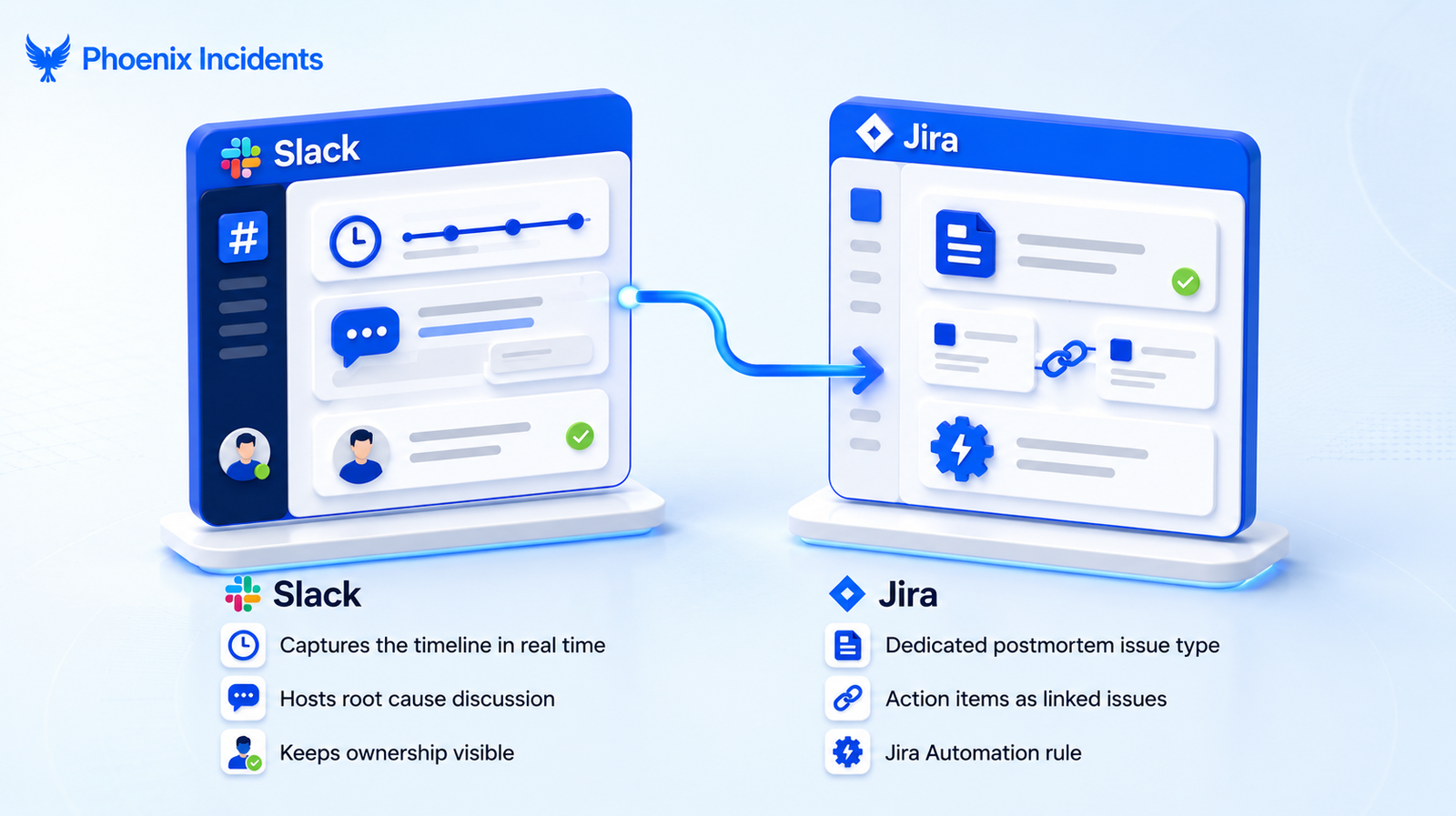
A postmortem process does not succeed or fail due to the quality of the template. It succeeds or fails on whether it lives in the two tools an engineering team already has open all day: Slack, where the incident actually unfolds, and Jira, where work actually gets scheduled and shipped.
1. Slack: Where the Conversation and Timeline Happen
For most engineering teams, the incident channel is the live record of what happened. The pages, the "I'm seeing it too," the rollback call at 2 a.m., the moment someone spots the real cause: it is all there in order, timestamped, with names attached.
That thread is the raw material of an honest timeline, and reconstructing it later from memory is exactly the work that makes late postmortems so thin.
Slack is also where reminders actually get seen. A nudge in the incident channel or a team channel lands in front of the owner; the same nudge buried in a doc does not.
In the post incident window, Slack does a few things better than anywhere else:
- Captures the timeline in real time, while the facts are still straight.
- Hosts the async root cause discussion across time zones without another meeting.
- Keeps ownership visible, so a reminder reaches the person who owns the fix.
2. Jira: Where Action Items Become Real Work
If Slack is where the conversation happens, Jira is where the real work happens. A postmortem fix only counts once it becomes a Jira work item with a named owner and a due date.
Putting it in the same backlog as the team's other work means it gets ranked alongside everything else, instead of sitting off to the side where it quietly gets forgotten. When incident work lives next to feature work, a manager can see it, give it a priority, and make sure it does not keep getting pushed aside.
None of this requires Jira Service Management or a separate ITSM setup. On plain Jira, the mechanics are straightforward:
- A dedicated postmortem issue type so reviews are consistent and searchable.
- Action items created as linked issues so the trail from incident to fix is intact.
- And a Jira Automation rule that flags any incident whose root cause fixes are still open.
That last one quietly enforces the rule that an incident is not done until its preventive work is.
Weak vs. Strong Action Items in Jira
The difference between an action item that ships and one that evaporates usually comes down to whether it can be assigned, tracked, and verified.
| Weak action (avoid) | Strong action in Jira (use this) | What makes it work |
|---|---|---|
| "Improve monitoring" | Alice: add an alert for DB replication lag over 30s in Datadog — JIRA-1234, due end of Sprint 14 | Named owner, specific outcome, issue link, due date |
| "Look into scaling" | Jordan: add read replicas to the payments DB — JIRA-1235, due Mar 15 | Owner, concrete change, deadline |
| "Better docs" | Alex: update the auth service failover runbook — JIRA-1236, due Friday | Owner, verifiable deliverable, deadline |
The test is simple. If you can tell at a glance whether the action was done, it was a real action item. If you cannot, it’s thoughts and prayers.
How To Build a Strong Postmortem Process
| Step | Where it happens | What "done" looks like |
|---|---|---|
| Run the RCA within 72 hours | Slack timeline → review | Analysis complete while context is fresh |
| One owner, one due date | Jira | Every item is an assigned, dated issue |
| Structured RCA (Five Whys) | Review → Jira | Root cause reaches a system condition, tagged |
| Prioritize ruthlessly | Jira backlog | Only high impact fixes are scheduled |
| Review on a set schedule | Slack + Jira | Open items checked weekly, visible to stakeholders |
| Track themes across incidents | Jira reporting | Recurring causes named and addressed at org level |
You do not need a dozen new rituals to fix recurrence. You need a few reliable practices, each tied to where the work actually lives. Google SRE Book also stated that it’s always best for teams to use a variety of techniques for root-cause analysis and choose the technique best suited to their services.
Step 1: Run the RCA Within 72 Hours
Schedule the review while the incident is still fresh, ideally within three days. The Slack timeline is still intact, the responders still remember the decisions they made, and the analysis comes out sharper because of that. The more days you wait, the more context leaks away.
Step 2: Give Every Action Item One Owner and a Due Date
This is about getting things done, not assigning fault. Every action item gets a single accountable person and a realistic date, filed as a Jira issue. Shared ownership is the same as no ownership, so resist the urge to assign a fix to a team.
Step 3: Use a Structured RCA Method (Five Whys)
Skip the unstructured discussion and use a method that pushes past the first answer. The Five Whys is a reliable default: keep asking why until you reach a system condition rather than a person. Tag root causes with consistent categories while you are at it, because that is what lets you spot themes across incidents later instead of treating each one as brand new.
Step 4: Prioritize Ruthlessly
Not every idea from the review needs to become a task. The longer the list of action items, the more of it quietly goes undone. So rank them by how much each one would actually stop the problem from happening again, keep the top few, and drop the rest. A few fixes that get finished beat a long list that does not.
Step 5: Review Open Action Items on a Set Schedule
Set a regular time to review the action items that are still open, weekly if you can, and monthly at the very least. This keeps the work in front of the people who care about it and stops fixes from slowly disappearing to the bottom of the backlog. Sharing that same progress update with leadership on the same schedule keeps everyone moving and keeps owners accountable.
Step 6: Track Root Causes Across Incidents to Find Themes
The most valuable thing you can do is stop treating each incident as an isolated event. When you label the cause of every incident and look back over them as a group, the patterns start to show: the same shaky dependency, gap in monitoring, unclear ownership coming up again and again.
Those are problems to solve across the whole organization, by setting aside real time to improve your tooling or monitoring. That is what actually brings the number of incidents down.
How Phoenix Incidents Helps Prevent Repeat Incidents
Phoenix Incidents builds these practices into the workflow your team already uses, instead of handing you another tool to babysit.
It runs inside Jira and Slack, so the process lives where the work does:
- Incidents cannot be closed until their linked action items are complete, so follow through is enforced rather than hoped for
- Guided Five Whys and consistent root cause tagging are built into the review, so the analysis reaches systemic causes and stays comparable over time
- Slack reminders, dashboards, and report cards keep ownership and progress visible without anyone chasing it manually
Because it sits in plain Jira and Slack, there is no separate system to maintain and nothing for the team to migrate into.
The recurring incidents that drive engineer burnout and incident fatigue get fewer, and the mean time to recovery you report upward starts moving in the right direction because the same faults stop coming back.
Make This the Last Time That Same Incident Happens
If you want a quick read on where your own process stands, walk these four questions. A confident yes to all four is rare, and each no is a place recurrence is leaking in:
- Are your root cause analyses happening within 72 hours of the incident?
- Does every action item have a single owner and a due date?
- Do you know, right now, how many postmortem action items are open?
- Are you tracking root cause themes across incidents, not just fixing them one at a time?
None of this takes a heavy new process. It takes prompt reviews, structured root causes, real ownership, and a regular look at ongoing action items, all living in the tools your team already has open.
That is exactly what Phoenix Incidents is built to help with. It carries the follow through for you, right inside the Jira and Slack your team already lives in, so the answers to those four questions stay yes without anyone having to chase them down.
Get those right and the postmortem stops being paperwork and starts being the thing that keeps the same incident from happening twice.
Frequently Asked Questions
1. Why do most postmortems fail?
Most postmortems fail not because teams skip them but because the follow up work leaves the tools where work actually happens. Action items get captured in a doc or a chat message, lose their owner, never make it into the sprint backlog, and quietly expire. The failure is in execution and tracking, not in the review itself.
2. How quickly should you run an incident postmortem?
As close to the incident as possible, ideally within 72 hours. While the incident is fresh, the timeline is still reconstructable and responders remember the decisions they made under pressure. After a week, context fades and the review tends to document the obvious while missing the systemic cause.
3. Where should postmortem action items live: in Jira, Confluence, or a doc?
In Jira, alongside the rest of the team's work. Confluence and docs are fine for the postmortem write up itself, but action items need to be trackable issues with owners and due dates in the backlog the team works from every day. A fix that lives only in a document is out of sight and rarely gets done.
5. What makes a good postmortem action item?
A named individual owner, a specific and verifiable outcome, a home in the team's task tracker, and a due date. "Improve monitoring" fails every test. But "Alice: add an alert for DB replication lag over 30 seconds, JIRA-1234, due end of sprint" passes all of them. The test is whether you can look at it at a glance and tell if it is done.
6. How do you stop the same incidents from recurring?
Tag root causes with consistent categories and review them across incidents so recurring themes become visible, then fix those themes at the organizational level rather than patching each incident in isolation. Recurrence usually traces back to a systemic gap like weak alerting, a fragile dependency, or unclear ownership, and that is where the durable fix lives.
7. What's the difference between a postmortem and a retrospective?
A retrospective is part of the agile sprint cycle and reviews how the team worked over a set period. A postmortem is triggered by a specific incident, such as an outage or a degradation, and focuses on what failed, why, and what systemic changes prevent it from happening again.