Incident Management Best Practices for SRE and DevOps Teams in 2026

Most engineering teams know what they should do during an incident. Escalate early. Keep communication in one channel. Run a spotless post-incident review. Document the decisions. Now here’s where the problem comes in.
When a P1 fires at 2am, the on-call engineer is stressed, context-switching, and relying on muscle memory. If the process hasn't been embedded into the workflow, if it depends on someone remembering to follow it, it will break at the worst possible moment.
That’s the real purpose of incident management best practices: to design a system where the right things happen automatically, where escalation feels safer than waiting, where communication flows without someone needing to remind the team to communicate, where the post-mortem produces lasting change instead of a document nobody opens two weeks later.
In this guide, we’ll discuss the eight practices that make the difference during a production incident and what it takes to run them consistently.
The Cost of Getting This Wrong
Before diving into the practices, it’s worth anchoring the stakes. According to New Relic’s 2025 Observability Forecast Report, high-impact outages now cost organizations up to $2 million per hour. Enterprise incidents increased 16% year-over-year according to PagerDuty’s State of Digital Operations report. And according to DORA research, teams with high psychological safety are 47% more likely to engage in process improvements and 64% more likely to report near-misses, signals that culture and process are directly linked to reliability outcomes.
The gap is process infrastructure. Here are the eight practices that close it:
8 Best Practices for SRE and DevOps Teams
1. Lower the Barrier to Escalation
Most serious incidents don't start as serious incidents. They start as signals that someone noticed and chose not to escalate because they weren't sure, because they didn't want to look foolish, because the last time someone raised a false alarm the response wasn't welcoming.
That hesitation is where SEV1s are born.
As Google's SRE team notes, an atmosphere of blame risks creating a culture in which incidents and issues are swept under the rug, leading to greater risk for the organization. The inverse is also true: when declaring an incident feels lower-risk than waiting, engineers escalate faster, and small issues get caught before they compound.
Building this culture requires two things operating together. The first is a clear, shared definition of what qualifies for escalation: customer impact, service degradation, security risk, operational uncertainty. When the definition decides rather than individual judgment, the decision becomes procedural rather than personal.
The second is making canceled or downgraded incidents an expected, positive outcome rather than an embarrassment. A canceled incident means the system worked. Someone noticed a signal, triggered the process, and the issue turned out to be minor. That's a win and it should be treated as one. See Phoenix Incidents’ approach to blameless culture for more on building this foundation.
What this looks like in practice: When engineers know that escalating and being wrong carries no penalty, they escalate sooner. The decision to raise an incident becomes procedural, not personal, and that shift alone is one of the highest-leverage changes a team can make. (More on what to do with those canceled incidents in Practice 6.)
Phoenix Incidents requires human judgment to declare an incident, intentionally. Alerts signal potential problems; incidents require coordination, communication, and response. Not every alert deserves that overhead. By embedding the definition into the workflow and making cancellation a first-class outcome with a required reason field, the psychological safety for early escalation gets built into the tool rather than left to culture alone.
2. Define Severity Levels Before an Incident Fires
"Is this a SEV1 or a SEV3?" should never be a debate during a live incident. Every minute spent arguing severity classification is a minute not spent fixing the problem and in high-pressure situations, classification debates also signal to the team that the process isn't settled, which compounds stress.
Define your severity levels before incidents happen. Publish them somewhere every engineer can find in under 30 seconds. And build your paging, escalation, and stakeholder communication policies around them so classification automatically triggers the right response.
A framework that works for most SaaS teams:
| Severity | Definition | Response Expectation | Escalation Trigger |
|---|---|---|---|
| SEV1 | Complete outage or data loss affecting most users | Immediate page; IC assigned; all-hands response | Automatic page to primary + backup on-call |
| SEV2 | Major feature degraded; significant user impact | Page on-call; respond promptly; after-hours paging required | Page primary on-call; escalate to backup if no ack in 5min |
| SEV3 | Minor degradation; small subset of users affected | Respond within 1 hour during business hours | Page during business hours; ticket after-hours |
| SEV4 | Cosmetic or edge-case issue; no functional impact | Triage during business hours; add to backlog | Ticket only; no page required |
One practical rule: when you’re unsure whether something is a SEV1 or SEV2, declare the more severe classification and confirm your call in the post-mortem. Over-declaring briefly mobilizes extra resources. Missing a SEV1 because someone hesitated can cost you customers and revenue. The cost of over-declaring is almost always smaller than the cost of under-declaring.
3. Build an End-to-End Workflow and Enforce It
Without a defined workflow, incident response turns into improvisation. Jira drifts out of sync with Slack. Updates get lost. Engineers burn time managing the process instead of restoring service.
A structured incident workflow follows a clear sequence: incident creation → acknowledgment → active response and coordination → resolution → post-incident review. The value is in predictability. Everyone knows what happens next, regardless of who’s on call or how complex the technical situation is.
Runbooks are central to this: they define repeatable, structured response workflows that improve efficiency, ensure consistency, and enable seamless onboarding for new team members.
Well-structured runbooks: short, linked directly to the alerts that trigger them, reviewed after every relevant incident; see dramatically higher usage during live incidents than long-form documentation buried in Confluence. See on-call best practices for a detailed runbook framework.
A practical checklist for your incident workflow:
- Incident channel auto-created on declaration with a consistent naming convention
- Incident Commander role explicitly assigned and visible in channel header
- Stakeholder status channel separate from the working incident channel
- SLA-based update reminders that prompt the IC at regular intervals
- Jira incident record kept in sync with Slack throughout the response
- Post-incident review automatically scheduled after resolution
If more than half of those steps are still manual for your team, that's where your MTTR improvement is hiding.
4. Make Roles and Responsibilities Explicit Every Time
In the middle of an incident, ambiguity compounds stress. Two people assume someone else is updating stakeholders. Five engineers jump into debugging the same service. Important decisions get delayed because no one is sure who owns them. Clear role assignment at the start of every incident removes that friction. The roles don’t need to be rigid titles, but they do need to be explicit and visible to everyone in the incident channel.
| Role | Primary Responsibility | Critical Rule | Common Failure Mode |
|---|---|---|---|
| Incident Commander (IC) | Owns the response: manages resources, drives communication, makes escalation decisions | Does NOT touch the keyboard. The moment the IC starts debugging, they lose oversight of the full incident. | IC gets pulled into technical work; coordination collapses. |
| Technical Lead | Investigates root cause, proposes and executes fixes | Has full technical focus because coordination has been handed to the IC | Spends time on coordination instead of diagnosis |
| Communications Lead | Owns stakeholder updates; keeps public status channel current; drafts external comms | Shields technical responders from interruptions | Updates happen ad hoc or not at all; on-call engineers get interrupted |
| Scribe | Captures timeline, key decisions, and actions taken in the incident channel | Documents in real time, not from memory after the fact | Timeline reconstruction takes 90 minutes in the post-mortem |
When these roles are visible and assigned within the first five minutes of declaration, engineers stop stepping on each other and start trusting the process.
5. Separate Responders From Stakeholders
One of the fastest ways to derail incident response is constant status requests. Engineers get pulled out of diagnosis to answer the same question ‘any update?’ across three different Slack channels while simultaneously trying to isolate a root cause.
Effective incident management separates the people doing the work from the people who need visibility into it. These are not the same group, and they should not share a communication channel.
The structure that works:
- Working channel (for responders only): All technical discussion, hypothesis testing, diagnostic findings, and decision-making. This is the timeline of record.
- Public status channel (for stakeholders): Regular, concise updates on severity, current status, and expected resolution time. Anyone in the company can follow this without interrupting the response.
Reducing team assembly time and eliminating coordination overhead is consistently one of the highest-value improvements SRE teams can make and it comes from moving the entire incident into a structured, purpose-designed workflow rather than improvising across tools.
When stakeholders have a reliable place to get updates, they stop pinging on-call engineers. When on-call engineers stop being pinged, they can focus. That focus is directly reflected in your MTTR. See the major incident communication template for practical structure on stakeholder communication.
6. Treat False Alarms as Data
Early escalation only happens consistently when engineers believe they won't be penalized for being wrong. If raising a false alarm results in scrutiny, sarcasm, or being deprioritized for future incidents, people wait. They calibrate based on the last time someone was visibly embarrassed for over-escalating. That waiting is how minor service degradations become P1s.
Canceled incidents are one of the most valuable and most ignored data sources in incident management.
Phoenix Incidents embeds cancellation directly into the workflow with a required reason field. This does two things simultaneously. First, it makes escalation psychologically safe: canceling an incident isn't an admission of failure, it's a documented outcome that proves the process worked.
Second, it creates structured data for continuous improvement. When you review cancelled incidents regularly, patterns emerge: alerting thresholds that are too sensitive, escalation criteria that need tightening, service behaviours that are causing confusion.
The teams that build the lowest-MTTR cultures aren't just good at responding to incidents. They're good at learning from the ones that turned out to be nothing.
7. Run Blameless Post-Incident Reviews That Actually Produce Change
Post-incident reviews (PIRs) are where incidents generate lasting value or where they quietly die and the same failure recurs six months later. Most teams know they should run post-mortems. Far fewer run them in a way that actually changes anything.
Two failure modes are common. The first is spending the entire meeting reconstructing the timeline rather than analyzing the root cause. Post-mortem reconstruction takes 60 to 90 minutes when the timeline is scattered across three Slack channels, alert history, and fading memory.
If your tooling hasn't been capturing the timeline during the incident, the post-mortem starts with an hour of archaeology. The second failure mode is producing a list of action items in a document that nobody opens two weeks later.
Both are fixable.
On blameless culture: removing blame from a post-mortem gives people the confidence to be honest. When engineers know the post-mortem focuses on systemic failures rather than individual ones, they give you the honest account you need to actually fix the problem. When they're worried about how their decisions will look, you get the sanitized version.
Sanitized versions don't prevent repeat incidents. Blameless post-mortems assume that every team member acted with the best intentions based on the information they had at the time and that the goal is to find where the system gave them incomplete or misleading information, not to find someone to hold responsible.
Teams with high psychological safety are 47% more likely to engage in process improvements and 64% more likely to report near-misses, according to DORA research. That's not a soft culture metric. That's a reliability metric.
What a useful PIR covers:
- What happened and when, using the auto-generated timeline
- What the customer impact was, quantified
- Why it happened, using a structured method like 5 Whys to reach the systemic root cause
- What actions will prevent recurrence, captured as tracked Jira issues with named owners and due dates
Phoenix Incidents guides PIRs with structured Five Whys, AI-supported root cause analysis, and automatic timeline generation from the incident record. Action items become real Jira work items. They get assigned, estimated, and tracked in the team's normal sprint workflow. An incident isn't truly closed until the remediation risk is mitigated.
8. Automate Your Processes
If your team executes the same manual step twice during an incident, creating a channel, paging the same engineer, posting the same update, that step should be automated. This is a core SRE principle, and it applies directly to incident response.
Manual toil in incident management shows up quietly: the channel that gets created five minutes into the incident instead of immediately, the stakeholder update that gets forgotten because the IC was too busy debugging, the action item that doesn't make it into Jira because the post-mortem ran long.
Individually, each of these costs minutes. Collectively, they're what the MTTR data actually reflects.
Teams that systematically automate incident management toil have seen MTTR reductions of up to 80%. The gains come from eliminating the accumulated friction of a dozen small manual steps that repeat across every single incident.
Here's what automation should cover as a baseline:
- Alert fires → incident automatically declared or human prompted to declare
- Declaration → dedicated Slack channel created with correct naming, Jira issue opened, on-call engineer paged based on service ownership
- Active incident → stakeholder status channel updated on a cadence, SLA reminders sent to IC
- Resolution → post-mortem automatically scheduled, timeline pre-populated in the review template
- Post-mortem actions → created as Jira work items with owners and due dates, surfaced in sprint planning
If more than half of those steps are manual for your team today, you're suffering from a lack of infrastructure.
How the 8 Practices Interact: A System View
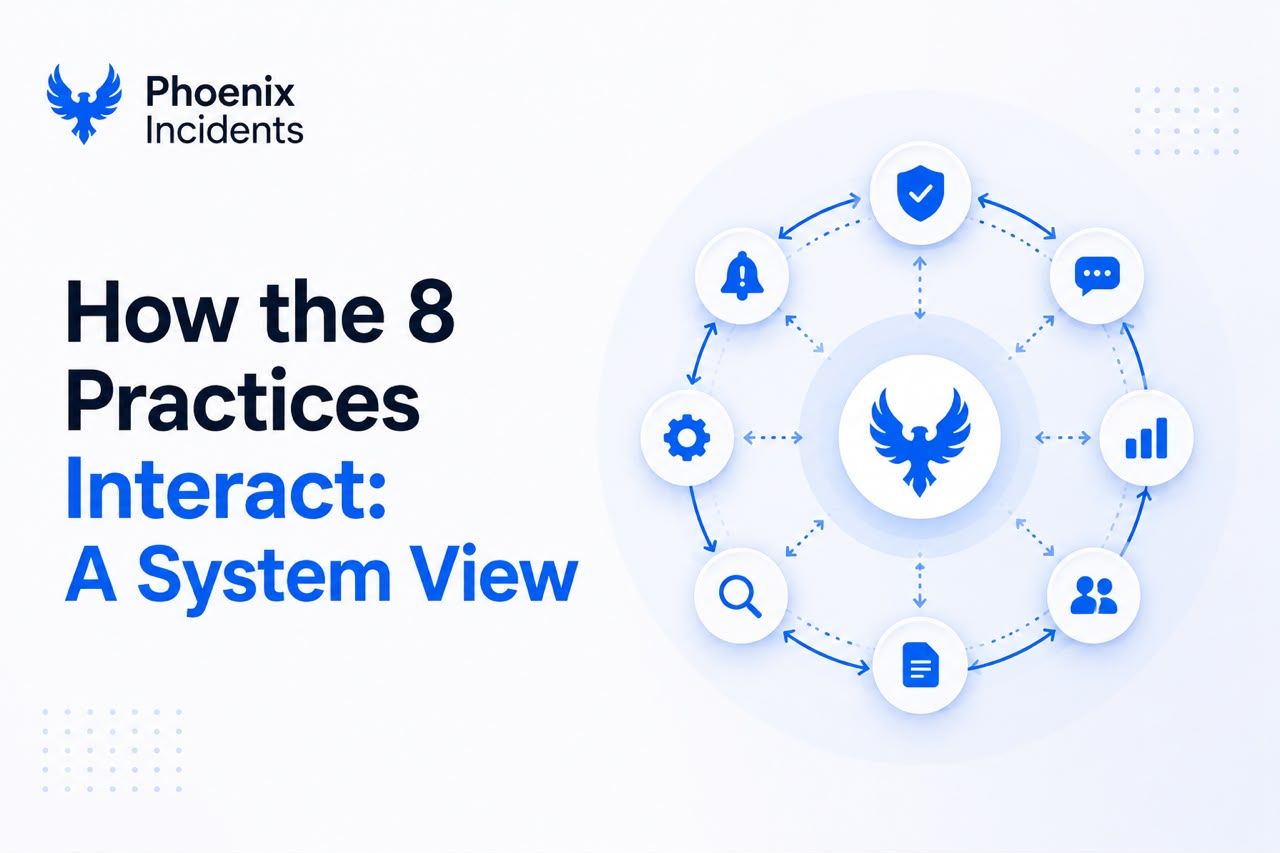
These aren’t eight independent practices, they’re a system. Each one strengthens the others. Psychological safety (Practice 1) makes blameless PIRs (Practice 7) possible. Blameless PIRs produce better action items. Better action items reduce incident recurrence. Lower recurrence means the false alarm data (Practice 6) gets cleaner and the runbooks (Practice 3) get sharper. Automation (Practice 8) makes all of the above run without adding cognitive load.
| Practice | Directly Enables | Compounds Over Time Into |
|---|---|---|
| 1. Lower escalation barrier | Earlier declaration; lower MTTA | Culture of psychological safety that accelerates every other practice |
| 2. Define severity levels | Faster classification; automatic escalation trigger | Consistent response regardless of who’s on call |
| 3. End-to-end workflow | Process predictability under pressure | Runbooks that get better with every incident |
| 4. Explicit roles | IC frees engineers to debug; no coordination overlap | Faster time-to-diagnosis across all incident types |
| 5. Separate stakeholders | Fewer interruptions to responders | Stakeholder trust; lower on-call burnout |
| 6. False alarms as data | Alert threshold calibration | Declining false alarm rate; more confident escalation culture |
| 7. Blameless PIRs | Honest root cause analysis; actionable follow-through | Declining incident recurrence rate quarter-over-quarter |
| 8. Automation | Removes toil from every step above | Process that enforces itself regardless of team growth or turnover |
The Common Thread Across All 8 Practices
Read back through these practices and notice what they share: none of them depend on your engineers being smarter, more experienced, or more dedicated than they already are. Every one of them is about designing a system where the right behaviors happen automatically, where the process runs itself rather than competing with the urgency of the incident for the team’s attention.
That’s the shift from reactive incident management to mature incident management. Not more documentation. A workflow that enforces the right thing by default, captures everything automatically, and makes every incident a compound investment in the team’s future reliability. This is what Phoenix Incidents was built to do and why it operates natively inside Jira and Slack rather than as another tool to context-switch into.
To see how Phoenix Incidents embeds these practices directly into your team’s existing workflow.
Incident Management Best Practices Checklist
Use this to audit where your team is today. If your team scores under 70%, that’s where your next reliability improvement is waiting.
| Category | Checklist Item | Status |
|---|---|---|
| Before | Severity levels defined, published, and understood by all engineers | |
| Before | Service catalog maps every service to an owner and a linked runbook | |
| Before | On-call rotation documented in incident tooling, not a spreadsheet | |
| Before | Escalation paths automated with primary, backup, and manager tiers | |
| Before | New engineers complete on-call training before going solo | |
| Before | False alarm/cancellation process documented and psychologically safe | |
| During | Dedicated incident channel created automatically on declaration | |
| During | IC, Technical Lead, Comms Lead, and Scribe assigned within 5 minutes | |
| During | All technical communication in working channel, not DMs | |
| During | Separate public status channel with regular stakeholder updates | |
| During | Jira incident record stays in sync with Slack throughout | |
| During | SLA-based reminders keep stakeholder updates on cadence | |
| After | Post-mortem scheduled automatically after resolution | |
| After | Timeline auto-generated from incident record, not reconstructed | |
| After | Root cause analysis uses Five Whys or equivalent structured method | |
| After | Post-mortem is blameless, focused on process, not people | |
| After | Every action item becomes a Jira work item with named owner and due date |
Frequently Asked Questions
1. What are incident management best practices for SRE teams?
The most effective SRE teams use clear severity levels, defined incident roles, fast escalation, blameless post-mortems, and automation wherever possible. The key is making these practices part of your workflow instead of relying on people to remember them during an incident.
2. What is a blameless post-mortem?
A blameless post-mortem reviews what happened, why it happened, and how to prevent it from happening again. It focuses on improving systems and processes, not assigning blame.
3. What should a post-incident review include?
A good post-incident review should include:
- An incident timeline
- Impact summary
- Root cause analysis
- Action items with owners and deadlines
The action items should be tracked in your team's workflow, not left in a document.
4. How often should teams run post-mortems?
Run a full post-mortem after every SEV1 and SEV2 incident. For SEV3 incidents, consider a lighter review if they reveal recurring issues. Ideally, complete the review within 24–48 hours while details are still fresh.
5. How does Phoenix Incidents support incident management?
Phoenix Incidents automates incident response inside Jira and Slack. It creates incident channels, assigns roles, captures timelines, generates post-mortems, and converts action items into Jira tickets—making the process easier to follow during high-pressure incidents.
6. What is the most important incident management metric?
MTTR (Mean Time to Resolve) is one of the most important metrics because it measures how quickly your team restores service. Breaking MTTR into stages, acknowledgement, response, diagnosis, and resolution, helps identify where improvements are needed.
7. How can engineering teams improve psychological safety during incidents?
Encourage engineers to escalate issues early, run blameless post-mortems, and make it easy to declare an incident without fear of criticism. Strong processes and supportive tooling help build a culture of trust over time.