Engineering Resilience Practices: How High-Growth Teams Recover Faster and Prevent Repeat Incidents

After years of running production systems and watching teams handle incidents across very different companies, one pattern keeps surfacing. The teams that handle incidents well are rarely the ones with the fanciest monitoring or the fastest raw response times. They are the ones who built resilience into how they work, not just into the tools they bought.
That distinction matters more as you scale. A five-engineer start up can survive on heroics and tribal knowledge, but a high-growth team can’t.
This is because the volume of incidents grows with the surface area of the product, and heroics don’t scale. What scales is a repeatable practice.
This guide lays out the engineering resilience practices that let fast-moving teams absorb failure, recover quickly, and get measurably stronger after each one.
What Engineering Resilience Means
Engineering resilience is the practice of building systems and teams that absorb failures, adapt under pressure, and improve from every incident. The goal is not zero downtime, it’s to shrink the blast radius when something breaks and make sure the same root cause doesn’t page you twice.
That changes where you invest. Instead of pouring everything into prevention, you build the muscles that decide how an incident actually plays out: how fast you notice, how cleanly you coordinate, and how well you learn afterward.
The 2023 State of DevOps Report found that elite performers restore service in under an hour, while low performers take a week to a month.
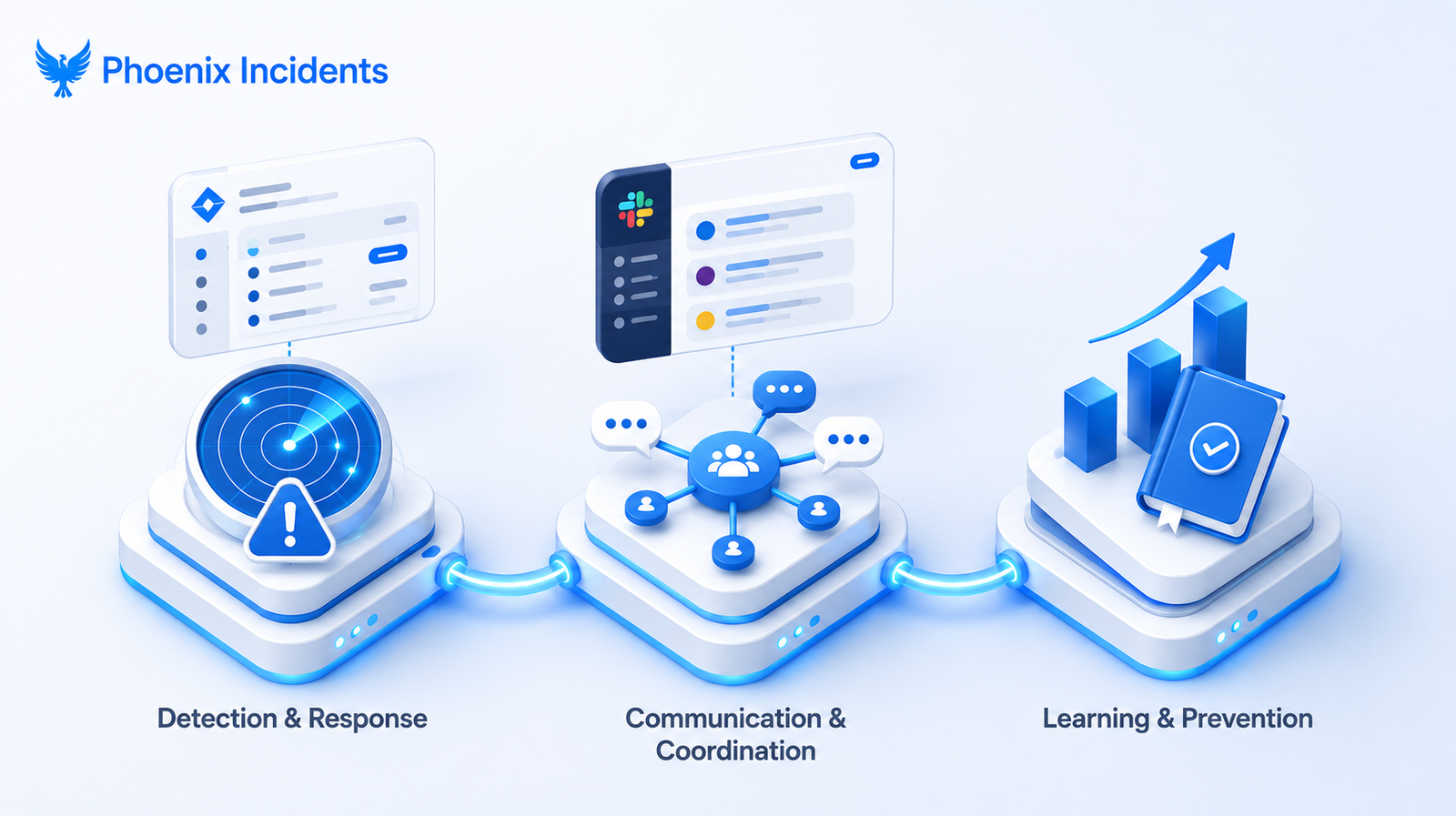
That gap comes down to practice, and the difference shows up across three dimensions:
| Dimension | What it covers | Where most teams fall short |
|---|---|---|
| Detection & response | How fast you spot an issue and start coordinating | Over-invested here, treated as the whole game |
| Communication & coordination | How information flows while the incident is live | Scattered across channels and DMs |
| Learning & prevention | How lessons get captured and turned into change | Mostly neglected once the fire is out |
Most teams pour their energy into the first row and quietly ignore the second and third. High-growth teams that scale without drowning in repeat incidents treat all three as equally important.
Before you can improve any of them, though, you have to be honest about where your team actually stands.
Signs Your Team Has a Resilience Problem
Resilience problems rarely announce themselves. They show up in ways that everyone has learned to live with.
If several of these sound familiar, your team has gaps worth closing:
| Warning sign | Type of failure | What it costs you |
|---|---|---|
| The same incidents keep coming back month after month | Learning and prevention | You are resolving symptoms and never touching root causes |
| People hesitate to declare an incident | Coordination and culture | Small issues turn into outages |
| Post-incident reviews get skipped when timelines are tight | Learning | The reviews you skip are usually the ones you needed most |
| Action items get written and never closed | Learning (the most common one) | Lessons that never become completed work are just discarded notes |
| Nobody is sure who is running the incident | Coordination | Engineers duplicate each other's work and decisions get delayed |
| Response depends on knowing who to ping | Detection and coordination | The day that person is on vacation, your response time collapses |
None of these are character flaws. They are process gaps, and every one of them is fixable. The first and most foundational fix is cultural.
Build Psychological Safety Into Your Incident Culture
The biggest barrier to resilient engineering is cultural.
- Engineers hesitate to declare incidents because they don't want the scrutiny that follows.
- Support teams who got chewed out for a past false alarm learn to stay quiet.
- Someone debates for twenty minutes whether a borderline issue is worth waking an on-call engineer at 2am.
Every one of those hesitations burns time, and during a live incident, time is the only currency that matters.
Early escalation only happens when the cost of being wrong is low. And if a false alarm means embarrassment or a postmortem with your name on it, people will wait, and waiting is exactly how a minor blip becomes a major outage.
Psychological safety, the strongest predictor of team effectiveness in Google's Project Aristotle research, is what gets problems surfaced while they are still small issues.
The Canceled Incident Practice
This is the concrete mechanism that helps build psychological safety: embrace the canceled incident.
When an engineer or a support rep escalates something that turns out not to be customer-impacting, do not bury it or treat it as a mistake.
Instead:
- Mark it canceled rather than deleting it or pretending it never happened.
- Capture the reason it was raised and why it turned out to be a non-event.
- Move on without blame: The person did the right thing by flagging it early, even though it turned out to be nothing.
Then review your canceled incidents monthly or quarterly. Those records are some of the most useful data you have. Use them to tune alerting thresholds that fire too eagerly, clarify escalation criteria that were unclear, and find the training gaps behind why a particular team keeps raising non-issues. Over time this builds a feedback loop that sharpens response judgment, and it does it without punishing anyone for caution.
A safe culture gets people to raise their hand. The next practice makes sure that once a hand goes up, everyone knows exactly what happens next.
Standardize Your Incident Response Workflow
When an incident hits, the worst possible time to invent your process is right then. You don’t want engineers debating which channel to use or where status updates should live while customers are down. Resilient teams run the same play every time. The repeatable process means the decisions are already made before the incident starts.
At a minimum, your workflow should standardize five things.
| Stage | What to standardize | Why it matters |
|---|---|---|
| Creation | Severity, impacted service, initial description | Consistent metadata is what lets you spot patterns across incidents later |
| Communication | A dedicated channel per incident | Contains the noise and gives everyone one place to look |
| Roles | A named incident commander | Engineers focus on fixing, the commander focuses on coordinating |
| Updates | A cadence tied to severity and SLA | A Sev1 might update every 30 minutes, a Sev2 every two hours; consistency beats frequency |
| Resolution | Close on documented cause plus action items, not just "service restored" | Restoring service ends the outage; documenting it prevents the next one |
That last row is what most teams ignore. Systems get restored and the incident gets closed before anyone documents anything. You can’t build resilience without repeatability, and you can’t repeat what you never recorded.
Which is exactly why what happens after resolution deserves as much structure as the response itself.
Make Post-Incident Reviews Non-Negotiable
The real work starts once the fire is out. Most teams treat post-incident reviews as optional or performative. They write them when leadership is watching, skip them when things get busy, and rarely check whether the action items got done. That is where resilience breaks down.
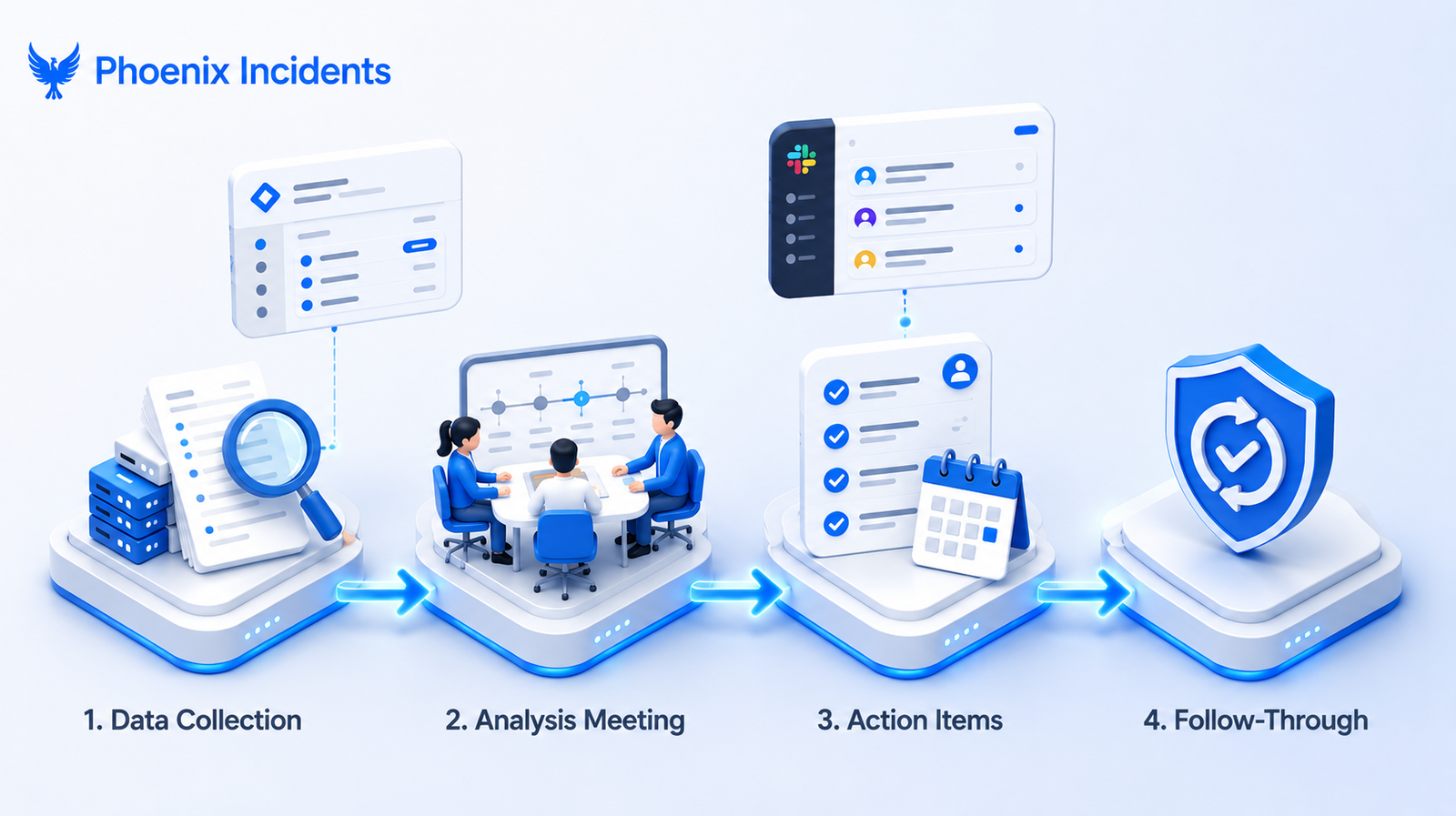
A PIR is a structured investigation into what broke, why, and what concrete change will keep it from breaking again. Done consistently, it is the single best tool you have for driving down repeat incidents. The strongest post-incident review process runs in four phases.
The Four Phases of an Effective PIR
Phase 1: Data collection. Gather all the facts. Pull logs, error messages, the timeline of events, and impact metrics. Document which customers were affected and how. Do this while the details are still fresh, because memory degrades fast once the pressure is off.
Phase 2: Structured analysis meeting. Bring the team together and walk the timeline. Push past the first plausible cause with disciplined root-cause questioning: for each contributing factor, ask what made that possible, and keep going until you reach systemic issues rather than individual mistakes. The useful question is not "who pushed the bad config" but "why did our system let a bad config reach production unchecked."
Phase 3: Action items with owners and deadlines. Don’t close the meeting on vague good intentions. Write specific, time-bound action items, assign a named owner to each, and make them visible.
Phase 4: Follow-through enforcement. Action items get created and then forgotten. Resilient teams track them, send reminders when they go overdue, and keep the incident in a pending mitigation state until every item is complete.
Why Most Action Items Die
The gap between writing an action item and finishing it is the gap between knowing what to fix and actually building resilience. The problem is rarely a lack of good intentions. It is the absence of any mechanism that forces follow-through. Adding that mechanism makes a dramatic difference.
In one PagerDuty case study, a team that put structure and accountability around its reviews lifted post-incident review completion on major incidents from 38% to 100%. The reviews were never the problem. Consistency and enforcement were. When every review gets done and every action item gets closed, the same incidents stop coming back, and that shows up directly in your numbers.
Track Resilience Metrics That Matter
You cannot improve what you don’t measure. You also cannot let the measurement become the goal, because the moment a metric becomes a target, people start optimizing the number instead of the outcome. Track the basics, but understand the failure mode behind each one.
You cannot improve what you don’t measure. You also cannot let the measurement become the goal, because the moment a metric becomes a target, people start optimizing the number instead of the outcome. Track the basics, but understand the failure mode behind each one.
MTTA (Mean Time to Acknowledge): Measures how long it takes for someone to take ownership of an incident. The trap is relying on auto-acknowledgements that improve the metric without anyone actually responding.
MTTR (Mean Time to Resolution): Measures how long it takes to restore service. The trap is rushing to close incidents without completing proper root cause analysis.
Incident volume by severity: Shows whether the number and severity of incidents are increasing or decreasing over time. The trap is under-reporting incidents or assigning lower severity levels just to improve the numbers.
Action item completion rate: Measures whether your team follows through on improvements after an incident. The biggest issue is that many teams don't track this metric at all.
Recurring incident themes: Highlights the systemic issues that continue to cause incidents. The trap is treating each recurring incident as a separate event instead of addressing the underlying root cause.
MTTR is useful for spotting trends, but optimizing for it at all costs creates bad incentives.
- Engineers skip the root-cause work to close tickets faster.
- They mark an incident resolved before validating the fix actually held.
What these numbers are really measuring is how well your team learns. How fast you catch issues, how often you repeat incidents, if you’re closing the loop on follow-up work.
If your dashboards are all green but you are still getting paged for the same database issue every month, the metrics are not the problem. The follow-through is. And follow-through depends on capturing the right information in the first place.
Learn From Every Incident
Every incident is a data point. The only question is whether you capture it in a way that compounds into knowledge or let it evaporate into chat history. Resilient teams treat their incident record as a knowledge base and they actively mine it for patterns:
- Which services generate the most incidents? That tells you which services to harden first.
- Which root causes keep reappearing? That tells you what to fix permanently instead of patching repeatedly.
- Which kinds of change tend to cause incidents? Deployments and config updates are the most common. Changes are consistently the single largest contributor to production incidents, so labelling each incident with the change that triggered it pays off quickly. You start to see which kinds of change keep causing incidents.
This analysis does not happen by accident. It requires structured data capture, consistent tagging, and reporting that surfaces trends over time. The result is the shift from reactive to proactive. When you can see that 40% of your incidents trace back to database connection pooling, you stop treating each one as a surprise and fix the underlying cause.
Teams that do this well end up with executive-ready reporting on incident volume, resolution trends, and root causes, the kind of view that earns a place in QBRs and board decks. But none of it is possible if your incident data is scattered across a dozen places.
Build Better Incident Workflows
Your incident process is only as strong as the tools that enforce it. If your incident management lives in a patchwork of Jira tickets, Slack threads, Google Docs, and somebody's memory, you don’t exactly have a process.
You just have good intentions, which is a fine place to start and a dangerous place to stay. Resilient teams anchor their workflows in the tools their engineers already live in, so following the process is the path of least resistance rather than another dashboard to remember.
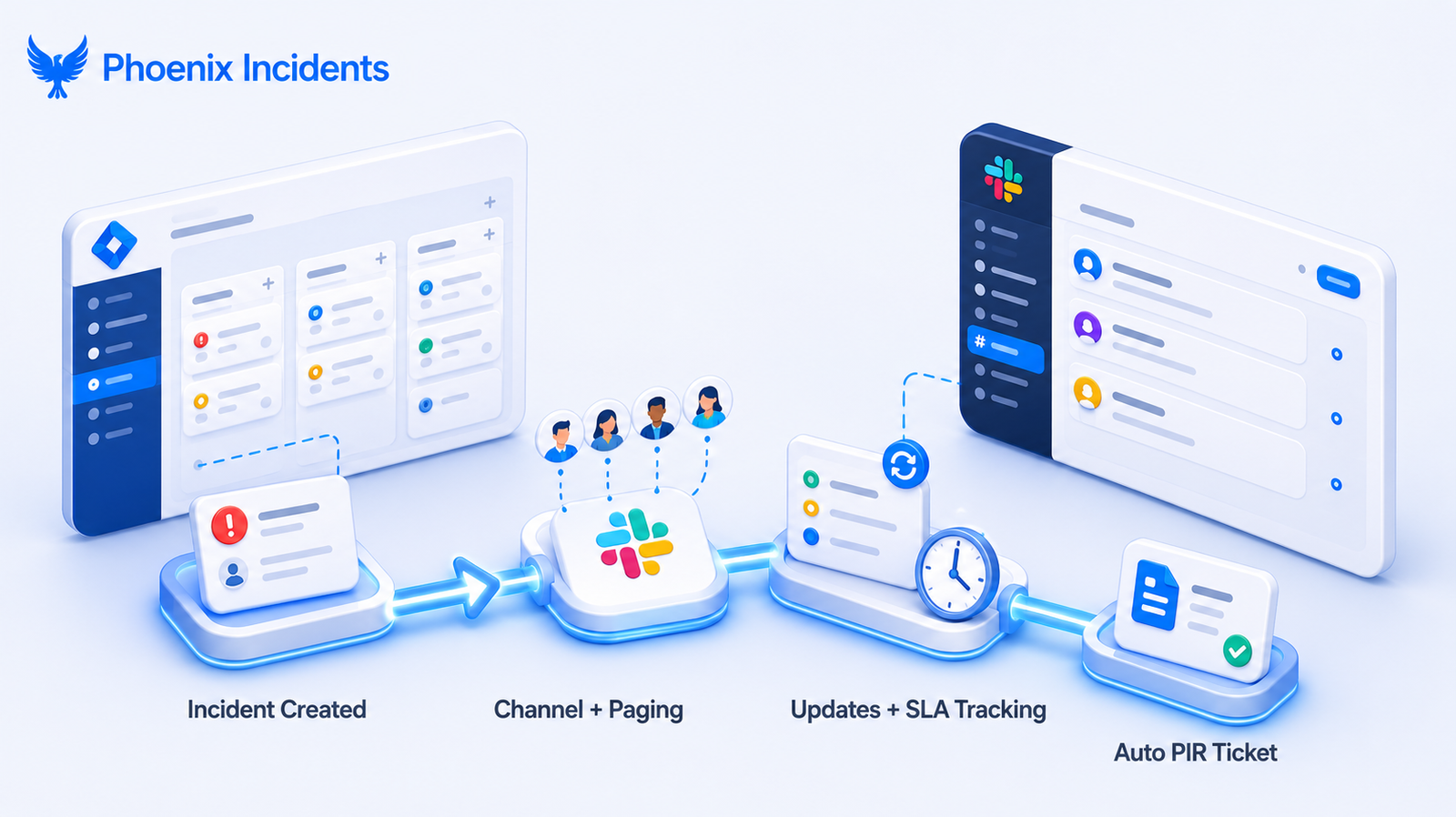
Picture the workflow when it is wired together properly:
- An engineer creates an incident in Jira.
- A dedicated Slack channel spins up automatically and the right people get paged.
- Status updates stay in one place, and SLA reminders fire automatically when a response is running late.
- The moment the incident resolves, a PIR ticket is generated automatically, with a structured workflow ready to guide the analysis.
None of that is magic. It is automation applied exactly where the manual work slows you down.
Phoenix Incidents was built for this workflow. It is an end-to-end incident management platform that lives inside Jira and Slack, so engineers never leave the tools they already use.
Leaders get visibility into trends, SLA performance, and action item completion without chasing anyone for updates, and the system enforces follow-through by holding incidents in pending mitigation until every action item is closed.
The point of the design is to make good practice the default. But tooling only speeds up a process you already have. The starting point is habit.
A Four-Week Rollout Plan for Engineering Resilience
You don’t need to overhaul your entire incident process overnight, and you should not try. Start with one practice, make it stick, then layer on the next. Four weeks is enough to establish the core.
Week 1: Standardize how incidents are created: severity, impacted service, basic metadata
Week 2: Set up a dedicated communication channel for every incident
Week 3: Assign incident commanders for all Sev1 and Sev2 incidents
Week 4: Require PIRs for every Sev1, each with owned, deadlined action items
Build the habit before you build the tooling. Once the process runs reliably by hand, automating it with Phoenix Incidents speeds up a system that already works. Resilient engineering is a consistent practice, and the teams that do it well recover faster, learn systematically, and get stronger with each incident.
Start Building Engineering Resilience Today
Resilient engineering is a practice where your team builds one habit at a time, and the right tooling makes those habits stick. Phoenix Incidents brings incident creation, response, post-incident reviews, and action item follow-through into the Jira and Slack workflows your engineers already use, so resolving incidents faster and preventing the repeats becomes the default rather than the exception.
To see how it enforces your incident workflow without adding another tool to the stack.
Frequently Asked Questions
1. What are engineering resilience practices?
Engineering resilience practices are the processes that help teams recover quickly from incidents and prevent them from happening again. They include clear incident response, blameless post-incident reviews, tracking key metrics, and learning from every incident.
2. How is engineering resilience different from reliability?
Reliability is about keeping systems running with minimal failures. Resilience is about how quickly your team responds, recovers, and improves when failures do happen.
3. What is a post-incident review (PIR)?
A post-incident review is a structured review that explains what happened, why it happened, and what actions will prevent it from happening again. It should end with clear action items, owners, and deadlines.
4. How do you reduce repeat incidents?
Run post-incident reviews after major incidents, assign every action item to an owner, and follow through until each task is complete. Reviewing incident trends also helps identify and fix recurring problems.
5. What metrics measure engineering resilience?
Useful resilience metrics include MTTA (Mean Time to Acknowledge), MTTR (Mean Time to Resolve), incident volume by severity, action item completion rate, and recurring incident trends. Together, they show how well your team responds, recovers, and improves over time.
6. What is the difference between MTTA and MTTR?
MTTA measures how quickly someone acknowledges and takes ownership of an incident. MTTR measures how long it takes to fully restore service. MTTA reflects response speed, while MTTR reflects recovery speed.