How to Rebuild Cross-Team Trust After an Incident (A Guide for Engineering Teams)

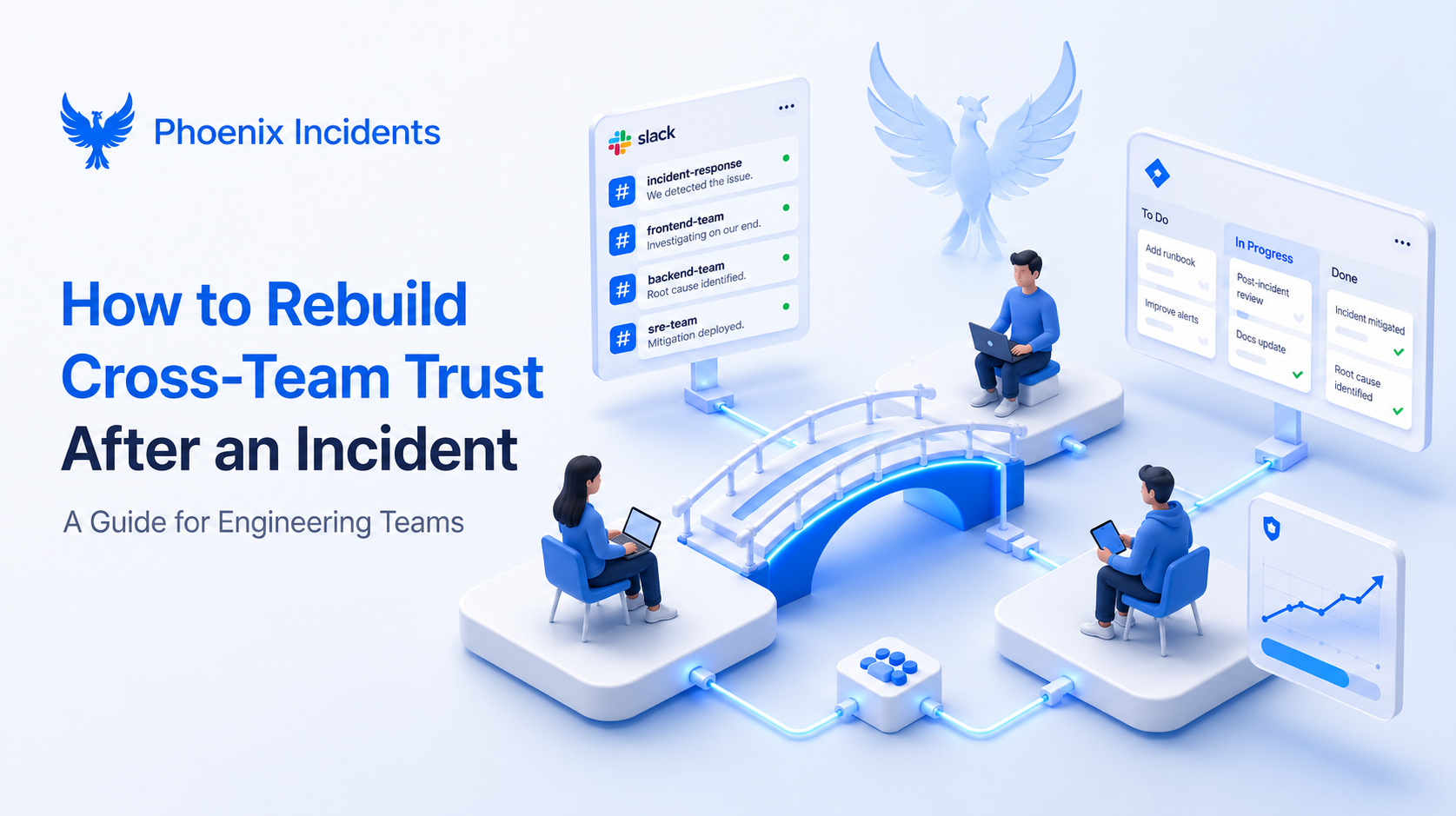
It started with a checkout outage on a Tuesday afternoon. Engineering caught it fast and got heads-down to fix it. But for forty minutes, nobody told anyone else. Support kept assuring customers everything was fine. Sales walked into a renewal call with no idea the prospect's account had been down all morning.
Two hours later, everything was fixed and the incident closed. But something didn't go back to normal. And the next time Engineering said "we've got it handled," nobody quite believed them. Support started double-checking, and the product manager began cc'ing extra people on every thread.
Long after the system recovers, the relationships stay degraded, and broken cross-team trust starts showing in:
- Slower decisions
- Defensive communication
- Duplicated work
- Other teams quietly routing around you
But the good news is, trust can be rebuilt through changed behavior and the operational mechanisms that make that behavior visible. Transparent communication, blameless postmortems, and reliable processes other teams can see for themselves.
The Two Kinds of Trust You Break During an Incident: Connection vs. Competence.
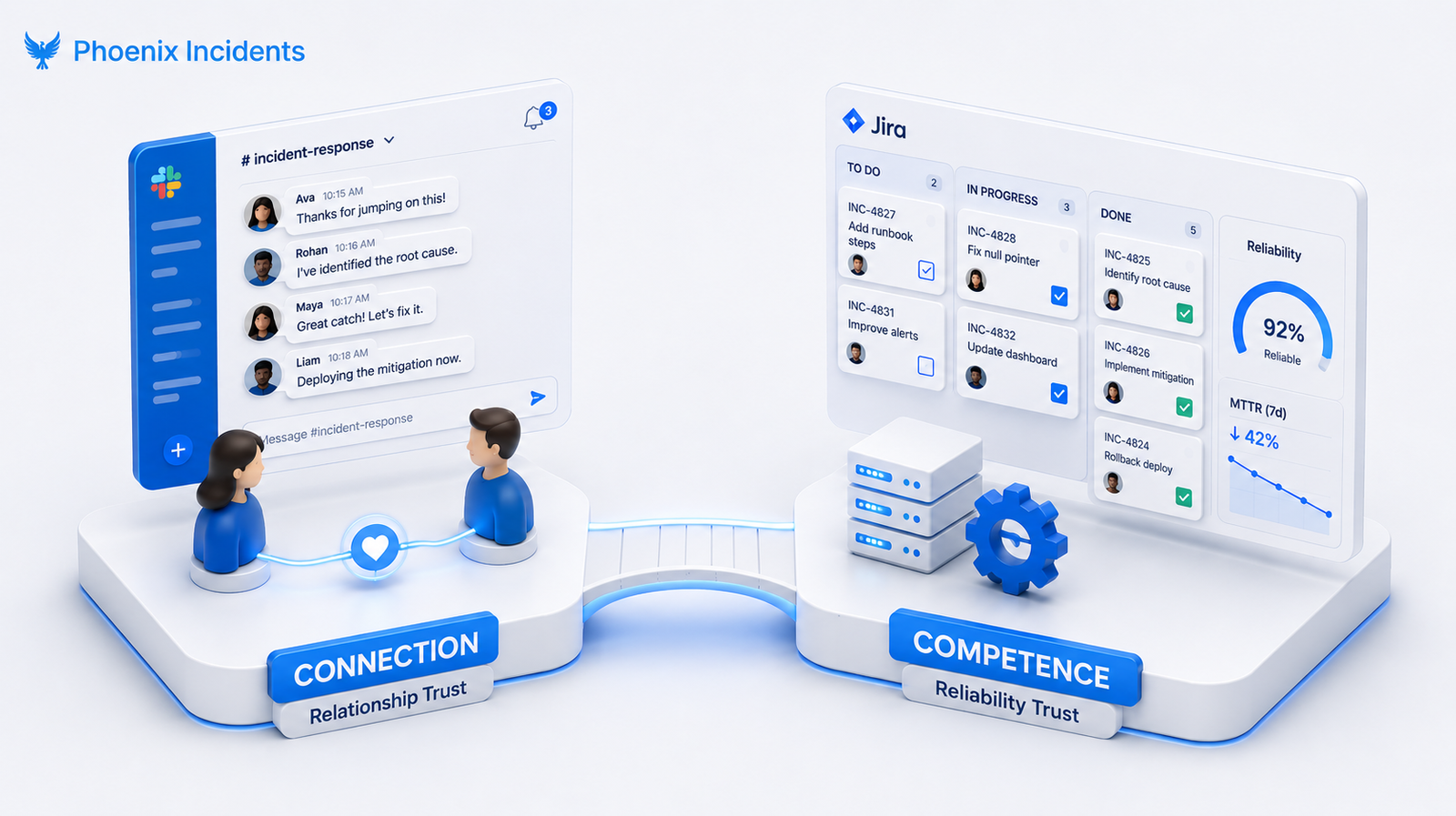
Organizational psychologist Liane Davey, who works with leadership teams on exactly this problem, describes trust as operating on distinct levels.
Two of them matter most after an incident: connection (the human relationship) and competence (confidence in your ability to deliver). As Davey puts it, “a teammate may not trust you, not because they don't feel connected to you, but because they're worried that you don't have the skills to be successful”.
| Connection (relationship trust) | Competence (reliability trust) | |
|---|---|---|
| What it is | Do these teams feel you're on their side? | Do they believe you can actually deliver? |
| How the incident broke it | Support and Sales found out from customers, not from you.They feel left in the dark, and treated as an afterthought | Confidence that Engineering can keep things stable, and respond fast, especially when incidents recur |
| What signals it's broken | Other teams feel blindsided: "Why didn't anyone tell us?" | When engineering team says, "we've got it handled", other teams never believe them |
| How you rebuild it | Communication and visibility: keep them informed | Show the steps along the way: transparent status, blameless postmortems, and reliable processes |
| Where it's covered in this article | Steps 1–2 | Steps 3–4 |
The reason this distinction matters is that each kind has a different cure.
Broken connection is repaired through communication and visibility, while restoring confidence in your competence is more demanding.
Of course, the only thing that’s ultimately going to restore your trust is when you deliver, but you can’t wait and just say, “Well, trust me, I’ll deliver.” It’s really important that if they aren’t trusting in your competence, that you show them the steps along the way.
- Liane Davey, Organizational psychologist
The 4-Step Framework to Rebuild Cross-Team Trust
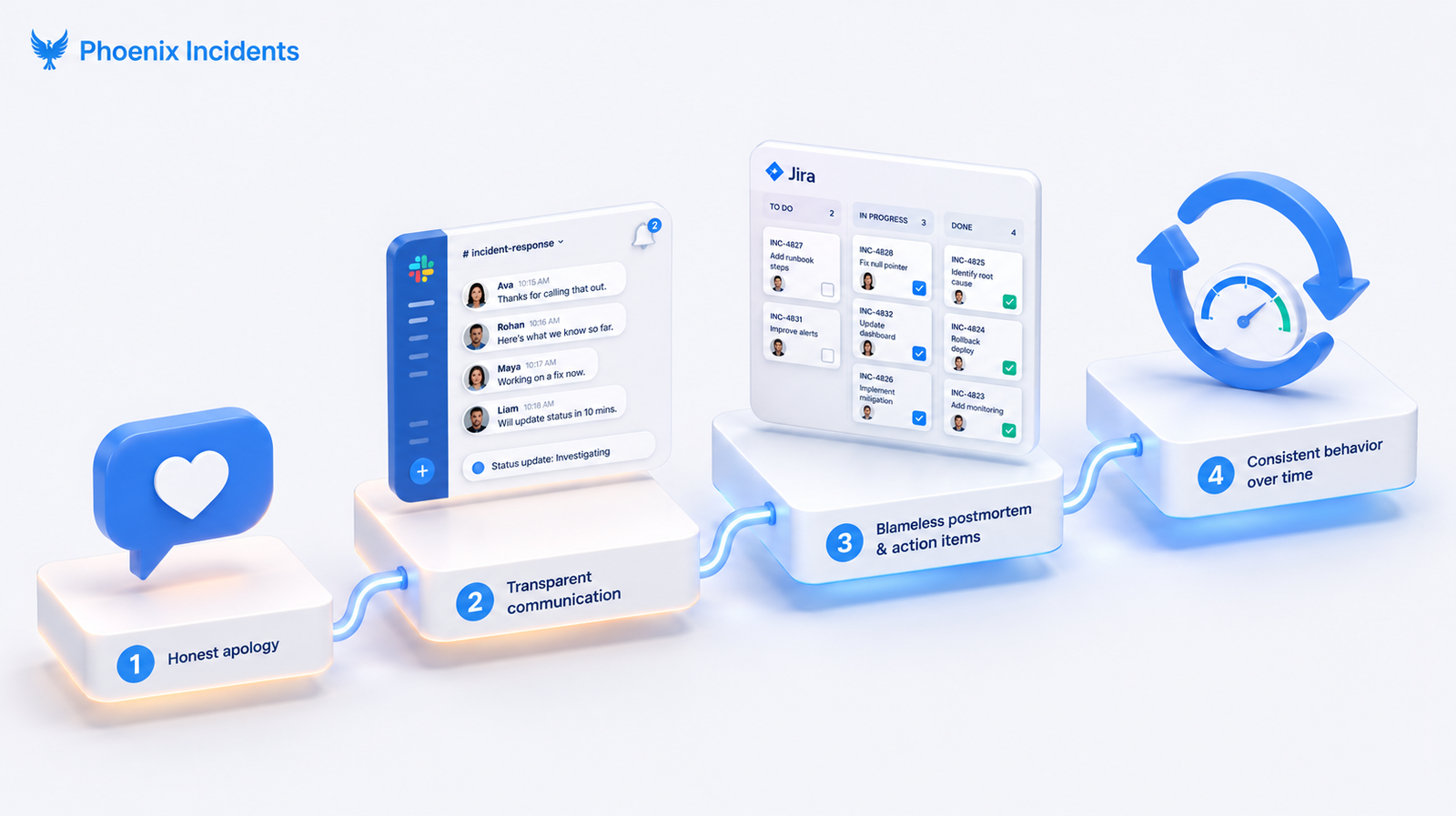
Alt text: Isometric diagram of the 4-step framework to rebuild cross-team trust after an incident: acknowledge, communicate, run blameless postmortems, and stay consistent.
Now that you know which kind of trust you broke, here's how to repair both. Steps 1 and 2 rebuild connection; Steps 3 through 4 rebuild competence.
Step 1: Acknowledge the Breach Without Deflecting
When trust breaks, the instinct is to explain, walk other teams through the root cause, edge case, and monitoring gap that's already being fixed. All of that might be true, but none of it is an apology.
The classic mistake here is the non-apology:
- "Sorry you were affected"
- "Sorry for any confusion this may have caused"
It sounds like ownership, but it makes it as if the problem was their reaction, not your incident. People see through it immediately, and it tends to do more damage. A real acknowledgment does the opposite. It names what happened, takes responsibility without a "but," and — this is the cross-team part, speaks to the specific impact on the specific teams who felt it.
A blanket "sorry, everyone" doesn't settle it.
But a, "Support spent two hours replying to angry tickets with no heads-up from us, and Sales walked into a renewal blind" does, because it shows you actually understand what you cost them.
| The Deflecting Apology | The Accountable Apology | |
|---|---|---|
| Sounds like | "Sorry you were affected by the downtime." | "We took the platform down for two hours and didn't tell anyone; that's our mistake." |
| Who it centers | You (your intent, your explanation) | Them (the impact they absorbed) |
| Names the impact | Vague and general | Specific to each team affected |
| What it does to trust | Breaks it further and reads as dodging | Starts rebuilding it and reads as honest |
The reason specificity matters so much is that it proves you were paying attention to them, not just to your own systems. Owning the impact fully is what actually builds back trust and accountability.
A genuine acknowledgement doesn't need to be long. Say it clearly, mean it, and then move to the part that matters more: showing them it won't happen the same way again.
Step 2: Make Incident Communication Transparent
Now, we’re getting past the generic "rebuild trust" advice, and moving into repairing what other teams can actually see during an incident. Because the thing they remember most isn't the outage; it's the silence from the backend.
Trust breaks fastest when people left in the dark start to expect the worst and, worse, start hearing about your incident from angry customers before they hear it from you.
The fix is to make your communication so visible that other departments can function and nobody has to chase you for an answer.
3 things make that work:
| Practice | What it looks like | Why it rebuilds trust |
|---|---|---|
| Real-time status updates | A live status page or channel, updated on a steady cadence even "still investigating, nothing new" counts | Other teams stop guessing and stop interrupting because they know where to look |
| Clear severity language | Shared definitions (SEV1–SEV3 or P1–P3) so "major" means the same thing to everyone | Support and Sales instantly grasp how bad it is and how to message customers |
| Proactive notification | You tell affected teams before they hear it elsewhere, routed by severity to the right people | Signals respect and shows that you're treating them as partners, not afterthoughts |
A steady update flow matters more than fresh news and an update that says nothing has changed still beats leaving people hanging.
As Uptimerobot puts it: Severity should drive cadence, channels, and tone, and should never be debated during an incident
Practical example: During a SEV1, every minute spent hand-writing a stakeholder update is a minute not spent fixing the problem. That's why the teams who communicate best wire communication directly into their tooling.
This is exactly where a platform like Phoenix Incidents comes in: native integrations with Slack and Jira to push real-time, severity-routed updates into the channels other departments already live in. So Support, Sales, and Product stay informed automatically, without anyone being pulled off to do it.
Get this right and you've repaired the first half of the trust equation: connection. The next two steps rebuild the harder half: competence.
Step 3: Run Blameless Postmortems Other Teams Can See
If Step 2 was about communicating during the incident, this is about what you do after. Because what other departments really want to know, once the dust settles, is simple: do you understand what went wrong, and have you made sure it won't happen the same way again?
A blameless postmortem is how you answer both. From Atlassian’s guide to run a blameless postmortem, the idea, popularized by Google and Etsy, is to focus on improving performance moving forward rather than identifying and punishing whoever screwed up.
You assume everyone acted with the best intentions given what they knew at the time, and you dig into the systemic causes instead of the person nearest the keyboard. The reason this matters beyond your own team is blaming individuals, if repeated often enough, Atlassian states that it creates a culture of fear and distrust; and that fear leaks across departments too.
A retrospective locked inside Engineering does nothing for the Support and Sales who absorbed the fallout. And according to Xurrent, transparent sharing of postmortems makes them accessible for others to learn from and just as importantly, it shows the teams you let down that you are prioritizing making it a non-repeat incident.
By the way, you don't need to expose every technical detail; you just need to expose the four things other departments actually care about:
| What to share | The question it answers for other teams |
|---|---|
| What happened | "What actually broke, in plain language?" |
| Impact | "How did this hit us and our customers?" |
| Root cause | "Do you actually understand why or was it a guess?" |
| What's changing | "What's stopping this from happening to us again?" |
That last row is the one that rebuilds trust. An action item with an owner and a deadline is a promise other teams can hold you to.
To make those commitments stick, leading teams treat them as first-class work: Atlassian notes that designated priority actions are given an agreed SLO and tracked with reminders until they're done, so "we'll fix it" doesn't quietly evaporate once the incident's forgotten.
Write the postmortem in plain language, refer to people by role rather than name, share it somewhere other departments can find it, and tie every "what's changing" line to a real owner.
Do that consistently and the postmortem stops being only for internal engineering and becomes the clearest signal other teams have that you can be trusted.
Step 4: Demonstrate New Behavior in Old Situations Consistently
None of the first three steps count until they're tested. Other teams have heard a good acknowledgment and an honest postmortem before. Now, what they're watching for isn't your words; it's the next incident that looks like the last one, to see whether anything actually changed.
That's because trust is really pattern recognition and people trust what they can predict in a good way. Every incident you handle the new way is one more data point that the change is real.
Which is what makes the second breach so dangerous. Going dark mid-incident or skipping the postmortem because you were "too busy" may confirm the suspicion you were trying to disprove.
The point isn't to be perfect. It's to be consistent and to aim not for one impressive incident, but for the boring, dependable competence that, incident after incident, stops giving other teams a reason to worry.
Make This Process Sustainable: Invest in the Right Tooling
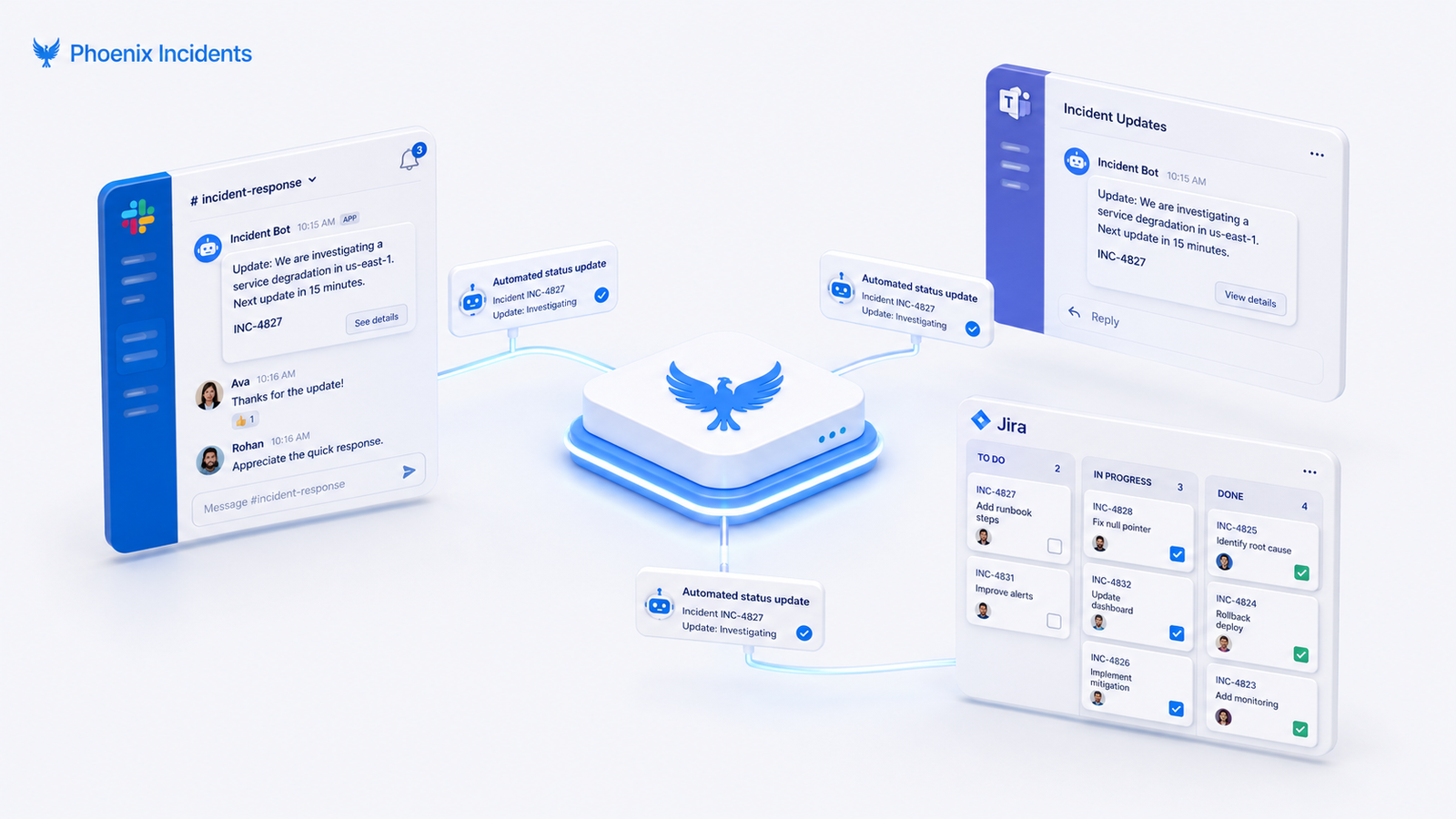
Doing all four steps, every time, under pressure is hard and consistency is the first thing to break when a team is stretched thin.
That's where the right tooling earns its place. Phoenix Incidents is an AI-powered communication automation platform that keeps everyone in the loop without burdening engineers with manual updates.
It automates status messages, guides RCA, and facilitates Jira-native follow-ups, integrating natively with the tools your teams already use Slack, Microsoft Teams, and Jira.
By automating the repetitive, easy-to-drop parts of incident response, it turns the four steps from a discipline you have to summon every time into something that happens by default.
How to Know Cross-Team Trust Is Coming Back
Trust repair is hard to feel in the moment, which is why most teams can't tell if it's working. But it leaves signs. Watch for these signals:
| Signal of returning trust | What it replaces |
|---|---|
| Other teams loop you in earlier, before things escalate | Finding out about problems secondhand, too late to help |
| Fewer "why didn't anyone tell us?" moments | Constant complaints about being left in the dark |
| Support and Sales function perfectly from your status updates | Teams chasing you directly for every answer |
| Faster sign-off and less defensive cc'ing | Extra approvers and paper trails "just in case" |
| Direct, unprompted feedback ("that incident was handled well") | Silence, or grumbling you only hear secondhand |
None of these is dramatic on its own. But when the defensive behaviors, double-checking, chasing, and the just-in-case cc's start reducing, that's the clearest evidence that the watching teams have started to relax.
Common Mistakes That Re-Break Trust
Plenty of teams do the hard work of repair and then undo it. The usual culprits:
- Overpromising: Committing to fixes or timelines you can't hit.
- Letting old habits creep back: Going dark mid-incident or skipping a postmortem once things calm down. Consistency that lapses the moment pressure returns isn't consistency.
- Treating one good incident as the finish line: Trust is rebuilt over a pattern, not a single clean response. Easing off too early resets the clock.
- Taking credit and deflecting blame: Claiming the win when things go right while distancing yourself when they don't, tells other teams the accountability was performance, not change.
Turn Trust Into Your Incident Response Advantage
Remember that Tuesday outage, the silent forty minutes, the blindsided Sales call, the teams that stopped believing when engineers said "we've got it handled." The same incident handled the way this guide lays out doesn't only avoid that damage, it builds something stronger.
When Support, Sales, and Product trust Engineering, incident response gets faster: people share information sooner, escalate without hesitation, and coordinate instead of bracing for impact.
Trust is part of what makes incident management work. So treat it like the operational asset it is.
Acknowledge honestly, communicate transparently, run postmortems others can see, be consistent with the change incident after incident, and give your team the tooling to make everything sustainable.
See how Phoenix Incidents helps engineering teams turn incidents into trust.
Frequently Asked Questions
1. How do you rebuild trust with other departments after an incident?
Start by acknowledging the incident openly and recognizing its impact on each affected team. Rebuild trust through clear communication, transparent postmortems, and consistent follow-through on action items.
2. Why does an incident damage cross-team trust?
Incidents can make other teams feel excluded or lose confidence in your team's ability to maintain reliable systems. Poor communication during an incident and blame afterward only make that trust harder to rebuild.
3. What is a blameless postmortem?
A blameless postmortem focuses on improving systems and processes instead of assigning blame. Sharing the findings across teams demonstrates transparency and a commitment to preventing similar incidents.
4. How long does it take to rebuild cross-team trust?
There's no fixed timeline. Trust is rebuilt over time through consistent communication, accountability, and reliable incident handling, not with a single successful incident.
5. How can you tell if cross-team trust is improving?
Signs of improvement include earlier collaboration, fewer communication complaints, less defensive behaviour, and positive feedback from other teams after incidents.